The Death of Marcus Aurelius

The Death of Marcus Aurelius

Monday, April 23, 2018

Marcus Aurelius, Meditations 4.25


Everything harmonizes with me, which is harmonious to you, O Universe. Nothing for me is too early nor too late, which is in due time for you.

Everything is fruit to me that your seasons bring, O Nature. From you are all things, in you are all things, to you all things return.

The poet says, “Dear city of Cecrops”, and can you not say, “Dear city of Zeus”?

—Marcus Aurelius, Meditations, Book 4 (tr Long)

I may be used to thinking of my world as the small confines of those things immediately around me, and that all is right in my own world when I have those things in accord with my wishes.

But the insistent Stoic within me promptly suggests there are two problems with such a view. I should never see my place in the world as being narrow, and it is never my place to ask anything to harmonize only with me. I should rather consider my own role, however humble, within the context of all things joined together, and I should always strive to freely harmonize myself to that whole.

We sometimes speak of thinking in the big picture, and then we assume this casts aside the small picture. Instead, can I not speak of the latter only becoming fully actualized through the former? My own particular concerns will have a complete sense of meaning and purpose when I understand their relation within a universal order.

Classical Stoicism always viewed Nature as a whole, not merely as a jumbled collection of parts. This is one reason why I, in my own experience, cannot separate, either in theory or in practice, Stoic physics from Stoic ethics. How I try to live a life of virtue asks me to live according to Nature, and this in turn is only possible with a profound respect for the Providential harmony of that unity.

This means that every time something happens, it is also the right time for it to happen, and for every circumstance that comes my way, it is also the right circumstance. This may often be mysterious, and I will not always grasp how and why it has come to pass, but I know it has come to pass for a perfectly good reason, or also through Perfect Reason, if you will.

My place, then, is not to try to rearrange the pieces to suit my preferences, but to rearrange my thinking and my choices to participate in the good of what exists around me. Nor should I do this begrudgingly or resentfully, or simply as being resigned to cold fate, but I can do so with liberation and joy, confident that I am embracing my own part in a beautiful arranging and unfolding.

How can any event or circumstance be timely and appropriate? Because the role I have is to turn anything and everything toward improving my character, and thereby also the benefit of everything around me. My power of estimation allows me to draw out what is good, even from what may at first appear to be evil. What happens may not be in my power, but what I do with what happens most certainly is.

The poet Aristophanes was proud to be a citizen of Athens, of the city of Cecrops.  This was surely a good thing, just as every man should love his home or his country. Should I not, however, be even more proud of being a citizen of the whole Universe, of the City of Zeus? My home is not just where and when I happen to be, but the harmony of the way all things should be together.

Written in 9/2005

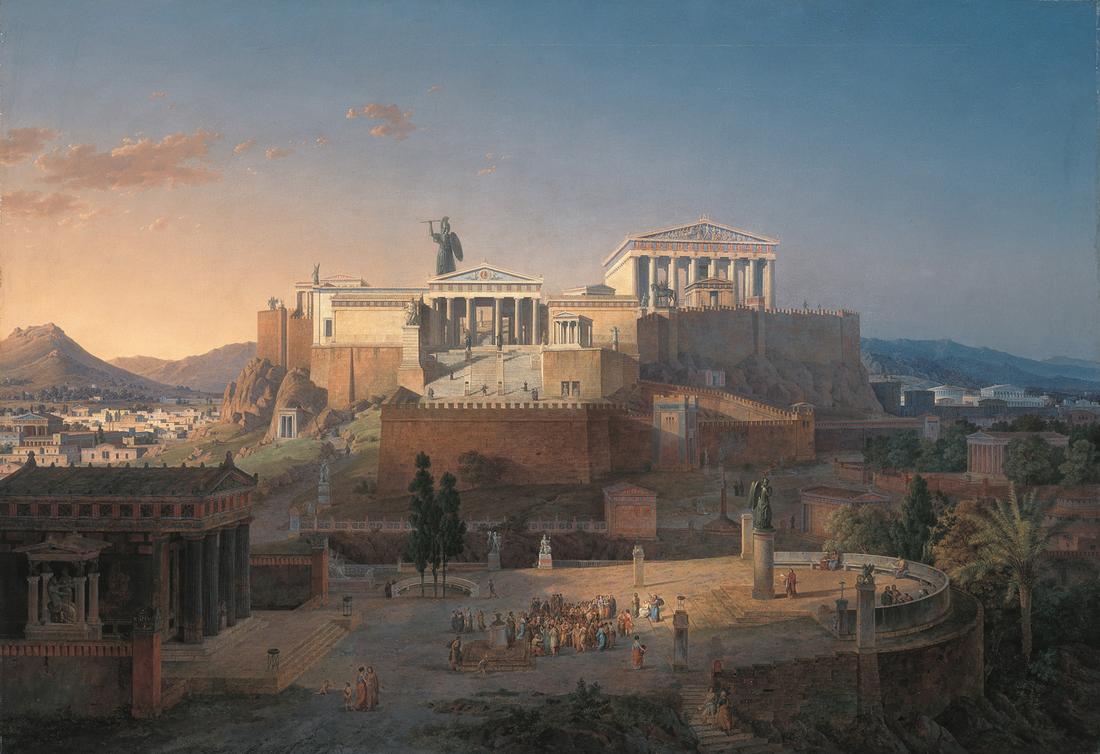
Image: Leo von Klenze, The Acropolis at Athens (1846) 

Boethius, The Consolation 1.12


Then did I rally my spirit until it was strong again, and answered, “Does the savage bitterness of my fortune still need recounting? Does it not stand forth plainly enough of itself?

“Does not the very aspect of this place strike you? Is this the library that you had chosen for yourself as your sure resting place in my house? Is this the room in which you would so often tarry with me, expounding the philosophy of things human and divine?

“Was my condition like this, or my countenance, when I probed with your aid the secrets of Nature, when you marked out with a wand the courses of the stars, when you shaped our habits and the rule of all our life by the pattern of the Universe?

“Are these the rewards we reap by yielding ourselves to you? No, you yourself have established this saying by the mouth of Plato, that commonwealths would be blessed if they were guided by those who made wisdom their study, or if those who guided them would make wisdom their study.

“By the mouth of that same great man did you teach that this was the binding reason why a commonwealth should be governed by philosophers, namely that the helm of government should not be left to unscrupulous or criminal citizens, lest they should bring corruption and ruin upon the good citizens.” . . .

—from Book 1, Prose 4

Boethius’ grief has here made him indignant, even resentful. I can usually tell that my own thinking is off balance when I respond to a question by saying something like “isn’t it obvious?”

Bitter sarcasm can also be a symptom of my closed mind and short temper. Lady Philosophy had offered Boethius rest and comfort through the pursuit of wisdom, and she had assured him that a life of virtue would provide the greatest blessings. Apparently being attacked from all sides, the loss of position and honor, and the approach of impending death are the fullness of that comfort and blessing?

I think it fitting that Boethius appeals to some of the arguments from Plato’s Republic, and I have also found myself deeply affected by them. The Republic is a sprawling text, touching on most every aspect of philosophy, but it grows from a quest for the definition of justice, and proceeds by means of a discussion on the qualities of an ideal society. We can only know what it means to be a just man when we discover how it is that all people in a community should come to live together, all of them with their own distinct strengths and contributions.

Whose judgment should be the highest authority in the state? Surely we must ask ourselves what sort of human excellence can be of benefit not just for some, but for all. Merely being smart or clever, having riches and power, or possessing popularity and charm will not be enough, because each of those attributes can be both used and abused. What is required first and foremost is the ability to distinguish true from false, and right from wrong to begin with, the virtue of wisdom. Nothing in life will be good if we are not guided toward a proper end.

For this reason, Plato has Socrates suggest a novel solution. We shouldn’t have rulers who are career politicians, who have learned how to play the game, or generals, who have learned to impose military might, or businessmen, who have learned how to buy influence with their money, or even fine orators, who have learned how to rouse popular opinion with their words. Instead, a community will be on the road to justice when philosophers become kings, or when kings become philosophers.

None of this will make any sense if we misunderstand what Plato means by a philosopher, or if we neglect to even consider the ultimate purpose of human nature. But Boethius seems to have understood that only wise men, committed to the knowledge of the truth and the love of the good, can help to keep us safe from the schemes of wicked and selfish men. Virtue is the only antidote to vice.

Lady Philosophy, through the mouth of Plato, taught Boethius these things, but there seems to be no sign of justice. Where is the resting place, and where are the rewards? Instead, he sees only more of the same corruption and ruin.

I can almost picture Boethius gritting his teeth and boiling with anger. I think of the times when someone may have promised me the world, but it all came to nothing, and the frustration I have felt both at another for deceiving me, and at myself for allowing myself to be deceived. When I get into this kind of dark mood, I immediately think of my favorite cynical joke:

What are three biggest lies in the world? “The check is in the mail”,  “I’m from the government, and I’m here to help”, and “I love you”. Boethius surely feels like Lady Philosophy seems to have made a promise she didn’t keep.

Yet even the first time I read these passages, before I knew where Lady Philosophy was going to go with her arguments, I already thought I saw something of a problem with Boethius’ lament. He understands that the philosopher, the wise man who is best suited to discover meaning in life, must oppose the greed of the vicious man. Now the vicious man is misled by a desire for wealth, power, gratification, and fame, and Boethius is bemoaning the loss of precisely these things.

Why should I even seek those same things? Why should I define my character by the terms of criminal wants? Why am I assuming that a life of justice should yield the same rewards as a life of corruption? I surely can’t claim to order my life around a higher measure, and then complain about losing the trappings of a lower measure.

Written in 5/2015

Image: Pedro Berruguete, Solomon (c. 1500)


Sunday, April 22, 2018

Marcus Aurelius, Meditations 4.24


Do not be whirled about, but in every movement have respect to justice, and on the occasion of every impression maintain the faculty of comprehension or understanding.

—Marcus Aurelius, Meditations, Book 4 (tr Long)

When I was still very young, our family would often spend time during the summer in Watch Hill, Rhode Island. I have fond memories of an old general store that sold all sorts of amazing things, as well as a place on the beach that had the best ice cream I ever tasted. My favorite by far, however, was an antique carousel, apparently the oldest in the country.

It was hardly one of those insane rides we are now used to from the big amusement parks, but I still recall being a bit frightened the first time I sat on one of those carved wooden horses. As I spun around, I felt anxious, and grabbed on tight. It was only when I realized I could keep my eye focused on a single unmoving spot that I could relax and enjoy the ride.

Life will often whirl us around, and we lose track of our position and direction. We become dizzy from all the motion, and one doesn’t have to be a child to be frightened by that. This passage, when I read it many years later, immediately made me think of the old carousel, and how I learned not to worry about being tossed in the air.

I am often guided by a strong sense of right and wrong, but this can quickly fade when I get befuddled and confused by my circumstances. I can often have a calm and keen mind, but my thinking can get all tangled up very suddenly if I am faced with something overwhelming.

The trick, however, with apologies to the great Douglas Adams, is not to panic. I can remember to firmly keep my attention on the things that matter the most in daily living, on always treating others with concern, decency and fairness, and on always using the gift of my mind to find meaning and purpose in the many bewildering appearances life will hurl at me.

It is easy to look at another person, and to see only opportunities for my own gratification. Instead, I can choose to focus on the fact that my neighbor is just like me, made with the same dignity and function as myself. He is not disposable, and he always deserves justice.

It is easy to face the broad range of my experience, and to act only on how something at first seems. Instead, I can choose to focus on the fact that impressions alone will often deceive me. Understanding requires moving beyond what something may look like to me, to knowing what something is in itself.

A careful and orderly grasp of reality will often show me that things are usually quite different, and often completely the opposite, of what I first perceived them to be. I do not need to view any man as my enemy, or wish him harm, and I do not need to let my circumstances rule over me, or decide the value of my life for me.

Written in 9/2005


Saturday, April 21, 2018

Marcus Aurelius, Meditations 4.23


What is the investigation into the truth in this matter?

The division into that which is material, and that which is the cause of form, the formal.

—Marcus Aurelius, Meditations, Book 4 (tr Long)

The Stoics often distinguished between different degrees of a higher and lower existence, of logos and ousia, of that which acts and that which is acted upon. Matter, simply in and of itself, is only given a formal identity through the action of the Divine, whether we choose to speak of it as fire, or as living breath, or in any number of other ways.

Whatever model of physics or metaphysics we may choose to employ, the distinction is a universal one. There is what something is made out of, and then there is the form that it takes upon itself. In practice, that something exists is inseparable from in what way it exists, but in abstraction we can understand these two principles at work together. What are the shapeless parts, and then how are all the parts joined together in a certain way, to produce a shaped and distinct whole?

I was first educated in an Aristotelian approach to form and matter, with a fancy name called hylomorphism, where there is a distinction between the potential stuff things are made of, and the actual way that they are ordered and organized. I have come to see that the only difference here between the Aristotelian and the Stoic is that while the former stresses the identity of individual substances, the latter stresses the unity of all substances.

This may seem a bit too much for daily life. I hardly disagree. Consider the theory put into concrete practice. By analogy, a house is made of many bits and pieces, including concrete, metal, lumber, and, it now seems, lots of toxic plastics. The parts are not the house. The parts must be assembled and arranged, in a certain way according to a blueprint, in order to make a house. The matter has now been given form.

Take a box you bought from Ikea, that is full of pieces of wood, a variety of screws, nuts, and bolts, and some mysterious bits that make no sense at all. But follow the multilingual instructions, and you may, God willing, end up with a piece of furniture. The matter has now been given form.

A cooking recipe is not simply a list of ingredients. How, when, and to what proportion are they prepared, mixed together, cooked, and what I must I do to them to present a brilliant dish? The matter has now been given form.

For those who love their history, take melted wax, and add the impression of the signet ring. The matter has now been given form.

Analogies are by definition weak, but I wish only to distinguish between the pieces, and how the pieces end up working together.

I have learned the hard way that I will only begin to make sense of anything in my life when I first begin to discern the stuff from the shape, the parts from the order of the whole, the bits from the pattern.

Truth, goodness, and beauty in our lives will not arise by lining up all the necessary components. They must be structured, through the use of reason, and directed toward our proper end. 

Written in 9/2005

Image: M.C. Escher, Mosaic II (1957)


Marcus Aurelius. Meditations 4.22


If souls continue to exist, how does the air contain them from eternity?

But how does the earth contain the bodies of those who have been buried from time so remote? For as here the mutation of these bodies after a certain continuance, whatever it may be, and their dissolution make room for other dead bodies, so the souls which are removed into the air after subsisting for some time are transmuted and diffused, and assume a fiery nature by being received into the seminal Intelligence of the Universe, and in this way make room for the fresh souls that come to dwell there.

And this is the answer that a man might give on the hypothesis of souls continuing to exist.

But we must not only think of the number of bodies which are thus buried, but also of the number of animals which are daily eaten by us and the other animals. For what a number is consumed, and thus in a manner are buried in the bodies of those who feed on them.

And nevertheless this earth receives them by reason of the changes of these bodies into blood, and the transformations into the aerial or the fiery element.

—Marcus Aurelius, Meditations, Book 4 (tr Long)

I very much enjoy considering passages that particularly address Stoic physics and cosmology, and I am especially interested in how these accounts of the greater order of the Universe relate back to the questions of ethics in everyday life.

At the same time, I can find myself feeling frustrated with them, not because of what the Stoics themselves have to say, but because of the disagreements that can arise from our contemporary reading of them. I suggest that we are often too quick to reject what seems unfamiliar to our modern sensibilities, and we are tempted to point only to differences, and not first to what is shared in common.

In particular I have often been told, from the perspective of secular materialism, that Stoic physics is outdated, and has apparently been refuted by modern science. I have also been told, from the perspective of traditional spirituality, that Stoic thought is too quick to reject the immortality of the soul. I find that reflecting on this passage by Marcus Aurelius can give me some insight on both concerns.

When the Stoics, or other Classical sources, speak of the four elements, we can recognize this as a way of describing different states of matter, and the awareness that matter constantly changes its form through an ordered causality, by the balanced tension of opposing forces. What is passing returns back into its source, and it proceeds to be transformed into something new.

Things do not randomly come to be, or cease to be, but they are varied emanations and modifications of existence. When a body dies, it does not simply disappear. It will break down into other forms, and eventually be subsumed into the bodies of other living things. Or when one living thing consumes another, it can be said that there is a direct continuity from one life to another.

Now just as bodies, which the Stoics associated with the more condensed matter of earth, move on into other states, so too souls, which the Stoics associated with the more rarefied matter of air and fire, will surely move on into other states. Like all things, each of them according to their own qualities, they return back to their Divine source. I should not think that my consciousness just ceases, but rather that it becomes quite a different form of consciousness.

I try not to assume that one manner of explaining the physical Universe necessarily contradicts another, just as I try not to assume that one manner of explaining the permanence of mind necessarily contradicts another. I maintain that the Stoic, the modern physicists, and the traditional Christian can get along, and can learn from one another.

Written in 9/2005

Image: Thomas Cole, Catskill Mountain House, The Four Elements (c. 1844)


Friday, April 20, 2018

Boethius, The Consolation 1.11


“Are such your experiences, and do they sink into your soul?” she asked.

“Do you listen only as the dull ass to the lyre? Why do you weep? Wherefore flow your tears?

“Speak, nor keep secrets in your heart. If you expect a physician to help you, you must lay bare your wound.”

—from Book 1, Prose 4

I take only these very few lines as a separate entry, because they are charged with meaning for me. Whenever I reread the Consolation, I always end up stopping right here for a moment, and I gather my bearings.

First, what is it that is driving me to despair? Second, what am I actually doing to find a cure? It is the very act of despair, of course, the very assumption that there can be no comfort, that leads me to think that there can be no solution.

It isn’t necessarily a sign of personal weakness to be lost, but I am certainly giving up entirely when I fail to seek help, when I don’t ask for directions, or when I don’t bother to understand those directions. If they make no sense, I should not be afraid to ask again.

My wife tells me this is a distinctly masculine failing, an unwillingness to admit that I can’t do it all for myself. I don’t know if it’s only a manly sort of weakness, but I do know it is a very foolish thing. The strength of self-reliance is never the same thing as stubbornly closing myself off to all the sources of inspiration and wisdom that are around me.

Now how often have I stared blindly at a map, trying to get somewhere, while not even knowing where I am to begin with? What shame would there be in rolling down the window, admitting I am befuddled, and asking a local to point the way?

Despair for me, and the accompanying Black Dog, have always been about seeing everything that’s wrong, and recognizing nothing that’s right.

When I perceived everything about my life going down the tubes, the few people who stuck with me offered all sorts of advice. Much of it suggested denial, repression, or mere force of will. I was grateful for the concern, but I saw immediately how that was not the right path. That was about dodging reality, not about managing it.

I saw red, for example, when someone urged me to make myself rich and famous, and then I could stick it to all the people who had done me wrong. Someone else told me I should pray harder to make myself tougher, and someone else told me it was just all about getting seriously medicated by a doctor. My favorite was someone who told me I should just stop caring, and then there would be no more worries.

I saw some misguided advice, and decided that there could never be any good advice. I clammed up, and said as little as I possibly could.

One day, I somehow ended up sitting with someone who wouldn’t let me weasel my way out of it.

“I can’t help you if you won’t even tell me what’s wrong!”

When I was child, my mother would ask me where it hurt, and I would point right to the spot, whether I had twisted my ankle, bumped my head, skinned my knee, or felt sad. If I felt sad, I would point to my heart. She always had a remedy.

Lady Philosophy is like the mother who can only help you if you point to where it hurts. Nothing will ever turn out right, if I cannot first admit what is wrong. There can be no diagnosis without revealing the signs and symptoms.

Boethius will go on for some time now about his worries, but I don’t think he’s just complaining. He’s finally explaining what is ripping him apart.


Written in 5/2015

Thursday, April 19, 2018

Marillion, "Beautiful"


As a reference for Marcus Aurelius, Meditations 4.21

I recall playing this song for someone when it was first released, who immediately described it as "sentimental sh#t written for people who can't be bothered to become popular. It's no wonder it never broke the top ten in the UK charts."

I smiled on the inside, because that was precisely the point.

Marillion, "Beautiful", from Afraid of Sunlight (1995)

https://www.google.com/search?q=marillion+beautiful&ie=utf-8&oe=utf-8&client=firefox-b-1-ab

Everybody knows we live in a world
Where they give bad names to beautiful things
Everybody knows we live in a world
Where we don't give beautiful things a second glance
Heaven only knows we live in a world
Where what we call beautiful is just something on sale
People laughing behind their hands
While the fragile and the sensitive are given no chance

And the leaves turn from red to brown
To be trodden down
To be trodden down
And the leaves turn from red to brown
Fall to the ground
Fall to the ground

We don't have to live in a world
Where we give bad names to beautiful things
We should live in a beautiful world
We should give beautiful a second chance

And the leaves fall from red to brown
To be trodden down
To be trodden down
And the leaves turn green to red to brown
Fall to the ground
And get kicked around

You strong enough to be?
Feel the faith to be?
Sane enough to be?
Honest enough to stay?
Don't have to be the same
Don't have to be this way
C'mon and sign your name
You wild enough to remain beautiful?
Beautiful

And the leaves turn from red to brown
To be trodden down
Trodden down
And we all fall green to red to brown
Fall to the ground
But we can turn it around

You strong enough to be?
Why don't you stand up and say?
Give yourself a break
They'll laugh at you anyway
So why don't you stand up and be
Beautiful?

Black, white, red, gold, and brown
We're stuck in this world
Nowhere to go
Turnin' around
What are you so afraid of?
Show us what you're made of
Be yourself and be beautiful
Beautiful


Marcus Aurelius, Meditations 4.21


Everything that is in any way beautiful is beautiful in itself, and terminates in itself, not having praise as part of itself. Neither worse then nor better is a thing made by being praised.

I affirm this also of the things that are called beautiful by the vulgar, for example, material things and works of art. That which is really beautiful has no need of anything, not more than law, not more than truth, not more than benevolence or modesty.

Which of these things is beautiful because it is praised, or spoiled by being blamed? Is such a thing as an emerald made worse than it was, if it is not praised? Or gold, ivory, purple, a lyre, a little knife, a flower, a shrub?

—Marcus Aurelius, Meditations, Book 4 (tr Long)

I often notice how discussions about the merit of anything, whether something is true, good, or beautiful, will seem to end when someone asks that question: “Well, who decides what’s beautiful anyway?” It is always understood as a rhetorical question that has no answer, and we are left to accept that it’s just relative to popular opinion.

That we have likes and dislikes, preferences and aversions, is not in doubt. What I do challenge is whether we are justified in reducing meaning and value to only our own approval or disapproval. Why are we assuming anyone at all “decides” what is beautiful? Perhaps it is simply beautiful in itself, regardless of what we decide or do not decide?

If all things share in existence, and each thing possesses its own distinct qualities, how is it that my own praise makes something beautiful, and my own blame makes it ugly? My estimation certainly changes how I judge something, but it does not change what something is. I am better served to make certain my perception conforms to what is real, instead of demanding that what is real conforms to my perceptions.

A man is no better or worse by whether he is honored or reviled, but by whether or not his own actions are in harmony with Nature. So too, something shares in beauty when it fulfills its purpose in the order of things, in its own specific way, and in a right proportion to what is around it. Whether or not anyone recognizes this will not change what is inherent in being itself.

When I first began to take an interest in all sorts of art, including music, film, painting, or literature, I was already very much aware that quality and popularity were not always the same. People would encourage me in this approach, and tell me that a true artist would strive to see things as they were, stripped of all the unnecessary assumptions and blind prejudices of life. This certainly spoke to a young soul trying to discover beauty.

Yet some of the people who spoke this way did not always end up acting this way. I might take an interest in the manner a certain shade of color was used, or a note was played, or a word was written, and I would quickly be directed to some source to set me straight. I realized that for some people beauty was still defined by praise, just not by the praise of a certain school or approach they disliked. I found that that there was quite a reputation to be made by being unpopular with some, but popular with others. It was the same game, just with different players.

I hope I learned from it all and moved on, and I hope I can live my life in such a way that I never expect to find truth, goodness, or beauty only in what happens to be praised by the right people. I should always seek to discover the beauty already within someone or something, and not see Nature as subject to anyone’s whims.

Written in 9/2005 

Marcus Aurelius, Meditations 4.20


He who has a vehement desire for posthumous fame does not consider that every one of those who remember him will himself also die very soon, then again also they who have succeeded them, until the whole remembrance shall have been extinguished as it is transmitted through men who foolishly admire and perish.

But suppose that those who will remember are even immortal, and that the remembrance will be immortal, what then is this to you?

And I say not what is it to the dead, but what is it to the living? What is praise except indeed so far as it has a certain utility? For you now reject unseasonably the gift of nature, clinging to something else.

—Marcus Aurelius, Meditations, Book 4 (tr Long)

A desire for reputation, in all of its possible variations and combinations, begins to appear all the more vain and shallow when I closely consider its true colors.  This in turn confuses me, because I wonder why there is still such a powerful and immediate attraction to acquiring fame. Why can I still be so easily misled?

Perhaps it is because fame offers the gratification of appearing to be important, without necessarily demanding the work of actually being good. It gives the illusion of character by means of a shortcut, whether or not character is actually present, and unlike virtue, it seems to be something I can quite easily buy and sell. Recognition has a certain intoxicating effect, quick to satisfy, easy to crave, and always offering the prospect of gaining more.

Fame is fickle, however, and she likes to pass on to someone else once we have had our fifteen minutes. Honor depends on the changing opinions of others, and will come and go as suddenly as fashions change, and as quickly as one generation is replaced by the next.

But let us, for the sake of argument, imagine that honor is permanent and lasting. Men could live forever, and they could always be in awe of my greatness. What difference will any of that make to me if I am gone?

We might further suggest the possibility that I too could live forever, and then I could bask in glory for all time. Even if such a permanent state of appreciation were possible, it would still leave me wanting. Fame has nothing to do with the fulfillment of my own nature, because it does not proceed from what I may think or do, but only from what others may think or do.

The error of pursuing fame follows from having the human good backwards, from falsely thinking that merit is a passive, and not an active, measure. Once I tell myself that action exists not for its own sake, but for the sake of recognition, I have defined the very dignity of people by how they are perceived from the outside, and not from what they truly are from the inside.

The problem with praise is not whether or not I may happen to receive it, but whether or not I think it worthy of attention to even want any of that attention. If I already have virtue, I won’t need to be admired for it, and if I lack virtue, no amount of being admired can replace that absence. I am the only one who can make myself worthy. 

Written in 9/2005


Tuesday, April 17, 2018

Marcus Aurelius, Meditations 4.19


How much trouble he avoids who does not look to see what his neighbor says, or does, or thinks, but only to what he does himself, that it may be just and pure.

Or as Agathon says, look not around at the depraved morals of others, but run straight along the line without deviating from it.

—Marcus Aurelius, Meditations, Book 4 (tr Long)

This passage calls to mind something from my childhood. I never understood it at the time, but my parents gave everything of themselves to help make my own life better. I was five years old, and we moved to a new house.

Until that point, we had lived on the top story of what Bostonians call a two-decker, renting from the family who lived below us. It all seemed wonderful to me at that age, but I also remember my mother being yelled at for accidentally flooding the washing machine. I stood there as an older lady cursed cruelly at my mother, the best Irish expletives of all possible sorts, and I watched my mother cry.

Somehow, there was suddenly a different home. The new house was a terrible mess, but it was all my parents could afford. This time they owned it. It was close to where my father worked, but I suspect it was also about the school I would soon be attending. My parents didn’t want me at a public school where stabbings were the norm, but at a public school where at least the appearance of learning was the norm.

The new neighborhood was classier, but it was no less malicious. A while later, when I was first allowed to stay at home alone for a few hours during the day, I overheard a neighbor gossiping with our mailman. It was right outside our open window.

“Look at all the terrible things they’ve done to the house! It was so much nicer when the Urdang’s lived here. That’s what happens when we let in the trash.”

I suddenly realized I was considered trash. Years later, I learned the same thing, when the mother of a girl I loved also told me that I was disposable.

“You’re no good, because you won’t give her any success. I won’t let my daughter marry a waste of life.” That still burns.

I’m not sure if people understand the effect they have when they speak that way. It all boils down to our sense of values. What do we care for? Why do we assume less of others, while also neglecting the dignity within ourselves?

It’s very difficult to try to be a good man, when others tell me that I am trash.

It should then come to mind that what others may think is quite irrelevant. It does not define me.

I am the measure of what I do, not of what others may think or say about me.

Written in 9/2005

Monday, April 16, 2018

Boethius, The Consolation 1.10


“He who has calmly reconciled his life to fate,
and set proud death beneath his feet,
can look fortune in the face,
unbending both to good and bad:
His countenance he can show unconquered.
The rage and threatening of the sea will not move him,
though they stir from its depths the upheaving swell.
Vesuvius' furnaces may never so often burst forth,
and he may send rolling upwards smoke and fire.
The lightning, whose wont it is to smite down lofty towers,
may flash upon its way,
but such men they shall never move.
Why then do they stand wretched and aghast
when fierce tyrants rage in impotence?
Fear nothing, and hope nothing.
Thus shall you have a weak man's rage disarmed.
But whoever fears with trembling,
or desires anything from them,
he stands not firmly rooted, but dependent.
Thus has he thrown away his shield.
He can be rooted up,
and he links for himself the very chain whereby he may be dragged.”

—from Book 1, Poem 4

On the one hand, I am encouraged by the idea that it is possible to both live well and live happily in the face of suffering. On the other hand, some of these obstacles still seem too overwhelming.

Reconciling myself to fate may sound ominous and defeatist, and setting death beneath my feet may seem rash and careless. Perhaps I can begin with an aspect that is more manageable for my wounded sensibilities? What does it mean to say that I can face fortune, and be unbending in the face of whatever is good or bad?

At first, even this may also feel like too much. Surely I want too pursue good things, and I want to avoid bad things? If I do not bend in the face of either, one way or the other, is that not a foolish thing to do? It hardly seems strong or brave to neglect the difference between things that are beneficial or harmful.

But Lady Philosophy is not telling me to be indifferent to anything and everything, but to be firm particularly in the face of fortune. Fortune, of course, is about the things that happen to me, the events in the world around me that can affect me one way or another. I will usually assume that these external circumstances are what make me happy or miserable, and very many people will likely agree. But is that necessarily the case?

I need to ask myself what kind of life it will really be if I make fortune my master. Things will occur, some pleasing and some disturbing, and everything about my own existence will now depend on those things. Very often, we have absolutely no control over these occurrences.

This suddenly appears as quite a weak life, quite a directionless life, and quite a dependent life. An infant can provide virtually nothing for himself, and requires most everything for his well-being to come from outside of himself, but this doesn’t seem to be the same for a full-grown man, who can think, choose, and act for himself.

If I could learn to rely on myself, instead of what happens to me, I could also learn to be stronger in the face of what opposes me. I could find ways to not let fortune bend me as much as it does. I wouldn’t need to fear certain events, or hope for certain events, if I could make my own value less contingent on those events. I would discern good and bad in a different way.

Fate and death suddenly don’t feel so intimidating when seen in this sort of a light. Fate is what is going to happen, and death is one of those things that are going to happen, in some manner or form. These conditions won’t disturb me if what is good in my life isn’t shaped by them. It isn’t defeatism or carelessness if I only recognize that they aren’t what matters in life.

The images of the forces of nature, of the seas, the earth, and the skies lashing out at us, are surely grand, but they can point me to a very practical truth. If a captain confident in his seamanship can ride through a raging storm, why can’t I ride through the raging of a tyrant?

I can try to make a shield for myself, or I can resign myself to forging the links of the very chains that enslave me.

Written in 5/2015

Image: Jan Porcellis, Ships in a Storm on a Rocky Coast (c. 1614)


Marcus Aurelius, Meditations 4.18


Do not act as if you were going to live ten thousand years. Death hangs over you.

While you live, while it is in your power, be good.

—Marcus Aurelius, Meditations, Book 4 (tr Long)

When we repeatedly hear the Stoic reminders of our mortality, we might begin to resent them, or consider them too abstractly, or grow numb to their daily meaning.

I have been told, for example, that Marcus Aurelius seems quite a morbid fellow, because he always seems to be discussing death. I have never taken this as morbidity at all, but actually as the opposite, an insistence on not wasting the beauty of life, and on making the most of every opportunity.

I try not to approach this question from the top down, but from the bottom up. I don’t just consider the idea of death and dying, but how that reality relates to my daily choices and actions. It isn’t just a matter of knowing that I will die one day, or even that today could be that day. It concerns how I will use that knowledge to make myself better right here, and live my life to the fullest.

When I am immediately aware that I have only the guarantee of this very immediate moment of now, I should not panic, but I should commit. What should I care about most in life? However I answer that question, that is what I should be doing now, first and foremost, whatever else may be going on around me.

If I know I should seek the truth, why am I telling myself to look the other way now, but to figure it out later?

If I know I should be brave, why am I telling myself to run away now, but to find the strength later?

If I know I should practice self-control, why am I telling myself I will live in excess now, but to find moderation later?

If I know I should be fair, why am I telling myself to neglect my neighbor’s needs now, but to find a solution later?

I may not literally think that I will live for ten thousand years, but I might as well be thinking it. When I cannot face the needs of right now, I might as well be putting them off forever. When I cannot show love and concern for someone else right now, I might as well be putting it off forever. When I cannot ultimately face the fact that I will not have infinite opportunities of circumstance to make my life right, I have already gotten it wrong.

I try to think of it not as fearing the concept of death, but as valuing the activity of life. Death should never be feared, because it is not an evil. But life should always be cherished, because however much of it is given to me is all that I will have within my power.

Written in 9/2005