The Death of Marcus Aurelius

The Death of Marcus Aurelius
Showing posts with label James Stockdale. Show all posts

Tuesday, August 4, 2026

Stockdale on Stoicism 58


On the tactical side, the main idea I bring away from Epictetus is to "stay off the hook." 

If a prisoner demands conveniences, accepts favors, pleads for relief, aspires to status, attempts to prove something about himself to others, this means giving a manipulator an opening through showing need for "externals." 

The smart inmate makes it his business to find his tormentor’s exact limits, to know his own, and to demonstrate a commitment his adversary finds it unprofitable to challenge. 

A man’s master is he who is able to confer or remove whatever that man seeks or shuns. Whoever then would be free, let him wish nothing, let him decline nothing which depends on others; else he must necessarily be a slave. 

Shun externals, yes. But a man must concern himself in the world of Epictetus and in the world of extortion and manipulation with "internals," or those matters that are "up to him," and only to him. 
 
Our opinions are up to us, our impulses, desires, aversions—in short whatever is of our own doing. 

Viktor Frankl, in Man’s Search for Meaning speaks of the "freedom" he found, even in the depths of terror in his Nazi prison, in realizing that there was one thing they could never take from him: his attitude and his opinion of what was going on. 

As Jean-Paul Sartre said to a priest in another Nazi prison, "Remember, the important thing in here is not what they do to you, but what you do with what they do to you." 

—from James B. Stockdale, Epictetus' Enchiridion: Conflict and Character 

IMAGE: Margaret Bourke-White, The Living Dead of Buchenwald (1945) 


Monday, June 22, 2026

Stockdale on Stoicism 57


Like all good squeeze-play systems, political prisons are meant to destroy the man who chooses the "middle way," who decides to be "reasonable," to "meet them half-way." 

For hours on end, my commissar would plead with me to follow that track: "You are an American, you are pragmatic; come, let us reason together." 

It is only when he can get you to level with him in some small way, to drop your guard and betray an emotional dependence on his good will, that he can get his crowbars of fear and guilt behind your armor and begin to twist.

Political prison extortion is one grand leverage game. The inmate is well served to chant the rules he must live by under his breath: "Show no fear." "Never trigger shame." "The credibility of your defiance must be maintained." "The prison onslaught must be contained." "Never level with a jailer." 

One soon learns that to survive with self-respect, he has to divest himself of the remnants of his student-body-president personality: the willingness to be open, to interact, to respond in interesting ways. 

With time and care, many prisoners create a new independent personality that even under torture is difficult to manipulate. In Stoic terms, having external needs makes one vulnerable and vulgar.

The condition and characteristic of a vulgar person is that he never looks for either help or harm from himself, but only from externals. The condition and characteristic of a philosopher is that he looks to himself for all help or harm.

I do not suggest that I understood all this while in prison or that the Enchiridion was familiar enough to use as a text on how to face the challenge. But, remembering my experiences in prison, I have since come to think that the Enchiridion has all the right answers. 

—from James B. Stockdale, Epictetus' Enchiridion: Conflict and Character 

IMAGE: Nikolai Yaroshenko, A Prisoner in His Cell (1878) 


Friday, May 15, 2026

Stockdale on Stoicism 56


Given their charge, the breaking of human will, all political prisons are similar. That is to say, neither what goes on there, nor how their prey grapple with it, appreciably change, century in and century out: Cervantes', Dostoevsky’s, and my accounts are all the same. 

At the heart of the organization is a master extortionist or commissar, like Gletkin of Darkness At Noon and the Cat of In Love and War. The same methods are used now as were used in the Middle Ages. 

They don’t use drugs; they want to impose guilt; they want authenticity with no easy outs or plausible denials. 

They don’t use brainwashing; there is no such thing. They do use pain, administered by a few selected torture guards. They also use isolation. 

Such prisons use a tripwire system of multitudinous regulations, some of which many inmates inadvertently break because of their number and ambiguity, and other regulations which almost all inmates eventually intentionally break because their requirements defy human nature. In particular, there was a regulation for us never to communicate in any way with another American prisoner. 

The idea in political prisons is to get prisoners to break regulations. Since any violation is considered, prima facie, moral turpitude or "evidence of ingratitude," it is used as justification to recycle the inmate through the torture meat grinder. From that, the commissars obtain, on a production line basis: confessions, apologies, and atonements. 

Seasoned veterans of these regimes realize that pain and isolation, to say nothing of other deprivations and miseries, are mere accelerators to the major pincers of this will-breaking machine: imposed fear and guilt. 

"Destabilize with fear, polarize with guilt," say the graffiti on the cave walls of the alchemists of the Middle Ages who worked on psychic transformation under pressure. In fact, the total regime comes to seem to its sufferers like an alchemist’s hermetically sealed, pressurized, and heated retort, in which they are perpetually stalked, hounded down, and harpooned with barbs of fear and guilt. 

—from James B. Stockdale, Epictetus' Enchiridion: Conflict and Character 

IMAGE: Jacek Malczewski, The Prisoners (1883) 


Saturday, March 21, 2026

Stockdale on Stoicism 55


So much for Stoicism as a guide to where one begins and where one leaves off in the world of free will. I now take leave of that relatively happy place, stale and jaded though it may have become in those years, and shift to the much worse circumstances of a political prison, a house of compulsion. There I found Stoicism an even more perfect fit. 

I’m about to tell you more about the psychological side of life in a political prison than many of you will want to know. I assure you it isn’t done for political instruction or shock effect but to take you inside the human mind in a state of its ultimate duress and show how Stoicism can elevate the dignity of man even in worst-case scenarios. 

I got to that political prison just a little over a year after I blew those tanks off the map. The Tonkin Gulf Resolution had been passed by the Congress two days later, and the air war in North Vietnam was on. It was on September 9, 1965, after a couple of hundred bombing missions in that war, and just three years after I left graduate school, that my airplane was finally shot out of the sky. I arrived at the old French dungeon called Hoa Lo ("Fiery Furnace") Prison in Hanoi, as a stretcher case, three days later. 

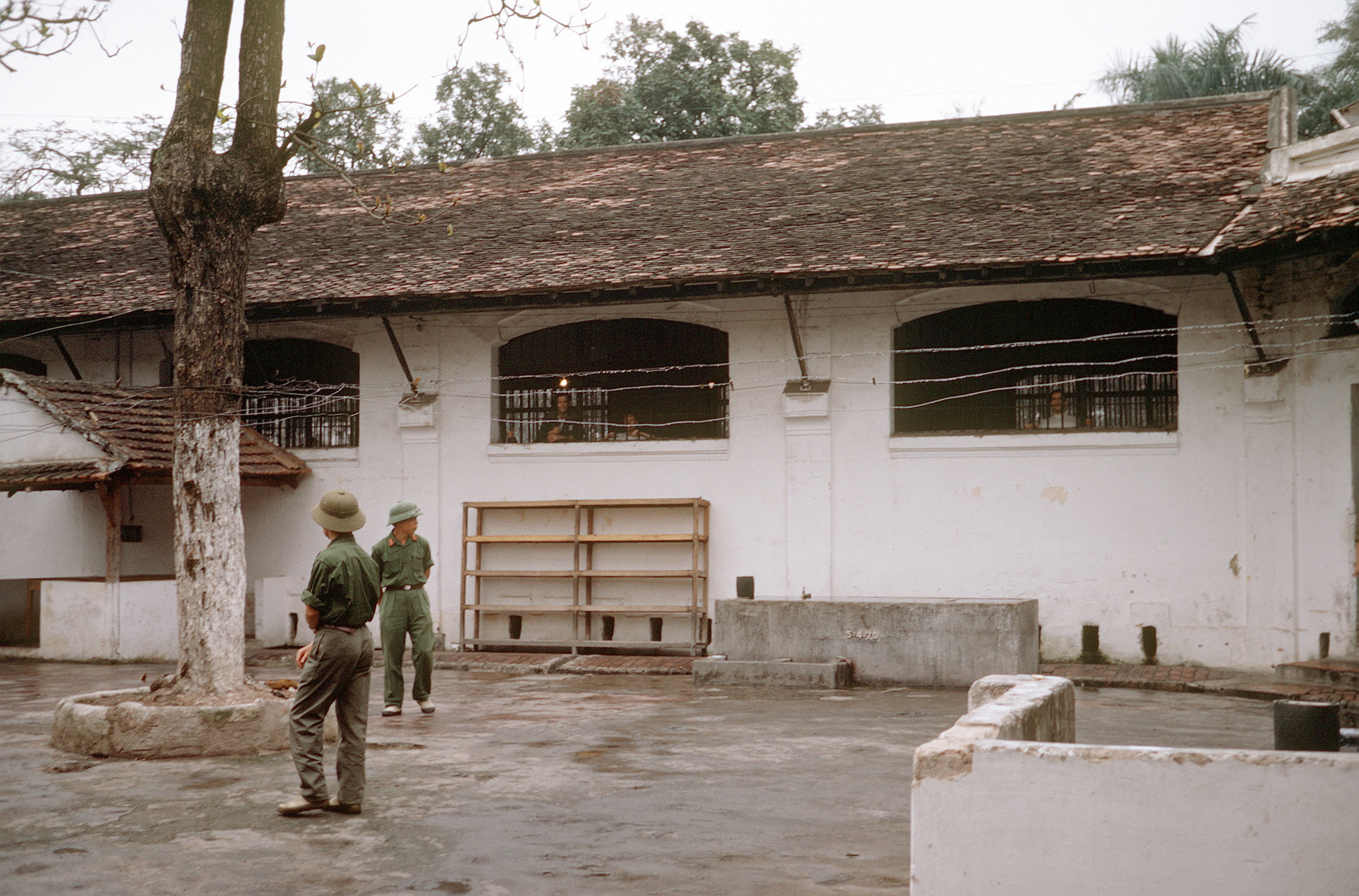
I identify Hoa Lo as a political prison rather than a "P.O.W. camp," not just because of its honeycomb of tiny cells, each with a cement-slab bed, leg irons at its foot, a food chute above the irons, a toilet bucket beside, and a "rat hole" to the outside drainage ditch for flushing, but because it was a place where people are sent to be used, to have their minds changed, or both. 

Political prisons are not to be confused with penitentiaries or prison camps where people are locked up to preserve the public peace or pay their debts to society. Little attention is given to terms of confinement or time schedules. They are institutions devoted only to the discrediting of the inmates’ causes; when all the prisoner’s juices have been squeezed out, when his forced confession of crimes never committed are judged as convincing as they can be made to be, he is usually free to go. 

It’s not generally known, but Americans held in Hanoi were free to go any time, provided the prisoner (1) cut juicy enough anti-American tapes, and (2) he was then willing to violate our prisoners’ underground organization’s self-imposed creed of comradeship: "Accept no parole or amnesty; we all go home together." 

Thus we came to imprison ourselves, for honor, in accordance with our Code of Conduct. I might add that this mystified several high officials of our government here in Washington. They didn’t know their own code. 

—from James B. Stockdale, Epictetus' Enchiridion: Conflict and Character 


Monday, February 2, 2026

Stockdale on Stoicism 54


So it was on that most chaotic night of those years, August 4th, 1964, when Washington decided to officially go to war. 

Just before midnight, I had been the eyewitness with the best seat in the house to see an action that had been reported as an attack by North Vietnamese PT boats against the American destroyers, Maddox and Joy

It was, in fact, a false alarm caused by the destroyers’ phantom radar contacts and faulty sonar operation on a very dark, humid, and stormy night. This was realized during the event by the boss of the destroyers at the scene, and by me, the boss of the airplanes overhead. Corrective messages were sent instantly to Washington: "No PT boats."

A few hours later, I was awakened to organize, brief, and lead the first air strike against North Vietnam, a reprisal for what I knew to be a false alarm. It was true that I had helped repulse an actual attack three days before, and that I thought it likely that another real one would occur in the future. 

But what to do, knowing that hours before, Washington had received the false-alarm messages, and that it would be none other than I who would be launching a war under false pretenses? 

I remember sitting on the side of my shipboard bed, alone in those predawn minutes, conscious of the fact that history was taking a major turn, and that it was I, little Jimmy Stockdale, who happened to be in the Ferris wheel seat that was just coming over the top and starting its descent. 

I remember two thoughts. 

The first was a pledge: that this was a moment to tell my grandchildren about someday, a history lesson important to future generations. 

The second was a reflection: I thought about Rhinelander, his "The Problems of Good and Evil" course, Epictetus, and how prophetic it had been that we had all come together those few years before. Probably nobody had ever tested Rhinelander’s course as I was likely to test it in not only the hours, but the years ahead. I knew we were stepping into a quagmire. 

There was no question of getting the truth of that night out; that truth had been out for hours. I was sure that there was nothing I could do to stop the "reprisal" juggernaut pouring out of Washington. 

My course was clear: to play well the given part. The Author had cast me in a lead role of a Greek Tragedy. Who else to lead my pilots into the heavy flak of the city of Vinh and blow the North Vietnamese oil storage tanks off the map? 

Remember that you are an actor in a drama of such sort as the Author chooses—if short, then in a short one; if long, then in a long one. If it be his pleasure that you should enact a poor man, or a cripple, or a ruler, or a private citizen, see that you act it well. For this is your business—to act well the given part, but to choose it belongs to another. 

—from James B. Stockdale, Epictetus' Enchiridion: Conflict and Character 


Wednesday, December 17, 2025

Stockdale on Stoicism 53


Had I been an ancient Stoic, I would have expressed what roughly went through my mind like this: "Just as in the Universe, where the mind of God is immanent and indwelling and moves in a manner self-sufficient and self-ruling, so I as the leader of pilots in times of unexpected change, frequent confusion, and occasional duplicity in high places, can do no better than to interpose myself between those pilots and our bumbling bureaucracy as their ultimate guide and protector. 

"I must cast off concern for all things not within my power. Remembering that as I aim for such goals, I must not undertake them by acting moderately, but must let go from within myself that enigmatic mixture of conscience and egoism called honor, and not hesitate to make exceptions to operational rules and procedures as necessary to follow my eternal guides of duty and personal responsibility." 

With such an outlook, 1963 and 1964, eerie years of national decision, were not times of great soul searching for me. I experienced one big soul search, embraced Stoicism, and was off and running; once I had made up my mind not to be concerned with things beyond my power, I was no longer hung up on where I began and where I left off in these enigmatic conditions. 

The conditions were tailor-made for Stoicism, and in my new-found freedom, tailor-made for me. I loved the life I lived during those years; it was unique in modern military history. Washington was determined to call every shot and their operations were compounding and stumbling over one another; normal business was crowded out and chaos frequently reigned. 

When caught in the crossfire of conflicting imperatives of our secret missions into places like Laos, my conscience counseled: "Follow your duty as you interpret it, don’t foolishly endanger your pilots, do what you think is best, improvise with confidence, and be prepared to stand accountable for your actions." 

—from James B. Stockdale, Epictetus' Enchiridion: Conflict and Character 


Friday, November 7, 2025

Stockdale on Stoicism 52


Mid-career graduate education is not uncommon in military life, though it is somewhat rare to have it in a field entirely separate from one’s immediate concerns. 

For nearly twenty years I had been on the operational and technical side of things—an engineering degree from Annapolis, with shore duty as an engineering test pilot bracketed by flying tours in carrier-based squadrons. 

I was now to return to such an aeronautical life after this sabbatical devoted to the study of political science, economics, and international relations with as much of the humanities as I could pack in. I did this in hopes of eventually achieving a high command that needed this education for policymaking and diplomatic and strategic planning duties.

I and others have found that a midlife second education, particularly one heavily salted with introspective subjects like classical philosophy, can precipitate an unexpected postgraduate wrinkle. An aftershock can develop as one returns to life in the world of cutting-edge technology, expediency, and not infrequent bureaucratic infighting. 

Throughout the first six or eight months after returning to the operational scene, I underwent a kind of transitional decompression. I groped for a stable platform of philosophical reference from which I could confidently call my shots. It wasn’t because I was in a new environment that I had to screw my head on a new way; it was just that I now saw contradictions where before I had seen only order. I had to hook my life to a big idea if I was to stay the course.

It was now 1963. Throughout 1961 and 1962 at Stanford, my mind had been awhirl with a whole new shopping list of big ideas. Rhinelander’s two-term philosophy course in "The Problems of Good and Evil" had alone taken me from the Book of Job to Camus, with more than a smattering of Plato, Aristotle, Shakespeare, Kant, Pascal, Leibnitz, Spinoza, Descartes, and Hume along the way. 

But now, as I led my squadron on and off the carrier decks in Southeast Asian waters, halfway between war and peace, I gravitated toward a more self-supporting, independent ethical balance wheel as I suffocated in the moral dilemmas that I could feel closing in on us all. 

There, my last-found model, Epictetus and his Stoicism, who by then I had made myself better understand, struck the very chord of self-respect and personal autonomy that I so needed to keep my mind clear and to break through the clutter of false hope and wishful thinking and to cut myself free. 

—from James B. Stockdale, Epictetus' Enchiridion: Conflict and Character 


Friday, September 26, 2025

Stockdale on Stoicism 51


I was thirty-eight years old in 1962 when I first encountered the classic text that influenced my life. The book was Epictetus’ Enchiridion, and we got off to a very unpromising start together. I just couldn’t bring myself to see that what that old coot Epictetus had to say bore any relationship to my life as a twentieth century technocrat.

The book had special meaning because it was a gift from a man sixteen years my senior, whom I idolized. It was given to me by Philip Rhinelander, my professor of philosophy at Stanford University Graduate School. He had been my mentor for almost a year when, during my last tutorial session, he removed the little worn and marked-up personal volume from a high shelf in his study and said: "Here is a book that a man in your profession should own. Keep it and read it from time to time."

I was a career naval officer, an experienced fighter pilot about to return to sea duty to command a carrier-based squadron flying the navy’s latest supersonic jets. What did I have in common with a first century Stoic, who went along page after page reciting epigrams like:

Men are disturbed not by things but by the view they take of them.

Do not be concerned with things that are beyond your power.

Demand not that events should happen as you wish, but wish them to happen as they do happen and you will go on well. 

—from James B. Stockdale, Epictetus' Enchiridion: Conflict and Character 

IMAGE: Philip H. Rhinelander 


Saturday, August 9, 2025

Stockdale on Stoicism 50


Then I got back into trouble. At that time, the commissar of prisons had had me isolated and under almost constant surveillance for the year since I had staged a riot in Alcatraz to get us out of leg irons. 

I was barred from all prisoner cell-blocks. I had special handlers, and they caught me with an outbound note that gave leads I knew the interrogators could develop through torture. The result would be to implicate my friends in "black activities," as the North Vietnamese called them. 

I had been through those ropes more than a dozen times, and I knew I could contain material—so long as they didn't know I knew it. But this note would open doors that could lead to more people getting killed in there. We had lost a few in big purges—I think in torture overshoots—and I was getting tired of it. 

It was the fall of 1969. I had been in this role for four years, and saw nothing left for me to do but check out. 

I was solo in the main torture room in an isolated part of the prison the night before what they told me would be my day to spill my guts. There was an eerie mood in the prison. Ho Chi Minh had just died and special dirge music was in the air. I was to sit up all night in traveling irons. 

My chair was near the only pane-glass window in the prison. I was able to waddle over and break the window stealthily. I went after my wrist arteries with the big shards. I had knocked the light out, but the patrol guard happened to find me passed out in a pool of blood but still breathing. The Vietnamese went to General Quarters, got their doctor, and saved me. 

Why? It was not until after I was released years later that I learned that that very week, my wife, Sybil, was in Paris demanding humane treatment for prisoners. She was on world news, a public figure, and the last thing the North Vietnamese needed was me dead. 

There was a very solemn crowd of senior North Vietnamese officers in that room as I was revived. Prison torture, as we had known it in Hanoi, ended for everybody that night. 

Of course, it was months before we could be sure that was so. All I knew at the time was that, in the morning, after my arms had been dressed and bandaged, the commissar himself brought in a hot cup of sweet tea, told my surveillance guard to take off my leg irons, and asked me to sit at the table with him. 

"Why did you do this, Stockdale? You know I sit with the army's General Staff; they've asked for a full report this morning." It was not unusual for us to talk like that by that time. 

But he never once mentioned the note, nor did anybody else thereafter. That was unprecedented. After a couple of months in a tiny isolated cell we called Calcutta to let my arms heal, they blindfolded me and walked me right into the "Las Vegas" cell block. The isolation and special surveillance were over. I was put, solo of course, in the Mint.

Dave Hatcher knew I was back because I walked under his window, and though he could not peek out, he could listen, and over the years he had attuned his ear to my walking "signature," my limping gait. 

Soon enough, the rusty wire over the sink in the washroom was bent to the north—Dave Hatcher's signal for "note in the bottle under the sink for Stockdale." 

Like an old fighter pilot, I checked my six o'clock, scooped the note up fast, and concealed it in my prison pajama pants, carefully. Back in my cell, after the guard locked the door, I sat on my toilet bucket—where I could stealthily jettison the note if the peephole cover moved—and unfolded Hatcher's sheet of low-grade paper toweling on which he had printed with rat dropping, without comment or signature, the last verse of Ernest Henley's poem lnvictus:

"It matters not how strait the gate,
How charged with punishment the scroll,
I am the master of my fate; 
I am the captain of my soul." 

—from James B. Stockdale, Master of My Fate: A Stoic Philosopher in a Hanoi Prison 


Wednesday, June 25, 2025

Stockdale on Stoicism 49


In prison, I never tapped or mentioned Stoicism once. You soon learned that if the guy next door was doing okay, that meant that he had all his philosophical ducks lined up in his own way. 

But some sharp guys read the signs in my actions. 

After one of my long isolations outside the cell-blocks of the prison, I was brought back into signaling range of the fold. My point of contact was a man named Dave Hatcher. 

As was standard operating procedure on a first contact after a long separation, we started off not with gushes of news but with, first, an agreed-upon danger signal; second, a cover story for each of us if we were caught; and third, a back-up communications system if this link was compromised—"slow movin' cagey prisoner" precautions. 

Hatcher's back-up system for me was a note-drop by an old sink near a place we called the Mint, the isolation cell-block of his wing of the prison—a place he rightly guessed I would soon enough be in. Every day we would signal for 15 minutes, over a wall between his cell-block and my "no-man's-land." 

—from James B. Stockdale, Master of My Fate: A Stoic Philosopher in a Hanoi Prison 

IMAGES: Francisco de Goya, The Prisoners (c. 1815) 

"The custody is as barbarous as the crime." 

"The custody of a criminal does not call for torture." 

"If he is guilty, let him die quickly." 


Sunday, April 13, 2025

Stockdale on Stoicism 48


Why did those men in "cold soak" after their first rope trip eat their hearts out and feel so unworthy when the first American contacted them? Epictetus knew human nature well. 

In that prison laboratory, I know of not a single case where a man was able to erase his pangs of conscience with some laid-back, pop-psychology theory of cause and effect. 

Epictetus emphasizes time and again the fact that a man who lays the causes of his actions onto third parties or forces is not leveling with himself. He must live with his own judgments if he is to be honest with himself. 

"But if a person subjects me to fear of death, he compels me," says a student. 

"No," says Epictetus, "It is neither death, nor exile, nor toil, nor any such things that is the cause of your doing, or not doing, anything, but only your opinions and the decisions of your Will." 

"What is the fruit of your doctrines?" someone asked Epictetus. 

"Tranquility, fearlessness, and freedom," he answered. 

You can have these only if you are honest and take responsibility for your own actions. You've got to get it straight! You are in charge of you. 

—from James B. Stockdale, Master of My Fate: A Stoic Philosopher in a Hanoi Prison 

IMAGE: Caspar Jacobsz Philips, Various Methods of Torment Employed by the Inquisition (c. 1770) 


Friday, January 10, 2025

Stockdale on Stoicism 47


Epictetus once gave a lecture to his faculty complaining about the common tendency of new teachers to slight the stark realism of Stoicism 's challenges in favor of giving the students an uplifting, rosy picture of how they could meet the harsh requirements of the good life painlessly. 

Epictetus said: "Men, the lecture-room of the philosopher is a hospital; students ought not to walk out of it in pleasure, but in pain." 

If Epictetus 's lecture room was a hospital, my prison was a laboratory—a laboratory of human behavior. I chose to test his postulates against the demanding real-life challenges of my laboratory. 

I'm not talking about brainwashing; there is no such thing. I'm talking about having looked over the brink, and seen the bottom of the pit, and realizing the truth of that linchpin of Stoic thought: that the thing that brings down a man is not pain but shame! 

—from James B. Stockdale, Master of My Fate: A Stoic Philosopher in a Hanoi Prison 

IMAGE: Rembrandt, St. Peter in Prison (1631) 


Thursday, October 31, 2024

Stockdale on Stoicism 46


Howie Rutledge, one of the four of us with more than four years, went back to school and got a master's degree after we got home. His thesis concentrated on the question of whether long-term erosion of human purpose was more effectively achieved by torture or isolation. 

He mailed out questionnaires to us (who had also taken the ropes at least ten times), and others with records of extreme prison abuse. 

He found that those who had less than two years' isolation and plenty of torture said torture was the trump card; those with more than two years' isolation and plenty of torture said that, for long-term modification of behavior, isolation was the way to go. 

From my viewpoint, you can get used to repeated rope torture—there are some tricks for minimizing your losses in that game. 

But keep a man, even a very strong-willed man, in isolation for three or more years, and he starts looking for a friend, any friend, regardless of nationality or ideology. 

—from James B. Stockdale, Master of My Fate: A Stoic Philosopher in a Hanoi Prison 

IMAGE: Jacques-Louis David, Psyche Abandoned (c. 1795) 


Wednesday, August 14, 2024

Stockdale on Stoicism 45


In May 1967, the PA system blared out: "Those of you who repent, truly repent, will be able to go home before the war is over. Those few diehards who insist on inciting the other criminals to oppose the camp authority will be sent to a special dark place." 

I immediately put out an order forbidding any Americans to accept early release, but that is not to say I was a lone man on a white horse. My order was accepted with obvious relief and spontaneous jubilation by the overwhelming majority. 

Guess who went to the dark place. They isolated my leadership team, myself and my ten top cohorts—and sent us into exile. The Vietnamese worked very hard to learn our habits, and they knew who were the troublemakers and who were not making any waves. They isolated those I trusted most: those with a long record of solitary and rope-mark pedigrees. 

Not all were seniors. One of my ten was only 24 years old—born after I was in the Navy. He was a product of my recent shipboard tendencies: "When instincts and rank are out of phase, take the guy with the instincts." 

All of us stayed in solitary throughout, starting with two years in leg irons in a little high-security prison right beside North Vietnam's "Pentagon"—their Ministry of Defense, a typical, old French building.

There are chapters upon chapters after that, but what they came down to in my case was a strung-out vengeance fight between the Prison Authority and those of us who refused to quit trying to be our brothers' keepers. The stakes grew to nervous-breakdown proportions. One of the eleven of us died in that little prison we called Alcatraz. There was not a man who wound up with less than three and a half years of solitary, and four of us had more than four years. 

—from James B. Stockdale, Master of My Fate: A Stoic Philosopher in a Hanoi Prison 


Saturday, June 15, 2024

Stockdale on Stoicism 44


An encapsulated history of how this bifurcated prison philosophy fared is this: The propaganda footage and interviews started to backfire. Smart American college men were salting their acts with double-meaninged sentences, gestures read as funny-obscene by Western audiences, and practical jokes. 

One of my best friends, tortured to give names of pilots he knew who had turned in their wings in opposition to the war, said there were only two: Lieutenants Clark Kent and Ben Casey. That went on the front page of the San Diego Union, and somebody sent a copy back to the government in Hanoi. 

As a result of that friendly gesture from a fellow American, Nels Tanner went into three successive days of rope torture, followed by 123 days in leg stocks—all while isolated, of course. 

So after several of these stunts, which cost the Vietnamese much loss of face, North Vietnam resorted to getting its propaganda from only the relatively few Americans they could trust not to act up—real loners who, for different reasons, never joined the prisoner organization, never wanted to get into the tap-code network, well-known sleazeballs we came to call "finks." 

The great mass of the other Americans in Hanoi were, by all standards, "honorable prisoners," but that is not to say that there was anything like a homogeneous prison regime we all shared. People like to think that because we were all in the Hanoi prison system, we had all these common experiences. It's not so. 

These differing regimes became marked when our prison organization stultified the propaganda efforts of this two-headed monster called the "Prison Authority." The North Vietnamese turned to vengeance against the leadership of my organization and to an effort to break down the morale of the others baiting them with an amnesty program in which they would compete for early release by being compliant to North Vietnam 's wishes. 

—from James B. Stockdale, Master of My Fate: A Stoic Philosopher in a Hanoi Prison 


Tuesday, April 23, 2024

Stockdale on Stoicism 43


Prison life became a crazy mixture of an old regime and a new one.

The old was the political prison routine mainly for dissenters and domestic enemies of the state. It was designed and run by old-fashioned Third-World Communists of the Ho Chi Minh cut. It revolved around the idea of "repentance" for "crimes" of anti-social behavior. American prisoners, street criminals, and domestic political enemies of the state were all in the same prison. 

We never saw a "POW camp" like in the movies. The Communist jail was part psychiatric clinic and part reform school. North Vietnamese protocol called for making all their inmates demonstrate shame, bowing to all guards, heads low, never looking at the sky. It meant frequent sessions with your interrogator, if for no other reason than to check your attitude. And if judged "wrong," then you were maybe down the torture chute of confession of guilt, of apology, and then the inevitable payoff—the atonement. 

The new regime, superimposed on the above, was for Americans only. It was a propaganda factory, supervised by young, English-speaking, bureaucratic army officers with quotas to fill, quotas set by the political arm of the government: press interviews with visiting left-wing Americans, propaganda films to shoot (starring intimidated people they called "American Air Pirates"), and so on. 

—from James B. Stockdale, Master of My Fate: A Stoic Philosopher in a Hanoi Prison 

Sunday, March 10, 2024

Stockdale on Stoicism 42


We organized a clandestine society via our wall tap code—a society with our own laws, traditions, customs, even heroes. 

To explain how it could be that we would order each other into more torture, order each other to refuse to comply with specific demands, intentionally call the bluff of our jailers, and force them to repeat the process described above, I'll explain with an apocryphal statement that could have come from at least half of those wonderful, competitive fly-boys I found myself locked up with:

"We are in a spot like we've never been in before. But we deserve to maintain our self-respect, to have the feeling we are fighting back. We can't refuse to do every degrading thing they demand of us, but it's up to you, boss, to pick out things we must all refuse to do, unless and until they put us through the ropes again. We deserve to sleep at night. We at least deserve to have the satisfaction that we are hewing to our leader's orders. Give us the list: what are we to take torture for?" 

This was a first step in claiming what was rightfully ours. Epictetus said: "The judge will do some things to you which are thought to be terrifying; but how can he stop you from taking the punishment he threatened?" 

That's my kind of Stoicism. You have a right to make them hurt you, and they don't like to do it. The prison commissar told my fellow prisoner Ev Alvarez when he was released: "You Americans were nothing like the French; we could count on them to be reasonable."

I put a lot of thought into what my first orders should be. They would be orders that could be obeyed, not a "cover your ass" move of reiterating some U.S. government policy like "name, rank, serial number, and date of birth," which had no chance of standing up in the torture room. 

My mindset was, "We here under the gun are the experts, we are the masters of our fate. Ignore guilt-inducing echoes of hollow edicts, throw out the book, and write your own." 

My orders came out as easy-to-remember acronyms. The principal one was BACK US:  

Don't Bow in public; stay off the Air; admit no Crimes; never Kiss them goodbye. US could be interpreted as United States, but really meant that each of us had to work at the lowest common denominator, never negotiating for himself, but only for all. 

—from James B. Stockdale, Master of My Fate: A Stoic Philosopher in a Hanoi Prison 


Monday, January 29, 2024

Stockdale on Stoicism 41


As an insider, I knew the whole setup; that the North Vietnamese already held about 25 prisoners, probably in Hanoi, and as I was the only wing commander to survive an ejection, that I would be their senior, their commanding officer—and would remain so, very likely, throughout this war that I felt sure would last at least another five years. And here I was, starting off crippled and flat on my back.

Epictetus turned out to be right. All told, it was only a temporary setback from things that were important to me, and being cast in the role as the sovereign head of an American expatriate colony which was destined to remain autonomous, out of communication with Washington, for years on end, was very important to me. I was determined to "play well the given part."

The key word for all of us at first was fragility. Each of us, before we were ever in shouting distance of another American, was made to "take the ropes." That was a real shock to our systems—and as with all shocks, its impact on our inner selves was a lot more impressive and lasting and important than to our limbs and torsos. 

These were the sessions where we were taken down to submission and made to blurt out distasteful confessions of guilt and American complicity into antique tape recorders, and then to be put in what I call "cold soak, " six or eight weeks of total isolation to "contemplate our crimes." 

What we actually contemplated was what even the most self-satisfied American saw as his betrayal of himself and everything he stood for. 

It was there that I learned what "Stoic harm" meant. A shoulder broken, a bone in my back broken, and a leg broken twice were peanuts by comparison. 

Epictetus said: "Look not for any greater harm than this: destroying the trustworthy, self-respecting, well-behaved man within you." 

When put into a regular cell block, hardly an American came out of that without responding something like this when first whispered to by a fellow prisoner next door: "You don't want to talk to me; I am a traitor." 

And because we were equally fragile, it seemed to catch on that we all replied something like this: "Listen, pal, there are no virgins in here. You should have heard the kind of statement I made. Snap out of it. We're all in this together. What's your name? Tell me about yourself."

To hear that last was, for most new prisoners, just out of initial shakedown and cold soak, a turning point in their lives. 

—from James B. Stockdale, Master of My Fate: A Stoic Philosopher in a Hanoi Prison 


Monday, December 18, 2023

Stockdale on Stoicism 40


So in prison I had become a man with a mission. To explain this, let me unload a little emotional baggage that was part of my military generation's legacy in 1965. 

In the aftermath of the Korean War, just over 10 years before, we all had memories of reading about and seeing early television news accounts of U.S. government investigations into the behavior of some American prisoners of war in North Korea and mainland China. The gist of it was that in prison camps for Americans, it was every man for himself. 

Since those days, I've come to know officers who were prisoners of war there, and I now see much of that as selective reporting and as a bum rap. 

However, there were cases of young soldiers who were confused by the times, scared to death, in cold weather, treating each other like dogs fighting over scraps, throwing each other out in the snow to die, and nobody doing anything about it. 

This could not go on, and President Eisenhower commissioned the writing of the American Fighting Man's Code of Conduct. It was written in the fonn of a personal pledge. Article 4:

"If I become a prisoner of war, I will keep faith with my fellow prisoners. I will give no information or take part in any action which might be harmful to my comrades. If I am senior, I will take command. If not, I will obey the lawful orders of those appointed over me and will back them up in every way."

In other words, as of the moment Eisenhower signed that document, American prisoners of war were never to escape the chain of command; the war goes on behind bars. 

—from James B. Stockdale, Master of My Fate: A Stoic Philosopher in a Hanoi Prison