The Death of Marcus Aurelius

The Death of Marcus Aurelius
Showing posts with label Luca Giordano. Show all posts

Wednesday, October 1, 2025

Sayings of Ramakrishna 272


Dispute not. As you rest firmly on your own faith, allow others also the same liberty to stand by their own faiths. 

By mere disputation you shall never succeed in convincing another of his error. 

When the grace of God descends on him, everyone will understand his own mistakes. 

IMAGE: Luca Giordano, Theologians Disputing (c. 1680) 


Friday, June 9, 2023

Epictetus, Discourses 2.1.7


“But” (says my pupil), “have I not recited to you? Do you not know what I am doing?” 

What are you engaged on? Paltry phrases. Away with your paltry phrases: show me how you stand in regard to the will to get and the will to avoid: if you do not fail to get what you will, or fall into what you will to avoid. As for those paltry periods, if you have sense you will take them away somewhere or other and make away with them. 
 
“What do you mean? Did not Socrates write?” 
 
Yes, who wrote so much as he? But under what conditions? He could not always have someone at hand examining his judgements or to be examined by him in turn, and therefore be examined and questioned himself and was always putting to trial some primary conception or other in a practical way. 
 
This is what a philosopher writes: but paltry phrases and periods he leaves to others, to the stupid or the blessed, those whose peace of mind gives them leisure for study or those who can draw no logical conclusions because of their folly. 

—from Epictetus, Discourses 2.1 
 
I have often felt a twinge of resentment when someone wiser and better is offering me sound advice. They aren’t being cruel, it’s rather my own guilty conscience talking, and instead of acting defensive I should get busy cleaning house. 
 
While the student is proud of all his fancy scholarship, the master knows how the study of words is empty when not in service to the increase of the virtues. Indeed, I have found that the lure of academic achievement can easily be a downright hindrance to improving my character. 
 
I think of how many hours I wasted memorizing only what I was expected to say. I cringe at the years of schooling spent learning to look clever instead of working to be wise. I regret trying to impress by bickering, when I really should have been seeking to love with understanding. 
 
Has philosophy helped me to become kinder, or am I using it as an excuse to become nastier? If you think I’m exaggerating, take a moment to listen in on a typical academic conversation, and the level of frivolous conflict and spite will make you think that the gossipy church ladies are downright saints. 
 
Am I being critical with myself, or am I merely criticizing others? There’s the rub. 
 
I suppose Socrates did write, though he never wrote down any formal treatises, thinking it more important to practice philosophy than to show off about the theories. He wouldn’t have lasted a week in an academic department, or ever gotten published, and I don’t imagine he would have had any interest in doing so. 
 
By all means, familiarize yourself with the tools—then start using them to do the actual job. 

—Reflection written in 5/2001 

IMAGE: Luca Giordano, A Philosopher Writing (c. 1680) 


Sunday, February 19, 2023

Sayings of Chilon


As a Spartan, it is perhaps fitting that Chilon's biography is sparse and his sayings terse. We do know that he lived in the 6th century BC, served as an ephor for the city, and wrote elegiac poetry. 

His brother complained that he had not also been elected an ephor, to which Chilon replied, "I know how to admit to injustice and you do not." 

When asked to define what was hard in life, Chilon answered, "To keep a secret. To employ leisure well. To be able to bear an injury." 

When asked the difference between a learned and an unleaded man, he said, "In good hope."

He is reported to have died from a combination of intense joy and the weakness of old age after congratulating his son on an Olympic victory in boxing. 

Give a pledge, and suffer for it. 

Seek no excess—all timely things are good. 

Control your tongue, especially at a banquet. 

Do not abuse your neighbors, for if you do, things will be said about you which you will regret. 

Threaten no one; for that is a womanly trick. 

Be more ready to visit friends in adversity than in prosperity. 

Do not make an extravagant marriage. 

Of the dead say nothing but good. 

Honor old age. 

Consult your own safety. 

Prefer a loss to a dishonest gain: the one brings pain at the moment, the other for all time. 

Do not laugh at another's misfortune. 

When strong, be merciful, if you would have the respect, not the fear, of your neighbors. 

Learn to be a wise master in your own house. 

Let not your tongue outrun your thought. 

Control anger. 

Do not hate divination. 

Do not aim at impossibilities. 

Let no one see you in a hurry. 

Gesticulation in speaking should be avoided as the mark of a madman. 

Obey the laws. 

Be restful. 

From one of his poems: 

Gold is best tested by a whetstone hard,
Which gives a certain proof of purity;
And gold itself acts as the test of men,
By which we know the temper of their minds.

IMAGE: Luca Giordano, The Philosopher Chilon (c. 1660) 


Thursday, August 25, 2022

Sayings of Heraclitus 63


The way of man has no wisdom, but that of God has. 

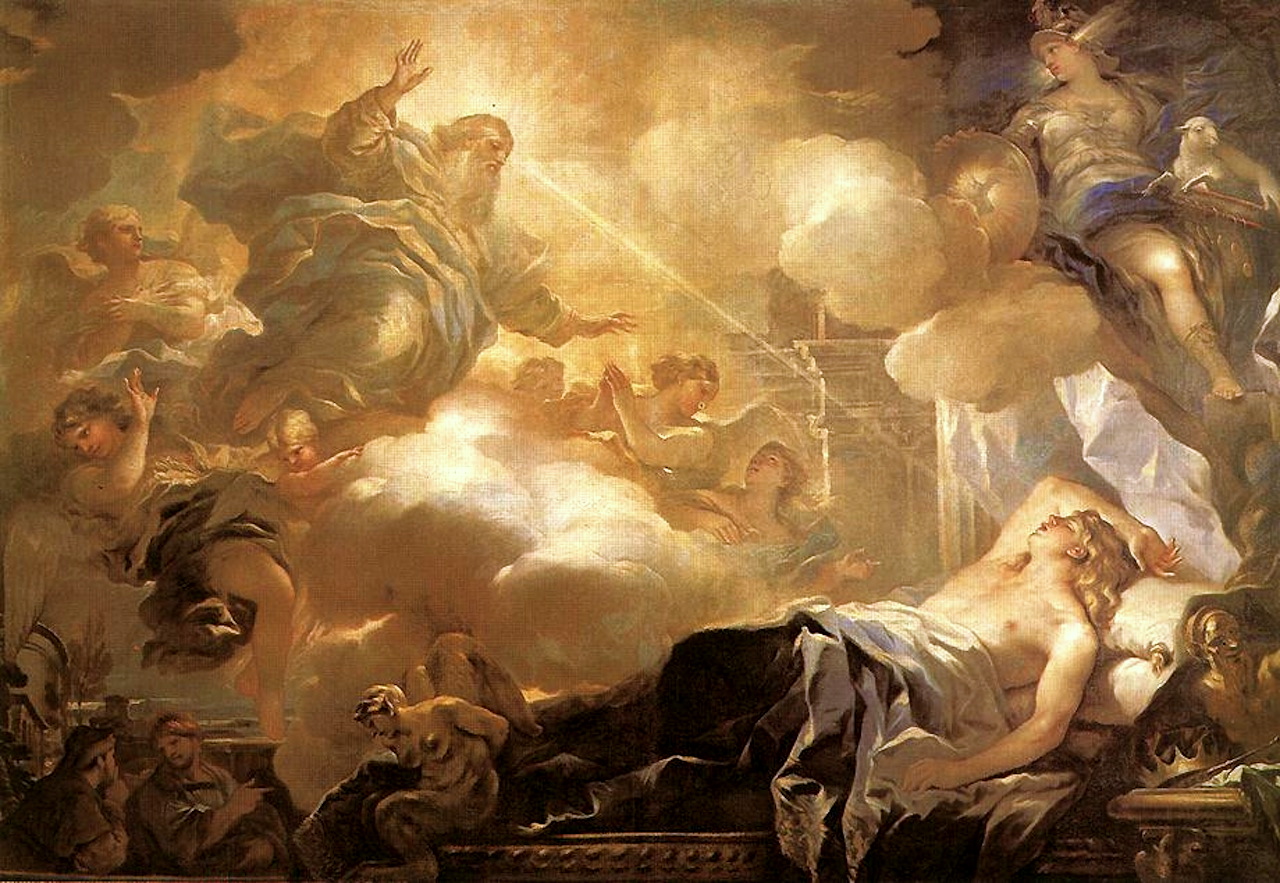
IMAGE: Luca Giordano, The Dream of Solomon (c. 1695) 


Friday, September 18, 2020

Allegories of the Virtues


Luca Giordano, Allegory of Prudence / Allegory of Fortitude / Allegory of Temperance / Allegory of Justice (1685)


The Wisdom of Solomon 6:12-20


[12] Wisdom is radiant and unfading,
and she is easily discerned by those who love her,
and is found by those who seek her.
[13] She hastens to make herself known to those who desire her.
[14] He who rises early to seek her will have no difficulty,
for he will find her sitting at his gates.
[15] To fix one's thought on her is perfect understanding,
and he who is vigilant on her account will
soon be free from care,
[16] because she goes about seeking those worthy of her,
and she graciously appears to them in their paths,
and meets them in every thought.

[17] The beginning of wisdom is the most sincere
desire for instruction,
and concern for instruction is love of her,
[18] and love of her is the keeping of her laws,
and giving heed to her laws is assurance of immortality,
[19] and immortality brings one near to God;
[20] so the desire for wisdom leads to a kingdom.


IMAGE: Luca Giordano, Allegory of Divine Wisdom (1685)


Saturday, June 6, 2020

Seneca, On Peace of Mind 11.1

These remarks of mine apply only to imperfect, commonplace, and unsound natures, not to the wise man, who needs not to walk with timid and cautious gait: for he has such confidence in himself that he does not hesitate to go directly in the teeth of Fortune, and never will give way to her.

Nor indeed has he any reason for fearing her, for he counts not only chattels, property, and high office, but even his body, his eyes, his hands, and everything whose use makes life dearer to us, no, even his very self, to be things whose possession is uncertain; he lives as though he had borrowed them, and is ready to return them cheerfully whenever they are claimed.

Confidence? By all means. Weakness? Quite unacceptable.

Most people would gladly insist on such principles, especially those folks caught up in the world of earning money, of winning status, and of acquiring influence. Think of all those inspirational phrases you will hear about the attitude of the winner, about never being second best, or about taking what you know you deserve.

And the meaning in all of that depends on our standards of winning and losing. It is admirable to be confident, but in what should I have confidence? It is shameful to be weak, but what actually makes me weak?

There is a vast difference between two models of success, between being more and getting more. What we mean by confidence or weakness hinges upon which model we choose.

The Stoic attitude is quite natural, in that it derives from who we essentially are as human beings, but it is also quite radical, in that it asks us to go against the grain of all the artificial habits we have acquired.

Is it reasonable to expect that the world will give us external rewards in proportion to what we do, that we will be fulfilled by the acquisition of things as a consequence of our efforts?

I have been told that for all of my life, and I do not wish to be crude, but I call bullshit. For each hard-working man who gets rich, another one remains poor. For each lazy man who rots in the gutter, another one hits the jackpot. In this sense, life is hardly fair at all.

Now consider it from a different perspective. Why should those circumstances, which are ultimately quite outside of our control, define who we are? There is another option, and it is completely within our control. Let our own thoughts and deeds define who we are, entirely for their own sake. In this sense, life is totally fair.

Hence the wise man is confident when he relies on his own actions, and he is weak when he relies on the actions of others. In contrast, the fool thinks he is confident when he worries about what he receives, and he thinks he is weak when he worries about what he might give.

To be confident in myself is not to make myself the center of the Universe; it is simply to make me a center for myself. I take what I have been offered, and I nurture it, and I make it grow. I can still be humble, since I know that my own worth fits within the worth of the whole.

When I fall into weakness, it has nothing to do with being worse than anyone else; it has everything to do with being worse than what I alone am able to be. My weakness comes from my requirement to define myself by everything except myself.

If I can remember that, and not just conceive it but actually live it, Fortune has no control over my happiness. I am the one who decides whether I will take it or leave it. I can be confident in that.

Why should Fortune hurt me, when everything she lends me was never mine to begin with? If I am truly myself, then I will care little for the rest. To lose property, or gratification, or reputation only causes such deep pain when I claim them as my own, and they cease to be such a burden when I no longer think of them as something to which I am entitled.

Was Dives happier than Lazarus? The only way to answer that question is to further ask who the better man was, the one who relied upon his own virtues or the one who relied on his situation. Who was really strong or weak? Who was really living on table scraps? 

Written in 11/2011

IMAGE: Luca Giordano, Dives and Lazarus (c. 1680)

Monday, May 4, 2020

The Death of Seneca in Art


Peter Paul Rubens (1613) 
School of Gerard van Honthorst (c.1625)
Jacques de l'Ange (c.1650)
Luca Giordano (c.1685)
Noel Halle (1750)
Jacques-Louis David (1773)
Manuel Dominguez Sanchez (1871)

Monday, April 6, 2020

Epictetus, Golden Sayings 119


Kings and tyrants have armed guards wherewith to chastise certain persons, though they themselves be evil. 

But to the Cynic conscience gives this power—not arms and guards. 

When he knows that he has watched and labored on behalf of mankind, that sleep has found him pure, and left him purer still, that his thoughts have been the thought of a Friend of the Gods—of a servant, yet one that has a part in the government of the Supreme God—that the words are ever on his lips:  

Lead me, O God, and you, O Destiny! 

as well as these: 

If this be God's will, so let it be! 

Why should he not speak boldly unto his own brethren, unto his children—in a word, unto all that are akin to him!

IMAGE: Luca Giordano, A Cynic Philosopher (c. 1650)


Tuesday, February 18, 2020

Seneca, On Peace of Mind 5.3

However, Athens herself put him to death in prison, and Freedom herself could not endure the freedom of one who had treated a whole band of tyrants with scorn.

You may know, therefore, that even in an oppressed state a wise man can find an opportunity for bringing himself to the front, and that in a prosperous and flourishing one wanton insolence, jealousy, and a thousand other cowardly vices bear sway.

I am deeply wary of deifying any man, and I have no interest in turning my heroes into saints. I will leave it to God to decide who the real saints are.

I have no illusions that Socrates was somehow perfect, and I am sure he had as many weaknesses as the rest of us. I imagine that he could be an annoying man; in the language of our day and age, he was probably quite offensive and inappropriate. I know that feeling, when someone has asked me to think for myself, to move beyond popular assumptions and shallow platitudes, and how deeply that can damage my vanity and the illusion of my power. There was a reason Socrates was like a gadfly.

The frustrations ran so deep that the Athenians put him to death. This ends the discussion for most, because death is perceived as one the greatest evils. So we neglect one of the most important lessons Socrates tried to teach, the necessity of thinking critically about what we really mean by “good” and “bad”. Show me what you will sacrifice anything else for, and I will see what you truly love, and who you really are.

When I look at Socrates, I see a man who not only understood that living well required thinking well, but also a man who was brave enough to then put into practice all he had learned about wisdom and virtue as the highest goods. In this, he is more than just some imposing historical figure, and becomes rather a model for anyone, anyone at all, who wishes to become genuinely human.

And yes, I do really mean for any of us, regardless of whatever fortune may have thrown our way. It requires only the humility and honesty to reflect upon our own nature, and then the courage and commitment to follow an informed conscience. What Socrates did, all people can do. No special powers are required, only a love of character. Any person who does this has now been of service.

So what can the life of Socrates ultimately teach Serenus? First, that a good man, under all circumstances, can always find the opportunity to live well. Second, by extension, don’t be fooled by the false idols of status and wealth, because the love of such things will so easily turn us into charlatans and hypocrites. Adding anything glorious on the outside can never cover up a rot on the inside.

I don’t know if Socrates had to die the way he did, but I do know that he had to live the way he did, and that he was willing to face misfortune and death for the sake of a good life.

“Oh, if only I could live like a Socrates!”

“What’s stopping you?” 

Written in 8/2011

IMAGE: Luca Giordano, Socrates (c.  1660)

Monday, November 25, 2019

Musonius Rufus, Lectures 3.4


But above all a woman must be chaste and self-controlled; she must, I mean, be pure in respect of unlawful love, exercise restraint in other pleasures, not be a slave to desire, not be contentious, not lavish in expense, nor extravagant in dress. Such are the works of a virtuous woman, and to them I would add yet these: to control her temper, not to be overcome by grief, and to be superior to uncontrolled emotion of every kind.

Now these are the things that the teachings of philosophy transmit, and the person who has learned them and practices them would seem to me to have become a well-ordered and seemly character, whether man or woman.

Back in our last year of high school, a fellow seemed quite keen to “set me up” with a girl he knew. I have no idea why he was so motivated in this task, or how he thought this could possibly be a successful match.

I did my best to be as polite as I could, but it was clear to me that no good could ever come from this. “I’m sure she’s very nice,” I said, “but we would hardly get along. She’s never given me the time of day, and she seems to have quite a few other boyfriends already.”

His eyes narrowed. “Don’t be so sexist! So you somehow think it’s okay for guys to sleep around all they want, but girls need to be all proper? That’s such a double standard!”

“No, you know that I don’t live that way, and so there’s no hypocrisy if I choose not to share my life with people who live that way.”

“Hey, you’d hardly have to share your life with her. You could just have a good time with her.”

“See? There is precisely where we will have to agree to disagree.”

Should a woman practice self-control in her passions? Yes, she will gladly do just that if she judges virtue as the greatest human good. And before all those accusing fingers get pointed, this would be just as true of a good man as of a good woman, or of any person who is of good character. It isn’t a feminine virtue or a masculine virtue—it is a human virtue.

There is, furthermore, no need to assume that temperance, or any of the virtues, is somehow restrictive or repressive. Quite the contrary, it can be something that is truly liberating, because it allowed us to rule ourselves, not to be ruled by our desires. If I look at other people only as objects of gratification, and not as subjects worthy of respect, I have already degraded them, and I have also degraded myself.

I know it seems like such a hopelessly outdated and romantic ideal, especially at a time when we so openly buy and sell sex, but I once took it deeply to heart when someone told me that chastity was never about self-denial, but about self-mastery. Nature made me to give with love, not merely to take with lust.

A passion without wisdom to guide it will always bring out the worst in us. I began to learn that the hard way, by bitter experience, only a few months after that attempted set-up. I suddenly found myself drawn to someone who was so very smart, charming, and sophisticated. I now had the chance to put my principles into real practice, but I ended up bending them so hard that I downright broke them. 

I discovered fairly quickly that she was also dishonest and disloyal, and that her conscience was the last place she looked for inspiration. But surely that would change, if only I stuck with her? I felt so loudly for her that it drowned out my thinking.

My friends frowned and shook their heads. “She will break your heart, just wait! How many more men in her bed will it take before you stop looking the other way? When will you have had enough of her laughing at you behind your back?”

It was too easy to eventually be angry with her, many years later, but that was attention entirely misdirected. She was going to be who she was going to be, but I could decide who I was going to be. Chaste, self-controlled, not a slave to desire? Let me master those virtues myself, instead of worrying about them so much in others. My intemperance, my feeling without thinking, was my problem, not hers. My own weakness, and no one else’s, was the cause of my downfall here.

By all means, I can choose to trust another for being good, but it will make no difference if I can’t first trust myself to be good.

Written in 4/1999

IMAGE: Luca Giordano, Temperance (c. 1686)


Tuesday, November 7, 2017

Epictetus, The Handbook 25: A Life of Any Account


Let not reflections such as these afflict you: 'I shall live without honor, and never be of any account'; for if lack of honor is an evil, no one but yourself can involve you in evil any more than in shame. Is it your business to get office or to be invited to an entertainment?

‘Certainly not.’

Where then is the dishonor you talk of? How can you be 'of no account anywhere', when you ought to count for something in those matters only which are in your power, where you may achieve the highest worth?

'But my friends,' you say, 'will lack assistance.'

What do you mean by 'lack assistance'? They will not have cash from you and you will not make them Roman citizens? Who told you that to do these things is in our power, and not dependent upon others? Who can give to another what is not his to give?. . .

—Epictetus, The Handbook, Chapter 24 (tr Matheson)

We are told that our lives need to matter, that we need to make a difference, that we must make our mark. These are noble sentiments, but what they mean hinges entirely upon what we consider to be a valuable life. It is much like our parents telling us to be good, though we aren’t quite sure what being good means.

I remember all the fine kids in college who were going to do something important with their lives. They were going to save the environment, ban nuclear weapons, fix the economy, or reform government. Since none of those things have actually happened, they clearly didn’t follow through. The one that wanted to become an environmental lawyer became a divorce lawyer instead, and the one that was going to go into government on a platform of integrity now sells insurance in New Jersey.

I would usually keep my trap shut when these conversations were going on, but one day I was asked straight out what I planned on doing with myself. In my usual flippant way, I suggested that I would build a log cabin as far away from civilization as possible, and whittle wooden ducks.

“Oh, and then you’ll write a bestseller about it, like that Thoreau guy? Dude, I can totally see you doing that.”

Jesus wept.

We see, of course, how easy it is to become scornful of human motives. My sardonic wit would take me only so far, and in the end I was left with exactly the same old question: what sort of life will be of any account?

The usual answer is that a life that matters is a life that has influence. To make a difference is to be remembered. To make our mark is to impress ourselves upon the world.

I’m fairly sure it was a combination of Marcus Aurelius and Ecclesiastes that eventually freed me from that illusion. Nothing I can ever do in this world will have any permanent influence, all of us will end up forgotten, and any impression I make will be quickly washed away.

This does not, however, need to leave me hopeless and without purpose. It is the mark of the pessimist to see only how something has failed, but the mark of the optimist to see how something can be transformed. To be someone that matters, to be a person of account, will simply not be found in the measure of the world around me. This is completely beyond my power. It will rather be found in the measure of the man within me. That is completely within my power.

I can move beyond flippant ways and sardonic wit to recognize that my highest worth is never determined by how many people cheer me as I walk by. I can be totally content walking on an empty road, or strolling through a crowd that ignores me, in the knowledge that I am more than a lump of flesh that will die and rot in the ground. I have a mind that can be open to infinite truth, and a heart that can embrace unending love.

Instead of asking what I was going to do to change the world, someone once asked me a much more important question. If I had the opportunity to offer any last words before I died, what would they be? The flippant response, that I would croak or gurgle before leaving this mortal coil, came to mind quickly, and also quickly passed. Without even thinking further, I blurted out a phrase from Ecclesiastes:

There is nothing better than that a man should enjoy his work, for that is his lot; who can bring him to see what will be after him?

No amount of wealth, or fame, or influence is going to make me a person of account. Those things are not mine to possess, and they are not mine to give. I possess only myself, and how I live with that which is given to me will make all the difference. My work in this life isn’t about making money or being recognized, but about living well.

I hardly think it an accident that Epictetus agrees with the Scriptures here.

Written in 3/2007

Image: Luca Giordano, The Dream of Solomon (c. 1694)