The Death of Marcus Aurelius

The Death of Marcus Aurelius
Showing posts with label Hieronymus Bosch. Show all posts

Thursday, September 26, 2024

Cicero, Tusculan Disputations 4.33


M. However, we may allow the poets to trifle, in whose fables we see Jupiter himself engaged in these debaucheries: but let us apply to the masters of virtue—the philosophers who deny love to be anything carnal; and in this they differ from Epicurus, who, I think, is not much mistaken. 
 
For what is that love of friendship? How comes it that no one is in love with a deformed young man, or a handsome old one? I am of opinion that this love of men had its rise from the Gymnastics of the Greeks, where these kinds of loves are admissible and permitted; therefore Ennius spoke well:
 
“The censure of this crime to those is due 
Who naked bodies first exposed to view.”
 
Now, supposing them chaste, which I think is hardly possible, they are uneasy and distressed, and the more so because they contain and refrain themselves. 
 
But, to pass over the love of women, where nature has allowed more liberty, who can misunderstand the poets in their rape of Ganymede, or not apprehend what Laius says, and what he desires, in Euripides? 
 
Lastly, what have the principal poets and the most learned men published of themselves in their poems and songs? What doth Alcaeus, who was distinguished in his own republic for his bravery, write on the love of young men? And as for Anacreon’s poetry, it is wholly on love. But Ibycus of Rhegium appears, from his writings, to have had this love stronger on him than all the rest. 

—From Cicero, Tusculan Disputations 4.33 
 
I am hesitant to offer any comment at all on this chapter, not because the topic is in itself distasteful, but rather because most anyone reading along will, without giving it a second thought, have the knee-jerk reaction of assuming that Cicero is a hateful homophobe. 
 
What good will come, I wonder, from engaging with an outraged partisan who refuses to do anything but toe the sacred party line? It sadly goes both ways. I remain confused by the way contempt is considered a fitting response to those with whom we disagree; if I am truly to be a champion of tolerance, I can hardly cherry-pick my causes. 
 
So, I simply ask myself to consider, in the privacy of my own thoughts, what the purpose of sexuality might be within the fullness of human nature. In the end, it really makes little difference whether our attractions are for men or for women, and it matters far more that we first reflect on why our desires should be guided by our understanding. 
 
I know all too well that not all of my instincts and urges are necessarily good for me, and I have learned the hard way that I become a monster when the reason is taken out of the animal, when I act only on my feelings, without the benefit of thinking. Lust, in any form, is a kind of slavery, and love, in any form, is a kind of liberation. Chastity, a sadly unpopular word, is not the same thing as celibacy—chastity is self-restraint, not self-denial. 
 
Once it is merely the pleasure I crave, I am treating both myself and others as objects of gratification. Once it is the genuine beauty I seek, I am finally treating both myself and others as end in themselves, and never as means. I suspect all of us really sense, deep down inside, when we are being vulgar, and when we are being virtuous. Is the heart being led by the head, or being dragged down by the gut? 
 
Poetry is certainly an art that inflames the passions, though this does not demand that the fervent man become a lecherous man. I will follow my own conscience in this matter, and I am happy for you to follow yours. And that’s all I’m going to say about that. 

—Reflection written in 1/1999 

IMAGE: Hieronymus Bosch, The Garden of Earthly Delights (c. 1490) 


Friday, February 25, 2022

Epictetus, Discourses 1.17.5


Why, pray, should the interpreter put on airs? 


Even Chrysippus has no right to do so, if he is only expounding the will of Nature, and does not follow it himself: how much less his interpreter. 


For we have no need of Chrysippus for his own sake, but only to enable us to follow Nature: just as we have no need, for himself, of the priest who offers sacrifice, but because we think that through him we shall understand the signs which the gods give of the future, nor do we need the sacrifice for itself, but because through it the sign is given, nor do we marvel at the crow or the raven but at God who gives His signs by them. 

—from Epictetus, Discourses 1.17


I used to think that taming inordinate sensual desires was the greatest challenge to my happiness; it is one thing to feel a passion, but another to be enslaved by it. I now recognize an equally dangerous obstacle, the nagging lure of vanity; it is one thing to receive fame, but another to deliberately seek it out. 


Why get so distracted by looking good, when the real task at hand is being good? 


If the teacher’s first calling is to interpret the truth, then he is bound to its service. Why, then, would he try to make himself the center of attention? He gladly defers to the order of Nature, and he is content to play his small part within the glory of the whole. Any honors he might win are dedicated right back to the dignity of the message, not exploited to feed the ego of the messenger. 


The real teachers prove this commitment by the selfless deeds that follow through on the noble words. He will stumble, of course, as we all must, though he then gets right back up and tries again. 


I am wasting my time if I listen to a Chrysippus, or an Epictetus, to be charmed by a force of personality, or to bask in some light of association. If he demands my adulation and asks me to kiss his ring, I am well advised to head for the hills. 


I think it no accident that the best teachers I have had, the interpreters who were true to their vocation, never sought to glorify themselves, to sell any sort of image. There were others who published books with fawning blurbs and posed pictures on the cover, and went on lecture tours to delight in the applause, yet everything seemed to be about putting on a show. The ones who really made a difference always bowed to something far greater. 


The wise man, therefore, is like an emissary or a mediator, and those who are drawn close to him are in turn lifted up to a higher ground. His own significance can then diminish, as when John the Baptist stepped aside for the one whose sandal he was not worthy to untie. 


What use is the priest who dwells upon the ritual without directing it toward God? 


What purpose is there in the study of logic without the end of improving character? 
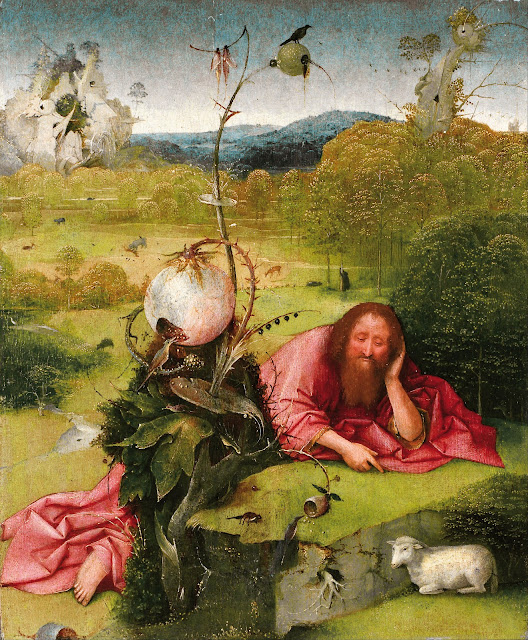

—Reflection written in 1/2001 


IMAGES: 

Hieronymus Bosch, Saint John the Baptist in the Desert (c. 1489)

Geertgen tot Sint Jans, Saint John the Baptist (c. 1490)


Saturday, May 23, 2020

Hell


M.C. Escher, Hell, Copy after Hieronymus Bosch (1935)


Hieronymus Bosch, Hell, Right Panel from The Garden of Earthly Delights (c. 1500)


Friday, May 15, 2020

Haywain Triptych


Hieronymus Bosch, The Haywain Triptych (c. 1516)

link to a high definition version (Prado version)

Tuesday, January 7, 2020

The Garden of Earthly Delights


Hieronymus Bosch, The Garden of Earthly Delights (c. 1500)

 link to a high definition version