The Death of Marcus Aurelius

The Death of Marcus Aurelius
Showing posts with label Zeno. Show all posts

Wednesday, July 22, 2026

Epictetus, Discourses 2.13.4


Therefore, Zeno was not distressed when he was going to meet Antigonus, for Antigonus had no authority over any of the things that Zeno admired, and Zeno paid no attention to the possessions of Antigonus. 
 
Antigonus was anxious when he was going to meet Zeno, and with good reason, for he wanted to please him, and this lay beyond his control; but Zeno did not wish to please Antigonus, any more than any artist cares to please one who has no skill. 
 
Do I want to please you? Why should I? Do you know the standards by which man judges man? Have you made it your study to learn what a good man is and what a bad man is, and what makes each of them so? Why, then, are you not good yourself? 
 
“Not good? What do you mean?” he replies. 
 
Why, no good man whines or groans or laments, no good man grows pale or trembles or says, “How will he receive me? What hearing will he give me?” 
 
Slave, he will do as he thinks good. What concern have you in what does not belong to you? Is it not his fault if he gives a bad reception to what you offer? 
 
“His fault, certainly.” 
 
But can the fault be one man's and the harm another's? 
 
“No.” 
 
Why, then, are you anxious about another's concerns? 

—from Epictetus, Discourses 2.13 
 
Among those many unwritten rules, we are expected to fret over pleasing our superiors, though I will rarely hear of anyone questioning what actually makes a man better or worse. Generally speaking, if someone is rich, or can slip you a favor, or might cause you some injury, you are told that you should grovel. I once lost a precious hour of my life trapped in a meeting about choosing the best birthday gift for the provost—it was getting awfully close to promotions season. 
 
By all means, give proper respect wherever it may be due, but first reflect upon your standards of merit, and do not treat fawning and fear as if they were forms of reverence. An anxiety over impressing the boss or placating the bully is a mark of weakness, not of virtue, for we dishonor both ourselves and others whenever we play such crafty games. 
 
Zeno was just an insignificant philosopher, and Antigonus was the mighty king of Macedon, yet the one felt absolutely no need to be esteemed, while the other was always worried about winning further approval. How odd that the people who make the most noise in this world will so often possess the least confidence in themselves! If only they had a greater trust in their own convictions, they would not be so moved by the opinions of their fellows. 
 
As much as I may prefer to be liked, it is not within my power to determine anyone else’s judgments. Let me carefully attend to my conscience, and whether I end up being recognized or ignored, let that stand for itself. If I win a friend, that can always serve me well, and if I make an enemy, I can continue to wish him well. Care enough to listen, without caring so much as to turn into a lackey. 
 
Even after over a decade of constant effort, I can still find this incredibly difficult; the obstacle is not, however, from any lack of fierce willpower but from a lack of calm understanding. It just goes to show how long those noxious habits can cling to us. Falling down is so easy, and standing back up is so hard.
 
I continue to feel a sting when I am insulted or rejected, and if I cling to that impression, I will invariably tumble into a pit of agitation and resentment. The only remedy I have found is to let that pesky passion be, to stop what I am doing right then and there, to take a deep breath and get my bearings. A moment of contemplation then makes the consternation seem quite ridiculous. 
 
Once again, if I can change it, there is no cause for worry, and if I can’t change it, there is no cause for worry. A deliberate decision to cease casting blame is a step in the right direction, since it removes the illusion of conflict. I will recognize the victory when the composure finally becomes like a second nature. 

—Reflection written in 8/2001 


Monday, July 13, 2026

Wisdom from the Early Stoics, Zeno of Citium 83


Of the three kinds of life, the contemplative, the practical, and the rational, the Stoics declare that we ought to choose the last, for that a rational being is expressly produced by nature both for contemplation and for action. 

They tell us that the wise man will for reasonable cause make his own exit from life, on his country’s behalf or for the sake of his friends, or if he suffer intolerable pain, mutilation, or incurable disease. 

—Diogenes Laërtius, 7.130 


Saturday, June 6, 2026

Wisdom from the Early Stoics, Zeno of Citium 82


The Stoic definition of love is an effort toward friendliness due to visible beauty appearing, its sole end being friendship, not bodily enjoyment. 

At all events, they allege that Thrasonides, although he had his mistress in his power, abstained from her because she hated him. 

By which it is shown, they think, that love depends upon regard, as Chrysippus says in his treatise Of Love, and is not sent by the gods. 

And beauty they describe as the bloom or flower of virtue. 

—Diogenes Laërtius, 7.130 

IMAGE: Alessandro Rosi, Love of Virtue (c. 1660) 


Saturday, April 11, 2026

Wisdom from the Early Stoics, Zeno of Citium 81


It is the Stoic doctrine that there can be no question of right as between man and the lower animals, because of their unlikeness. Thus Chrysippus in the first book of his treatise On Justice, and Posidonius in the first book of his De Officio

Further, they say that the wise man will feel affection for the youths who by their countenance show a natural endowment for virtue. So Zeno in his Republic, Chrysippus in book 1 of his work On Modes of Life, and Apollodorus in his Ethics

—Diogenes Laërtius, 7.129 

IMAGE: Bartolomeo Passarotti, Portrait of a Man with a Dog (c. 1585) 


Tuesday, March 3, 2026

Wisdom from the Early Stoics, Zeno of Citium 80


Another tenet of the Stoics is the perpetual exercise of virtue, as held by Cleanthes and his followers. For virtue can never be lost, and the good man is always exercising his mind, which is perfect. 

Again, they say that justice, as well as law and right reason, exists by nature and not by convention: so Chrysippus in his work On the Morally Beautiful. 

Neither do they think that the divergence of opinion between philosophers is any reason for abandoning the study of philosophy, since at that rate we should have to give up life altogether: so Posidonius in his Exhortations

Chrysippus allows that the ordinary Greek education is serviceable. 

—Diogenes Laërtius, 7.128-129 


Tuesday, January 13, 2026

Wisdom from the Early Stoics, Zeno of Citium 79


It is a tenet of the Stoics that between virtue and vice there is nothing intermediate, whereas according to the Peripatetics there is, namely, the state of moral improvement. 

For, say the Stoics, just as a stick must be either straight or crooked, so a man must be either just or unjust. 

Nor again are there degrees of justice and injustice; and the same rule applies to the other virtues. 

Further, while Chrysippus holds that virtue can be lost, Cleanthes maintains that it cannot. According to the former it may be lost in consequence of drunkenness or melancholy; the latter takes it to be inalienable owing to the certainty of our mental apprehension. 

And virtue in itself they hold to be worthy of choice for its own sake. At all events, we are ashamed of bad conduct as if we knew that nothing is really good but the morally beautiful. 

Moreover, they hold that it is in itself sufficient to ensure well-being: thus Zeno, and Chrysippus in the first book of his treatise On Virtues, and Hecato in the second book of his treatise On Goods: 

“For if magnanimity by itself alone can raise us far above everything, and if magnanimity is but a part of virtue, then too virtue as a whole will be sufficient in itself for well-being—despising all things that seem troublesome.” 

Panaetius, however, and Posidonius deny that virtue is self-sufficing: on the contrary, health is necessary, and some means of living and strength. 

—Diogenes Laërtius, 7.127-128 


Tuesday, December 2, 2025

Wisdom from the Early Stoics, Zeno of Citium 78


The Stoics hold that the virtues involve one another, and that the possessor of one is the possessor of all, inasmuch as they have common principles, as Chrysippus says in the first book of his work On Virtues, Apollodorus in his Physics according to the Early School, and Hecato in the third book of his treatise On Virtues

For if a man be possessed of virtue, he is at once able to discover and to put into practice what he ought to do. 

Now such rules of conduct comprise rules for choosing, enduring, staying, and distributing; so that if a man does some things by intelligent choice, some things with fortitude, some things by way of just distribution, and some steadily, he is at once wise, courageous, just, and temperate. 

And each of the virtues has a particular subject with which it deals, as, for instance, courage is concerned with things that must be endured, practical wisdom with acts to be done, acts from which one must abstain, and those which fall under neither head. 

Similarly each of the other virtues is concerned with its own proper sphere. To wisdom are subordinate good counsel and understanding; to temperance, good discipline and orderliness; to justice, equality and fair-mindedness; to courage, constancy and vigor. 

—Diogenes Laërtius, 7.125-126 


Thursday, October 16, 2025

Wisdom from the Early Stoics, Zeno of Citium 77


Furthermore, the wise man does all things well, just as we say that Ismenias plays all airs on the flute well. 

Also, everything belongs to the wise. For the law, they say, has conferred upon them a perfect right to all things. 

It is true that certain things are said to belong to the bad, just as what has been dishonestly acquired may be said, in one sense, to belong to the state, in another sense to those who are enjoying it. 

—Diogenes Laërtius, 7.125 


Tuesday, September 2, 2025

Wisdom from the Early Stoics, Zeno of Citium 76


Again, the Stoics say that the wise man never wonders at any of the things which appear extraordinary, such as Charon’s mephitic caverns, ebbings of the tide, hot springs, or fiery eruptions. 

Nor yet, they go on to say, will the wise man live in solitude; for he is naturally made for society and action. He will, however, submit to training to augment his powers of bodily endurance. 

And the wise man, they say, will offer prayers, and ask for good things from the gods: so Posidonius in the first book of his treatise On Duties, and Hecato in his third book On Paradoxes

Friendship, they declare, exists only between the wise and good, by reason of their likeness to one another. And by friendship they mean a common use of all that has to do with life, wherein we treat our friends as we should ourselves. 

They argue that a friend is worth having for his own sake and that it is a good thing to have many friends. But among the bad there is, they hold, no such thing as friendship, and thus no bad man has a friend. 

Another of their tenets is that the unwise are all mad, inasmuch as they are not wise but do what they do from that madness which is the equivalent of their folly. 

—Diogenes Laërtius, 7.123-124 

IMAGE: Benjamin Heinrich Orth, Three Friends (1835) 


Monday, July 21, 2025

Wisdom from the Early Stoics, Zeno of Citium 75


Again, the Stoics say that the wise man will take part in politics, if nothing hinders him—so, for instance, Chrysippus in the first book of his work On Various Types of Life—since thus he will restrain vice and promote virtue. 

Also, they maintain, he will marry, as Zeno says in his Republic, and beget children. 

Moreover, they say that the wise man will never form mere opinions, that is to say, he will never give assent to anything that is false; that he will also play the Cynic, Cynicism being a short cut to virtue, as Apollodorus calls it in his Ethics; that he will even turn cannibal under stress of circumstances. 

They declare that he alone is free and bad men are slaves, freedom being power of independent action, whereas slavery is privation of the same; though indeed there is also a second form of slavery consisting in subordination, and a third which implies possession of the slave as well as his subordination; the correlative of such servitude being lordship; and this too is evil. 

Moreover, according to them not only are the wise free, they are also kings; kingship being irresponsible rule, which none but the wise can maintain: so Chrysippus in his treatise vindicating Zeno’s use of terminology. 

For he holds that knowledge of good and evil is a necessary attribute of the ruler, and that no bad man is acquainted with this science. 

Similarly the wise and good alone are fit to be magistrates, judges, or orators, whereas among the bad there is not one so qualified. 

Furthermore, the wise are infallible, not being liable to error. They are also without offense; for they do no hurt to others or to themselves. 

At the same time they are not pitiful and make no allowance for anyone; they never relax the penalties fixed by the laws, since indulgence and pity and even equitable consideration are marks of a weak mind, which affects kindness in place of chastizing. Nor do they deem punishments too severe. 

—Diogenes Laërtius, 7.121-123 

IMAGE: Raphael, The Judgment of Solomon (c. 1519) 


Sunday, June 1, 2025

Wisdom from the Early Stoics, Zeno of Citium 74


The Stoics approve also of honoring parents and brothers in the second place next after the gods. They further maintain that parental affection for children is natural to the good, but not to the bad. 

It is one of their tenets that sins are all equal: so Chrysippus in the fourth book of his Ethical Questions, as well as Persaeus and Zeno. 

For if one truth is not more true than another, neither is one falsehood more false than another, and in the same way one deceit is not more so than another, nor sin than sin. 

For he who is a hundred furlongs from Canopus and he who is only one furlong away are equally not in Canopus, and so too he who commits the greater sin and he who commits the less are equally not in the path of right conduct. 

But Heraclides of Tarsus, who was the disciple of Antipater of Tarsus, and Athenodorus both assert that sins are not equal. 

—Diogenes Laërtius, 7.120-121 


Monday, March 3, 2025

Wisdom from the Early Stoics, Zeno of Citium 73


The good are also, it is declared, godlike; for they have a something divine within them; whereas the bad man is godless. 

And yet of this word—godless or ungodly—there are two senses, one in which it is the opposite of the term "godly," the other denoting the man who ignores the divine altogether: in this latter sense, as they note, the term does not apply to every bad man. 

The good, it is added, are also worshippers of God; for they have acquaintance with the rites of the gods, and piety is the knowledge of how to serve the gods. 

Further, they will sacrifice to the gods and they keep themselves pure; for they avoid all acts that are offenses against the gods, and the gods think highly of them: for they are holy and just in what concerns the gods. 

The wise too are the only priests; for they have made sacrifices their study, as also the building of temples, purifications, and all the other matters appertaining to the gods. 

—Diogenes Laërtius, 7.119 


Thursday, November 28, 2024

Wisdom from the Early Stoics, Zeno of Citium 72


Again, the good are genuinely in earnest and vigilant for their own improvement, using a manner of life which banishes evil out of sight and makes what good there is in things appear. 

At the same time they are free from pretense; for they have stripped off all pretense or "make-up" whether in voice or in look. 

Free too are they from all business cares, declining to do anything which conflicts with duty. 

They will take wine, but not get drunk. 

Nay more, they will not be liable to madness either; not but what there will at times occur to the good man strange impressions due to melancholy or delirium, ideas not determined by the principle of what is choiceworthy but contrary to nature. 

Nor indeed will the wise man ever feel grief; seeing that grief is irrational contraction of the soul, as Apollodorus says in his Ethics

—Diogenes Laërtius, 7.118 

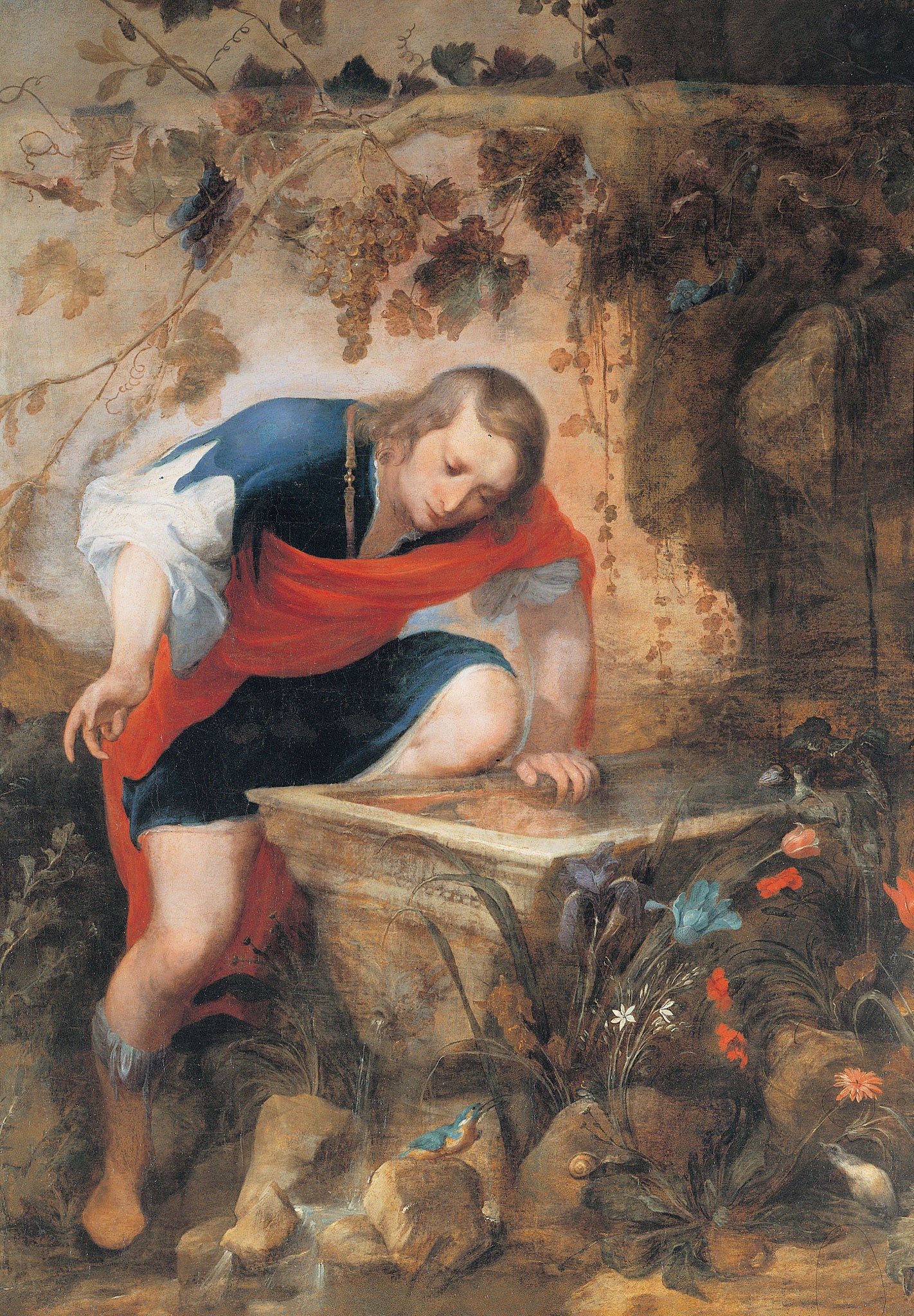
IMAGE: Jan Roos, Narcissus at the Spring (c. 1620) 


Sunday, October 13, 2024

The Hand and the Fist


I do my best not to inflict my love of epistemology, the philosophy of knowledge, on unsuspecting victims, so I will keep this brief. 

For all of the theoretical complexities, the problems really boil down to what we can truly know, and how we might come to knowing it. 

The Stoics stood apart from the Skeptics, whether Academic or Pyrrhonian, and also, to a lesser degree, from the Epicureans, by insisting that the mind possessed the power to understand the identity of things, and thereby to learn about its own place within the order of the whole. 

Such knowledge was, however, not instantaneous, and it demanded long commitment and rigorous discipline. 

The process of coming to awareness moves gradually through stages, from receiving an impression, to granting or withholding assent through belief, to comprehending how and why something is true, and to finally acquiring the certainty and conviction of wisdom. 

Given the dominant skepticism, relativism, and subjectivism of contemporary philosophical fashion, we see yet another way in which Stoicism goes against the grain. I am regularly told how we can never really know anything at all, and that hasty assumption becomes a convenient excuse for avoiding any genuine responsibility. 

A task may well be difficult, but that hardly makes it impossible. Indeed, the difficulty may itself be a mark of its merit. 

In his Academica, Cicero offers a wonderful account of how Zeno of Citium would illustrate the progress of knowledge. I find myself turning to this image, time and time again, to ground myself whenever I feel overwhelmed by confusion. One step at a time: 

Zeno would display his hand in front of one with the fingers stretched out and say "A visual appearance is like this." 

Next he closed his fingers a little and said, "An act of assent is like this." 

Then he pressed his fingers closely together and made a fist, and said that this was comprehension (and from this illustration he gave to that process the actual name of katalepsis, "grasping", which it had not had before).  

But then he used to apply his left hand to his right fist and squeeze it tightly and forcibly, and then say that such was knowledge, which was within the power of nobody save the wise man. 

IMAGE: Theo van Doesburg, Study of a Fist (c. 1906) 


Sunday, September 29, 2024

Wisdom from the Early Stoics, Zeno of Citium 71


Now the Stoics say that the wise man is passionless, because he is not prone to fall into such infirmity. 

But they add that in another sense the term apathy is applied to the bad man, when, that is, it means that he is callous and relentless. 

Further, the wise man is said to be free from vanity; for he is indifferent to good or evil report. 

However, he is not alone in this, there being another who is also free from vanity, he who is ranged among the rash, and that is the bad man. 

Again, they tell us that all good men are austere or harsh, because they neither have dealings with pleasure themselves nor tolerate those who have. 

The term harsh is applied, however, to others as well, and in much the same sense as a wine is said to be harsh when it is employed medicinally and not for drinking at all. 

—Diogenes Laërtius, 7.117 

IMAGE: Jan van Bijlert, Young Man Drinking a Glass of Wine (c. 1640) 


Tuesday, July 16, 2024

Wisdom from the Early Stoics, Zeno of Citium 70


And as there are said to be certain infirmities in the body, as for instance gout and arthritic disorders, so too there is in the soul love of fame, love of pleasure, and the like. 

By infirmity is meant disease accompanied by weakness; and by disease is meant a fond imagining of something that seems desirable. 

And as in the body there are tendencies to certain maladies such as colds and diarrhea, so it is with the soul, there are tendencies like enviousness, pitifulness, quarrelsomeness, and the like. 

Also the Stoics say that there are three emotional states which are good, namely, joy, caution, and wishing. 

Joy, the counterpart of pleasure, is rational elation. 

Caution, the counterpart of fear, is rational avoidance; for though the wise man will never feel fear, he will yet use caution. 

And they make wishing the counterpart of desire (or craving), inasmuch as it is rational appetency. 

And accordingly, as under the primary passions are classed certain others subordinate to them, so too is it with the primary eupathies or good emotional states. 

Thus under wishing they bring well-wishing or benevolence, friendliness, respect, affection; under caution, reverence and modesty; under joy, delight, mirth, cheerfulness. 

—Diogenes Laërtius, 7.115-116 

IMAGE: James Gillray, The Gout (1799) 


Friday, May 17, 2024

Wisdom from the Early Stoics, Zeno of Citium 69


According to the Stoics there is an eight-fold division of the soul: the five senses, the faculty of speech, the intellectual faculty, which is the mind itself, and the generative faculty, being all parts of the soul. 

Now from falsehood there results perversion, which extends to the mind; and from this perversion arise many passions or emotions, which are causes of instability. Passion, or emotion, is defined by Zeno as an irrational and unnatural movement in the soul, or again as impulse in excess.

The main, or most universal, emotions, according to Hecato in his treatise On the Passions, Book II, and Zeno in his treatise with the same title, constitute four great classes: grief, fear, desire or craving, pleasure. 

They hold the emotions to be judgements, as is stated by Chrysippus in his treatise On the Passions: avarice being a supposition that money is a good, while the case is similar with drunkenness and profligacy and all the other emotions. 

And grief or pain they hold to be an irrational mental contraction. Its species are pity, envy, jealousy, rivalry, heaviness, annoyance, distress, anguish, distraction. 

Pity is grief felt at undeserved suffering; envy, grief at others' prosperity; jealousy, grief at the possession by another of that which one desires for oneself; rivalry, pain at the possession by another of what one has oneself. 

Heaviness or vexation is grief which weighs us down, annoyance that which coops us up and straitens us for want of room, distress a pain brought on by anxious thought that lasts and increases, anguish painful grief, distraction irrational grief, rasping and hindering us from viewing the situation as a whole.

Fear is an expectation of evil. Under fear are ranged the following emotions: terror, nervous shrinking, shame, consternation, panic, mental agony. 

Terror is a fear which produces fright; shame is fear of disgrace; nervous shrinking is a fear that one will have to act; consternation is fear due to a presentation of some unusual occurrence; panic is fear with pressure exercised by sound; mental agony is fear felt when some issue is still in suspense. 

Desire or craving is irrational appetency, and under it are ranged the following states: want, hatred, contentiousness, anger, love, wrath, resentment. 

Want, then, is a craving when it is baulked and, as it were, cut off from its object, but kept at full stretch and attracted towards it in vain. 

Hatred is a growing and lasting desire or craving that it should go ill with somebody. 

Contentiousness is a craving or desire connected with partisanship; anger a craving or desire to punish one who is thought to have done you an undeserved injury. 

The passion of love is a craving from which good men are free; for it is an effort to win affection due to the visible presence of beauty. 

Wrath is anger which has long rankled and has become malicious, waiting for its opportunity, as is illustrated by the lines: 

Even though for the one day he swallow his anger, yet doth he still keep his displeasure thereafter in his heart, till he accomplish it.

Resentment is anger in an early stage. 

Pleasure is an irrational elation at the accruing of what seems to be choiceworthy; and under it are ranged ravishment, malevolent joy, delight, transport. 

Ravishment is pleasure which charms the ear. Malevolent joy is pleasure at another's ills. Delight is the mind's propulsion to weakness, its name in Greek (τέρψις) being akin to τρέψις or turning. To be in transports of delight is the melting away of virtue. 

—Diogenes Laërtius, 7.110-114 


Tuesday, April 2, 2024

Wisdom from the Early Stoics, Zeno of Citium 68


Furthermore, the term Duty is applied to that for which, when done, a reasonable defense can be adduced, e.g. harmony in the tenor of life's process, which indeed pervades the growth of plants and animals. For even in plants and animals, they hold, you may discern fitness of behavior

Zeno was the first to use this term καθῆκον of conduct. Etymologically it is derived from κατά τινας ἥκειν, i.e. reaching as far as, being up to, or incumbent on so and so. 

And it is an action in itself adapted to nature's arrangements. For of the acts done at the prompting of impulse some, they observe, are fit and meet, others the reverse, while there is a third class which is neither the one nor the other. 

Befitting acts are all those which reason prevails with us to do; and this is the case with honoring one's parents, brothers and country, and intercourse with friends. 

Unbefitting, or contrary to duty, are all acts that reason deprecates, e.g. to neglect one's parents, to be indifferent to one's brothers, not to agree with friends, to disregard the interests of one's country, and so forth. 

Acts which fall under neither of the foregoing classes are those which reason neither urges us to do nor forbids, such as picking up a twig, holding a style or a scraper, and the like. 

Again, some duties are incumbent unconditionally, others in certain circumstances. 

Unconditional duties are the following: to take proper care of health and one's organs of sense, and things of that sort. 

Duties imposed by circumstances are such as maiming oneself and sacrifice of property. 

And so likewise with acts which are violations of duty. 

Another division is into duties which are always incumbent and those which are not. 

To live in accordance with virtue is always a duty, whereas dialectic by question and answer or walking-exercise and the like are not at all times incumbent. 

The same may be said of the violations of duty. 

And in things intermediate also there are duties; as that boys should obey the attendants who have charge of them. 

—Diogenes Laërtius, 7.107-110 

IMAGE: Edward Leighton, Duty (1883) 


Tuesday, February 20, 2024

Wisdom from the Early Stoics, Zeno of Citium 67


To benefit is to set in motion or sustain in accordance with virtue; whereas to harm is to set in motion or sustain in accordance with vice. 

The term "indifferent" has two meanings: in the first it denotes the things which do not contribute either to happiness or to misery, as wealth, fame, health, strength, and the like; for it is possible to be happy without having these, although, if they are used in a certain way, such use of them tends to happiness or misery. 

In quite another sense those things are said to be indifferent which are without the power of stirring inclination or aversion; for example, the fact that the number of hairs on one's head is odd or even, or whether you hold out your finger straight or bent. 

But it was not in this sense that the things mentioned above were termed indifferent, they being quite capable of exciting inclination or aversion. 

Hence of these latter some are taken by preference, others are rejected, whereas indifference in the other sense affords no ground for either choosing or avoiding. 

Of things indifferent, as they express it, some are "preferred," others "rejected." Such as have value, they say, are "preferred," while such as have negative, instead of positive, value are "rejected." 

Value they define as, first, any contribution to harmonious living, such as attaches to every good. 

Secondly, some faculty or use which indirectly contributes to the life according to nature: which is as much as to say "any assistance brought by wealth or health towards living a natural life". 

Thirdly, value is the full equivalent of an appraiser, as fixed by an expert acquainted with the facts – as when it is said that wheat exchanges for so much barley with a mule thrown in. 

Thus things of the preferred class are those which have positive value, for example among mental qualities, natural ability, skill, moral improvement, and the like. 

Among bodily qualities, life, health, strength, good condition, soundness of organs, beauty, and so forth.

And in the sphere of external things, wealth, fame, noble birth, and the like. 

To the class of things "rejected" belong, of mental qualities, lack of ability, want of skill, and the like. 

Among bodily qualities, death, disease, weakness, being out of condition, mutilation, ugliness, and the like. 

In the sphere of external things, poverty, ignominy, low birth, and so forth. 

But again, there are things belonging to neither class; such are not preferred, neither are they rejected. 

Again, of things preferred some are preferred for their own sake, some for the sake of something else, and others again both for their own sake and for the sake of something else. 

To the first of these classes belong natural ability, moral improvement, and the like; to the second wealth, noble birth, and the like. 

To the last strength, perfect faculties, soundness of bodily organs. 

Things are preferred for their own sake because they accord with nature; not for their own sake, but for the sake of something else, because they secure not a few utilities. And similarly with the class of things rejected under the contrary heads. 

—Diogenes Laërtius, 7.104-107 

IMAGE: Friedrich Friedländer, A Difficult Decision (c. 1870)