The Death of Marcus Aurelius

The Death of Marcus Aurelius

Sunday, September 6, 2020

Vanitas 20


Cornelius Norbertus Gijsbrechts, Trompe l’oeil Studio Wall with a Vanitas Still Life (1664)


Saturday, September 5, 2020

Virtues in Sculpture


Jacques Du Broeucq, The Four Cardinal Virtues and The Three Theological Virtues (c. 1545)


Wisdom from the Bhagavad Gita 20


The Blessed Lord said:

1. He who performs his bounden duty without leaning to the fruit of action—he is a renouncer of action as well as of steadfast mind: not he who is without fire, nor he who is without action.

2. Know that to be devotion to action, which is called renunciation, O Pândava, for none becomes a devotee to action without forsaking Sankalpa (Resolution).

3. For the man of meditation wishing to attain purification of heart leading to concentration, work is said to be the way: For him, when he has attained such concentration, inaction is said to be the way.

4. Verily, when there is no attachment, either to sense-objects, or to actions, having renounced all Sankalpas, then is one said to have attained concentration.

5. A man should uplift himself by his own self, so let him not weaken this self. For this self is the friend of oneself, and this self is the enemy of oneself.

6. The self,the active part of our nature, is the friend of the self, for him who has conquered himself by this self. But to the unconquered self, this self is inimical, and behaves like an external foe. 

7. To the self-controlled and serene, the Supreme Self is, the object of constant realization, in cold and heat, pleasure and pain, as well as in honor and dishonor.

8. Whose heart is filled with satisfaction by wisdom and realization, and is changeless, whose senses are conquered, and to whom a lump of earth, stone, and gold are the same: that Yogi is called steadfast.

9. He attains excellence who looks with equal regard upon well-wishers, friends, foes, neutrals, arbiters, the hateful, the relatives, and upon the righteous and the unrighteous alike.

—Bhagavad Gita, 6:1-9

Musonius Rufus, Lectures 15.3


And that raising many children is an honorable and profitable thing one may gather from the fact that a man who has many children is honored in the city, that he has the respect of his neighbors, that he has more influence than his equals if they are not equally blest with children.

I need not argue that a man with many friends is more powerful than one who has no friends, and so a man who has many children is more powerful than one without any or with only a few children, or rather much more so, since a son is closer than a friend.

I have seen some people break out into mocking laughter when I have shared this passage with them.

“Seriously? He thinks that children are somehow profitable? He thinks that children will win me some respect? He thinks that children will give me more power? This guy must be crazy!”

Properly define profit, or respect, or power. The misunderstanding will be found right there.

Will a child make me rich? Rich in spirit, certainly, even if not in money. It all depends on what we think is truly worth possessing.

Will a child give me a better reputation? Yes, it will bring me honor with people of character, the ones whose judgments we should take to heart.

Will a child offer me greater strength? The love for my offspring will provide me with more power to live according to virtue, the only sort of power that really matters.

I can think of how great a blessing it is to have friends, and then I can think of how much more of a blessing it is to have children. In both cases, and in increasing degrees, I am given the opportunity to be more fully human, to exercise all of the qualities that allow me to live well and be happy.

I could merely look at a friend as an amusement or convenience for myself, or at a child as an extension of my own wishes, and yet that would only make me a worse man.

Another option is open to me, that I consider a friend as someone to offer my love, and a child as someone to offer every last bit of my love. I can learn to be more just through a friend, while I can learn what it means to sacrifice absolutely everything for a child.

I can make myself better by helping other people to be better, where the practice of moral worth is the greatest gain, the most complete reward.

Is there really profit, respect, or power in any of that? The grasping man, the fellow committed to his station in life, may not think so, but I’ve decided on a different path, a commitment to what I can give, not to what I might receive.

Written in 2/2000

Thursday, September 3, 2020

Stoic Snippets 32


Whatever happens at all happens as it should; you will find this true, if you watch carefully. 

—Marcus Aurelius, Meditations 4.10

Abandoned Places 5


Nature 7


Boethius, The Consolation of Philosophy 5.6


“But I do not lay down that this is equal in all beings. Heavenly and divine beings have with them a judgment of great insight, an imperturbable will, and a power which can effect their desires.

“But human spirits must be more free when they keep themselves safe in the contemplation of the mind of God; but less free when they sink into bodies, and less still when they are bound by their earthly members.

“The last stage is mere slavery, when the spirit is given over to vices and has fallen away from the possession of its reason. For when the mind turns its eyes from the light of truth on high to lower darkness, soon they are dimmed by the clouds of ignorance, and become turbid through ruinous passions; by yielding to these passions and consenting to them, men increase the slavery which they have brought upon themselves, and their true liberty is lost in captivity.

“But God, looking upon all out of the infinite, perceives the views of Providence, and disposes each as its destiny has already fated for it according to its merits: ‘He looketh over all and heareth all.’”

—from Book 5, Prose 2

Perhaps it was simply my eccentric interest in all things medieval, but I was immediately taken by the concept of the “Great Chain of Being”. I had a college professor, a scholar of the old school, who described it with such brilliance and beauty that I could not help but come across it wherever I went. I deeply miss that man; you won’t find ones like that anymore.

I would look at all the scenes that passed before me in life, and I would suddenly no longer see a messy hodgepodge. I noticed how things fit together, both in the horizontal and in the vertical, each part playing a role, each part in the service of the whole.

Who needs all those fancy drugs when you can start thinking like that?

I could blow my own mind by watching a dog chase a cat, or a man mow a lawn, or hundreds of people milling about their business. There was actually an order, a pattern to it all, even when the pieces did not necessarily understand what they were doing.

From the boundless and immovable center, that which alone can properly be called Being, there are many emanations. They differ in the degrees of their perfection, some containing this, and other containing that, and yet they are all intended for a reason.

Go closer to the source, and creatures become more complete. Go further from the source, and they become less complete. A rock is not a fern, and a fern is not a slug, and a slug is not man. In the end, a man is most certainly not a god.

“How dare you say that a man is better than a slug!”

Nothing that is meant to be is, strictly speaking, any better than anything else, for the simple reason that is meant to be, by its own nature. No, in the way these things exist they are either more or less independent, and therefore more or less free.

The rock does not think at all, and it is only moved by other things. The fern has life, though it only grows and reproduces. The slug has sensation, but it has no consciousness. A man, however, possesses reason, and so he also possesses choice.

Does this make man the pinnacle of creation? Hardly. Above him, think of creatures of pure intellect and will, not bound to a body as we understand it, and so not limited by mortality. Now think of what is even above that, and there you will find God, the ultimate principle and measure, that by which all other things exist.

Where there is more self-sufficient being, there is also greater freedom.

Human nature fits in a wonderful place, and also a frightening place, a sort of point in the middle. My mind can rise to the highest highs, if only I allow myself to do so. My mind can also fall to the lowest lows, if only I allow myself to do so.

Sometimes I will feel called to greatness by my soul, and at other times I will feel dragged down by the weakness of my body. These two aspects of myself should work together, but I will often get the priorities confused.

The irony of it all is that I am the one who actually chooses whether I am free or a slave, at least in the ways that matter. My own judgements and decisions will determine that. Which part of myself will I allow to rule me?

Am I miserable because of my circumstances? Yes, I am beholden to them, but that was my choice to begin with. I could have chosen very differently.

I can still choose very differently now, while it remains in my power. I am sharing and participating in my fate.

Written in 1/2016

IMAGE: The Chain of Being


The Stages of Life


Caspar David Friedrich, The Stages of Life (c. 1834)


Wisdom from the Early Stoics, Zeno of Citium 20


Diogenes of Ptolemas, it is true, begins with Ethics; but Apollodorus puts Ethics second, while Panaetius and Posidonius begin with Physics, as stated by Phanias, the pupil of Posidonius, in the first book of his Lectures of Posidonius. 

Cleanthes makes not three, but six parts, Dialectic, Rhetoric, Ethics, Politics, Physics, Theology. But others say that these are divisions not of philosophic exposition, but of philosophy itself: so, for instance, Zeno of Tarsus. 

Some divide the logical part of the system into the two sciences of rhetoric and dialectic; while some would add that which deals with definitions and another part concerning canons or criteria: some, however, dispense with the part about definitions.

Now the part which deals with canons or criteria they admit as a means for the discovery of truth, since in the course of it they explain the different kinds of perceptions that we have. And similarly the part about definitions is accepted as a means of recognizing truth, inasmuch as things are apprehended by means of general notions. 

Further, by rhetoric they understand the science of speaking well on matters set forth by plain narrative, and by dialectic that of correctly discussing subjects by question and answer; hence their alternative definition of it as the science of statements true, false, and neither true nor false.

Rhetoric itself, they say, has three divisions: deliberative, forensic, and panegyric.

Rhetoric according to them may be divided into invention of arguments, their expression in words, their arrangement, and delivery; and a rhetorical speech into introduction, narrative, replies to opponents, and peroration.

Dialectic, they hold, falls under two heads: subjects of discourse and language. 

And the subjects fall under the following headings: presentations and the various products to which they give rise, propositions enunciated and their constituent subjects and predicates, and similar terms whether direct or reversed, genera and species, arguments too, moods, syllogisms and fallacies whether due to the subject matter or to the language; these including both false and true and negative arguments, sorites and the like, whether defective, insoluble, or conclusive, and the fallacies known as the Veiled, or Horned, No man, and The Mowers.

The second main head mentioned above as belonging to Dialectic is that of language, wherein are included written language and the parts of speech, with a discussion of errors in syntax and in single words, poetical diction, verbal ambiguities, euphony and music, and according to some writers chapters on terms, divisions, and style.  

—Diogenes Laërtius, 7.41-44

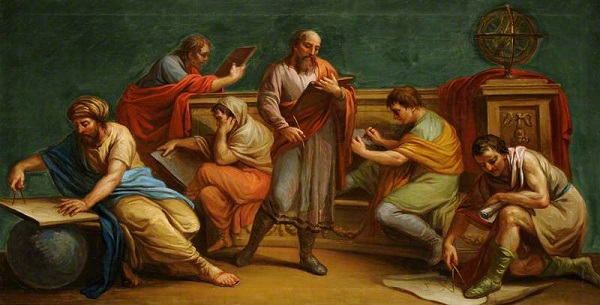
IMAGE: Antonio Zucchi, A Greek Philosopher and His Disciples (1767)

Wednesday, September 2, 2020

Sayings of Ramakrishna 33


At a certain stage of his path of devotion, the devotee finds satisfaction in God with form; at another stage, in God without form. 

Musonius Rufus, Lectures 15.2


How, then, can we avoid doing wrong and breaking the law if we do the opposite of the wish of the lawgivers, godlike men and dear to the gods, whom it is considered good and advantageous to follow?

And certainly, we do the opposite if we avoid having many children. How can we help committing a sin against the gods of our fathers and against Zeus, guardian of the race, if we do this?

For just as the man who is unjust to strangers sins against Zeus, god of hospitality, and one who is unjust to friends sins against Zeus, god of friendship, so whoever is unjust to his own family sins against the gods of his fathers and against Zeus, guardian of the family, from whom wrongs done to the family are not hidden, and surely one who sins against the gods is impious.

Now an appeal to piety? What else could Musonius possibly do to go further against the grain of modernity?

The Divine here, however, is not just some clever crutch to prop up this or that set of arbitrary social customs. The Divine is the Mind behind the order and purpose of everything, that which binds the world together, the meaning of the totality.

When I have the courage to do what is right, to follow the calling of my own nature, then I will also find myself in harmony with all of Nature. Therefore, whenever I act with virtue, with understanding and with love, I also act with piety.

I cannot help but be reverent to God as long as I pursue virtue. By extension, I cannot help but be irreverent to God as long as I follow vice.

Whatever name we may give it, the Divine is present in every expression of justice. The Divine is further present in every act of friendship. The Divine is even more deeply present in every bonding with the family.

As I narrow the circle, from my responsibility to all people, to my responsibility to those who immediately live around me, to my responsibility to my own flesh and blood, the degree of piety increases.

Where there is fairness, there you will also find God. Where there is a personal fellowship, you will find a bit more of God. Where there is the love between parents and children, there you will find perhaps the greatest presence of God on this Earth. The greater the love, the greater the holiness.

I must not confuse this with spouting noble words, while turning my back on the needs of any person at all. I must not replace friendship with mere utility. I must not look at my family as something made to serve me, but as something I am made to serve.

Please don’t tell me that Jesus, or Krishna, or the Buddha are just a bunch of pretty stories. In each case, even if it is manifest in very different ways, the Universal was brought forth. The Divine was made present in something human, reminding us how the love of neighbor and the love of God go hand in hand. To love the whole is to love the part, and to love the part is to love the whole.

I learn, more and more, that if I can’t find the face of God in the people around me, then I also won’t manage to treat them with the unconditional respect that they deserve. The smaller scene is merely a part of the bigger picture.

No man or woman should ever be a mere convenience, and no child should ever be treated like a burden. Zeus is honored when the most helpless life is honored.

Written in 2/2000


Tuesday, September 1, 2020

Sayings of Socrates 42


He could afford to despise those who scoffed at him. He prided himself on his plain living, and never asked a fee from anyone. 

He used to say that he most enjoyed the food which was least in need of condiment, and the drink which made him feel the least hankering for some other drink; and that he was nearest to the gods in that he had the fewest wants. 

This may be seen from the Comic poets, who in the act of ridiculing him give him high praise. Thus Aristophanes:

O man that justly desirest great wisdom, how blessed will be thy life amongst Athenians and Greeks, retentive of memory and thinker that thou art, with endurance of toil for thy character; never art thou weary whether standing or walking, never numb with cold, never hungry for breakfast; from wine and from gross feeding and all other frivolities thou dost turn away. 

Ameipsias too, when he puts him on the stage wearing a cloak, says:

a. You come to join us, Socrates, worthiest of a small band and emptiest by far! You are a robust fellow. Where can we get you a proper coat?
b. Your sorry plight is an insult to the cobblers.
a. And yet, hungry as he is, this man has never stooped to flatter. 

This disdainful, lofty spirit of his is also noticed by Aristophanes when he says:   

Because you stalk along the streets, rolling your eyes, and endure, barefoot, many a hardship, and gaze up at the clouds. 

And yet at times he would even put on fine clothes to suit the occasion, as in Plato's Symposium,where he is on his way to Agathon's house.

—Diogenes Laërtius, Lives of the Eminent Philosophers 2.27-28

Musonius Rufus, Lectures 15.1


Lecture 15: Should every child that is born be raised?

Is it not true that the lawgivers, whose special function it was by careful search to discern what is good for the state and what is bad, what promotes and what is detrimental to the common good, all considered the increase of the homes of the citizens the most fortunate thing for the cities and the decrease of them the most shameful thing?

And when the citizens had few or no children, did they not regard it as a loss, but when they had children, yes, plenty of them, did they not regard it as a gain?

So it was for this reason that they forbade women to suffer abortions and imposed a penalty upon those who disobeyed; for this reason they discouraged them from choosing childlessness and avoiding parenthood, and for this reason they gave to both husband and wife a reward for large families, and set a penalty upon childlessness.

I believe this the last of the politically uncomfortable lectures from Musonius, the ones my old professor would not dare to teach in class, because the Pharisees of our age would have nailed him to the wall.

All of Musonius’ lectures are politically uncomfortable, of course, if we only bother to dig beneath the surface. We don’t like doing that, however, so the rest of his lectures are safe, at least for the moment. Only certain “trigger phrases” get us upset.

This passage at first confused me quite a bit, since the “lawgivers” I know would actually prefer it if there were fewer people about. They judge a society by its efficiency, not by its charity, and so having a few wealthy taxpayers is preferable to having more mouths to feed.

The “law” that Musonius describes seems downright insane to our supposedly enlightened age.

This what they tell me:

Consume as much as you can, but produce as little as you have to. Take what you think is yours, but leave the rest to fend for themselves. Have sex whenever you want, but divorce it from its natural context and consequences. Make a child when it is convenient, but dispose of it when it is inconvenient.

Gratify yourself first, and then ask the questions later.

Again, I will usually no longer debate about sex, or family, or abortion with most people, not because these matters are unimportant, but because what is important needs to go back much further, a good three or four steps, to the first principles about what is truly good in this life.

The “law” that Musonius describes begins with something quite contrary to our current customs.

Stoic values, those grounded in Nature instead of selfish profit, are actually deeply countercultural. This is why I have little patience for the current fad of Hipster Stoicism, which glorifies the word but not the task, which wants to maintain all the current conveniences and change nothing of substance in the soul.

A Stoic “law”, not one of coercion but one of conscience, looks at a human life from a different angle. What makes a life, any life at all, worth living? The chance to live well. What makes for such a good life? It will involve none of the usual suspects.  

Virtue makes us good, not pleasure. Virtue makes us good, not wealth. Virtue makes us good, not power. Virtue makes us good, not fame. Give a person the chance to live with wisdom and with love, whatever the other circumstances may be, and everything else is only a footnote.

But how do we raise our children, the few that we still choose to have? To be satiated, to be rich, to be influential, to be admired. We will now obviously have fewer children, not because there isn’t enough to go around, but because we are unwilling to give, unwilling to share what we already have.

“But there are too many people in the world!”

No, there is not enough love in the world. Nature gives us all what we need, if only some didn’t take more than they deserved.

Musonius understood how a society that refuses to procreate is a society that is killing itself. Such a society has all of its priorities confused, because love is no longer the law.

Lust is then the law. I am foolishly looking to the wrong lawgivers.

Written in 2/2000


Monday, August 31, 2020

Tao Te Ching 67


All the world says that, while my Tao is great, it yet appears to be inferior to other systems of teaching. Now it is just its greatness that makes it seem to be inferior. If it were like any other system, for long would its smallness have been known!

But I have three precious things which I prize and hold fast. The first is gentleness; the second is economy; and the third is shrinking from taking the precedence of others.

With that gentleness I can be bold; with that economy I can be liberal; shrinking from taking the precedence of others, I can become a vessel of the highest honor. 

Nowadays they give up gentleness and are all for being bold; economy, and are all for being liberal; the hindmost place, and seek only to be foremost—of all which the end is death.

Gentleness is sure to be victorious even in battle, and firmly to maintain its ground. Heaven will save its possessor, by his very gentleness protecting him.

IMAGE: Muxi Fachang, Lao Tzu (13th century)


Seneca, On Peace of Mind 15.6


In one's own misfortunes, also, one ought so to conduct oneself as to bestow upon them just as much sorrow as reason, not as much as custom, requires: for many shed tears in order to show them, and whenever no one is looking at them their eyes are dry, but they think it disgraceful not to weep when everyone does so.

So deeply has this evil of being guided by the opinion of others taken root in us, that even grief, the simplest of all emotions, begins to be counterfeited.

Though they will rarely admit it, many people will express an emotion, whether of joy or of sadness, for the sake of appearances. They can become quite adept at manipulating impressions, to the point where it almost looks sincere.

If I dwell on this in others, however, it will only breed resentment within me, so, as always, it is best for me to work on my own integrity. I should certainly be wary of another’s crocodile tears, yet I should be most concerned about never fabricating any lies of my own.

I do wonder how I should present myself to others, whether I feel elated or despondent, and then I remember that it is more important for me to be good than to seem good. Who I am on the outside should mirror who I am on the inside, and I will only get myself into trouble when the two are at odds with one another.

It can a bit more difficult when it comes to responding to the joy or pain of others, but most especially if they are suffering. I know that I am expected to say all sorts of things, whether or not I actually mean them, and I will then struggle with choosing my words.

What is the best way to say that I am sorry, that I am mourning with you, that I am there for you?

A few simple rules have always been helpful for me:

I should think before I speak, being sure that I am coming from genuine love and understanding. Just winging it won’t do. Better to be completely silent that spout nonsense.

Less is often more. A single gesture from the heart is far greater than many fancy lines copied from a playbook. Instead of writing a flowery eulogy for the crowd, spend a moment of absolute commitment.

Whatever I should say, it should be said in private, where no one else is around to see or to hear, to ensure that it serves one purpose and one purpose only, that of fulfilling my compassion for a friend.

Perhaps most important of all, it will mean nothing if actions do no follow from the words. If necessary, drop the words entirely, and go straight to the actions. A helping hand is far more powerful than the promise of a helping hand.

When I offer comfort, am I just stroking my own ego, or do I really mean it? As we said in the 1980’s, “where’s the beef?”

Moaning, wailing, or wallowing only make matters worse. Fancy speeches are just window dressing. How am I assisting other human beings to strengthen their happiness, instead of only encouraging further pain?

Grief is not a game to be played. Grief does not have to be the end of it all. Grief is deeply painful, but it is still an opportunity to know and to love all the more. Saying that isn’t enough; transforming the suffering into joy is necessary.

No more crocodile tears.

Written in 12/2011

Sunday, August 30, 2020

Allegory of Justice


Albrecht Dürer, An Allegory of Justice (1498)

The Wisdom of Solomon 6:1-11


[1] Listen therefore, O kings, and understand;
learn, O judges of the ends of the earth.
[2] Give ear, you that rule over multitudes,
and boast of many nations.
[3] For your dominion was given you from the Lord,
and your sovereignty from the Most High,
who will search out your works and inquire into your plans.
[4] Because as servants of his kingdom you did not rule rightly,
nor keep the law,
nor walk according to the purpose of God,
[5] he will come upon you terribly and swiftly,
because severe judgment falls on those in high places.
[6] For the lowliest man may be pardoned in mercy,
but mighty men will be mightily tested.
[7] For the Lord of all will not stand in awe of anyone,
nor show deference to greatness;
because he himself made both small and great,
and he takes thought for all alike.
[8] But a strict inquiry is in store for the mighty.
[9] To you then, O monarchs, my words are directed,
that you may learn wisdom and not transgress.
[10] For they will be made holy who observe holy things in holiness,
and those who have been taught them will find a defense.
[11] Therefore set your desire on my words;
long for them, and you will be instructed.


Seneca, On Peace of Mind 15.5


Yet it is better to accept public morals and human vices calmly without bursting into either laughter or tears; for to be hurt by the sufferings of others is to be forever miserable, while to enjoy the sufferings of others is an inhuman pleasure, just as it is a useless piece of humanity to weep and pull a long face because someone is burying his son.

There is a great danger, however, in laughing or crying for all the wrong reasons.

Sometimes my smiling is not from cheerfulness, but from condescension.

Sometimes my frown is not from sympathy, but from despair.

The intentions behind the expressions are far more important than just the expressions themselves.

It is best, in the end, not to let any extreme emotion lead me about by the nose, but to find a constant and peaceful center.

I am an admittedly odd fellow, and I am often told that I think far too much, yet I still can’t help but notice how both laughter and tears can arise from either healthy or unhealthy motives.

I may assume, for example, that laughing is all about fellowship and joviality, or that crying is all about compassion and understanding. That is, sadly, not always the case.

Now my evidence is only anecdotal, but when I look back at my life, I find that most of the laughter I saw was about a sense of power that came from mocking and dismissing others, and most of the tears I saw were signs of the deepest self-pity, the stroking of a sense of wounded vanity.

In either case, people too often laugh out of pride, and they too often cry out of pride. I am fairly certain we can do better than that.

I unfortunately have a very vivid memory, and so past events will often seem more vivid to me than those right here in the present. I have been laughed at more often than I can count, and I have cried for myself more often than I can count. It was no good when others chose to degrade me, and it was no good when I chose to degrade myself.

It is easier for me to understand how ridicule is a reflection of my arrogance, while it is more difficult for me to understand how wallowing is a reflection of my arrogance. Nevertheless, when I care only for a most glorious me, they are both much the same, two sides of the same coin.

Do I make myself bigger by making others smaller? My misguided anger or my misguided grief will do precisely that on the inside, even as they may look quite attractive on the outside.

Written in 12/2011

Saturday, August 29, 2020

Stoic Snippets 31


That which makes a man no worse than he was makes his life no worse: it has no power to harm, without or within. 

—Marcus Aurelius, Meditations 4.8