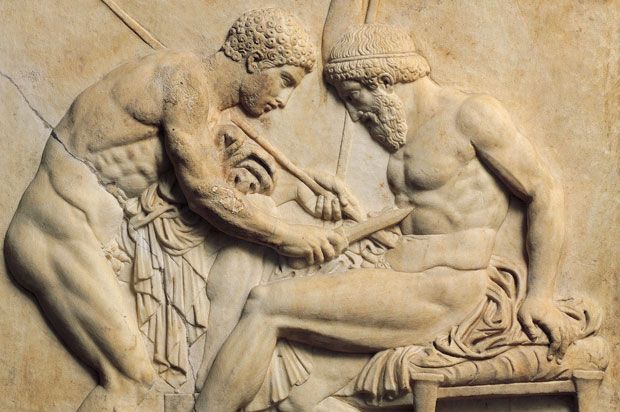
The Death of Marcus Aurelius

The Death of Marcus Aurelius

Friday, May 8, 2020

Seneca, On Peace of Mind 9.6


Thus in the houses of the laziest of men you will see the works of all the orators and historians stacked upon bookshelves reaching right up to the ceiling. At the present day a library has become as necessary an appendage to a house as a hot and cold bath.

I would excuse them straightway if they really were carried away by an excessive zeal for literature; but as it is, these costly works of sacred genius, with all the illustrations that adorn them, are merely bought for display and to serve as wall furniture.

Is it bad for me to love my books? Not at all. What matters is why I love them, and toward what end I will put them to use. It will be similar with most every other thing I come across in this world, in that I must decide where I will find its meaning and value, and how I will go about respecting what is good within it.

Some people treat a job as a way to increase their influence, and other people treat it as a way to be of service. Some people consider possessions to be ends, and other people consider them to be means. Some people will look at their friends and ask what they can receive, and other people will look at their friends and ask what they can give.

So it also is with learning in general, and with books in particular. The inner life of a man will become clearer by observing how he relates to the power of understanding, whether he employs it to glorify himself, or to glorify the truth.

I seem to notice more and more how certain people are engrossed in playing a grand role in life; what is important to them is not who they are or what they are doing, but how they are perceived and what they are seen to be doing.

It is common not just in the world of entertainment, but in business, politics, and academics as well, where acting skills are thought of as more profitable than living skills.

I have become so conscious of the tendency that I will often go out of my way not to deliberately promote or advertise myself. As much as I enjoy being admired and recognized, I think it more important to first practice integrity; I should be in the business of working on my merits, not the selling of impressions. Perhaps I am too weak, but it is too easy for me to get these things confused, to flip necessity with preference.

If a man is a liar in his trade, I think it likely that he will also be a liar in the other aspects of his life, and so I am hesitant to trust him. It is the danger of what my daughter calls being “such a fake”, of failing to be true to others because one can’t even be true to oneself.

My own library is hardly extensive, and I am at the point where a volume must be passed on to someone else before a new one might be added, but there are still times when someone will look at my shelves and ask, “Have you read all of these books?”

That is what the books are for, I tell myself, and I suppose I could take offense at the question, but I need to remember that books, like framed diplomas, are decorations for most people, sometimes even symbols of vanity.

They will really only matter to me if I read them, not in public but in private, and if they help me to improve myself, not in my appearance but in my character.

“If you see any with a layer of dust on them, you are free to take them. I ask only that you not sell them, and that you not let them stay dusty.” 

Written in 10/2011

Wednesday, May 6, 2020

The Art of Peace 52


To injure an opponent is to injure yourself. 

To control aggression without inflicting injury is the Art of Peace. 

Musonius Rufus, Lectures 9.12


These things I used to repeat to myself and I say them to you now. If you are wise, you will not consider that exile is a thing to be dreaded, since others bear it easily, but that evil is to be dreaded. It makes wretched every man in whom it is present.

And neither of the two necessary alternatives is a just cause for repining. For either you were banished justly or unjustly.

If justly, how can it be right or fitting to feel aggrieved at just punishment?

If unjustly, the evil involved is not ours, but falls upon those who banished us—if in fact you agree that doing a wrong (as they have done) is the most hateful thing in the world, while suffering a wrong (as has been our fate) in the eyes of the gods and of just men is held a ground not for hate but for help.

What I have come to call “making a Stoic turn” is a fundamental shift of priorities, far more transformative than changing a career, or finding new friends, or moving to a new town. It involves a complete rebuilding of the self, from the bottom up, based upon living with Nature instead of following mere convention, caring for what I do more than what is done to me, and defining myself by the goods of the soul over the goods of the body.

I will only understand what Musonius tells me if I look at my life from this perspective. Others will surely find me ridiculous, but I will have found for myself a source of unassailable happiness, confident that while anything around me can change or be taken away, I will still possess power over my own character.

Musonius would remind himself that he should fear evil within his own soul far more than any form of exile, and I hope I am in good company when I cling to this same principle, each and every day.

Another rule I keep ready to hand, one that has helped me more often than I can count, is to directly confront my eagerness to complain. When I do not enjoy a situation, I will feel frustration, and when I am angry, I am inclined to cast blame.

“If only this had not happened, or if only that person had acted differently, my life would be so much better!” Careful. If I am brutally honest with myself, I will remember that I am the only one who determines how I choose to live, and so I am the only one who is responsible for my happiness.

Keeping this in mind, all the incrimination can pass away. Either it is something I can fix for myself, so I should get down to it, or it is something I can do nothing about, so my resentment affects only my own serenity.

Say that I have been exiled or cast aside, and I am tempted to point the finger for my perceived loss. There are really only two options for the situation I find myself in, and neither one justifies anxiety or despair. I can’t help but smile at how Stoicism always puts me in win-win situations, if only I take the time and effort to understand myself correctly.

First, I may have done wrong myself, in which case I should rightly pay a just retribution for my errors, and take up the opportunity to redeem myself. If it is a punishment for my sins, let me use exile as a means for undoing what I have done. A penalty is only unbearable when I do not embrace my need to return what I owe.

Second, another may have done wrong to me, in which case the weight does not rest upon me. I can still find in my struggle the chance to become more just myself, even as someone else may have treated me unjustly, and so I may transform his vice into my own virtue. Who is truly hurt? I have lost my fortune, but he has lost his character.

I admittedly have obscure and eccentric interests when it comes to narratives, but I am drawn to them not because they are unknown, but because I think they contain wisdom that should be more widely known.

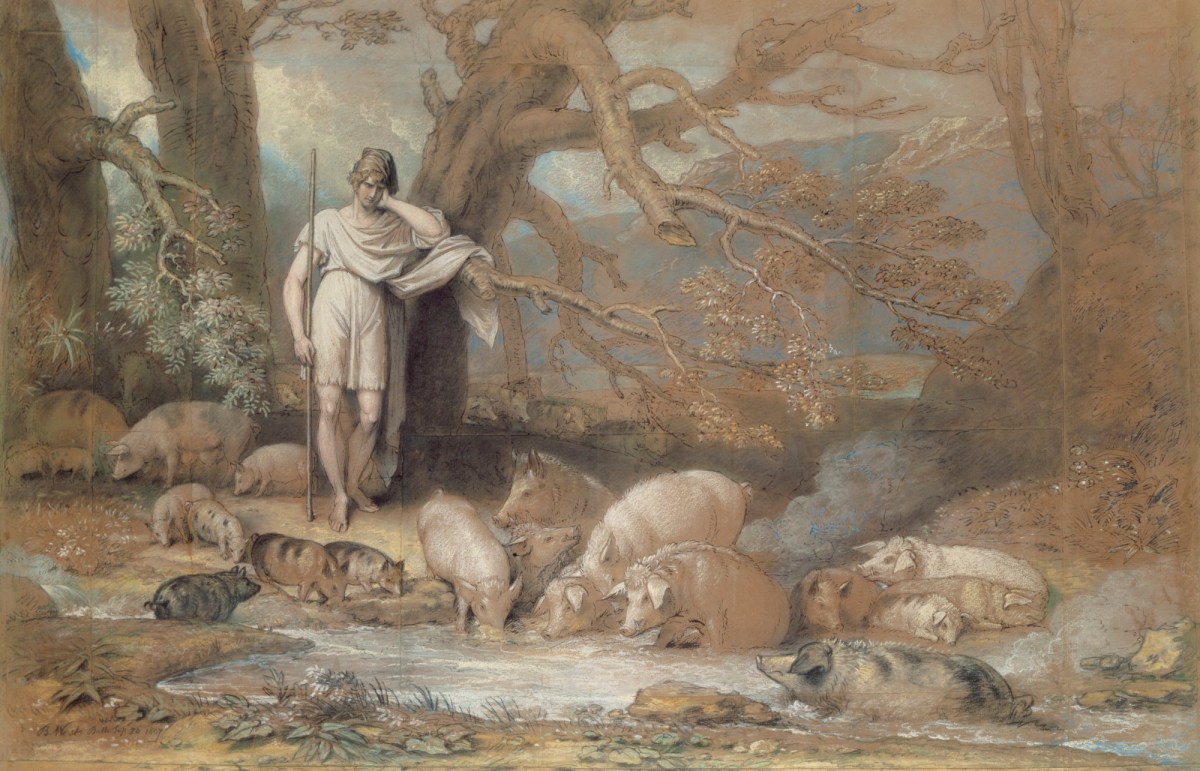
One of these is the legend of Bladud, a prince in ancient Britain who was set to inherit the crown from his father. He contracted leprosy, however, and was exiled from the kingdom, reduced to becoming a swineherd in the wilderness, separated from all he had previously known.

He noticed that his pigs would roll about in the mud by some hot springs, and that this seemed to cure any ailments they had. He bathed in the water himself, only to find that that his leprosy had disappeared. Later, after assuming the throne, he established the city of Bath on the site of the springs, in gratitude for his healing, and for the health of his people.

Yes, it has the happy ending, where the hero’s rights are in this case restored, but what always struck me about the story is the way exile gave the young Bladud not only the opportunity to heal his body, but also to improve his soul, to use his experience to be of service to others.

If Bladud could become a better man by spending some time with pigs in the mud, so can any one of us. Blessings and curses are not in events themselves, but in our estimation of events. 

Written in 12/2016 

IMAGE:Benjamin West, Bladud in Exile (1807)

Monday, May 4, 2020

The Death of Seneca in Art


Peter Paul Rubens (1613) 
School of Gerard van Honthorst (c.1625)
Jacques de l'Ange (c.1650)
Luca Giordano (c.1685)
Noel Halle (1750)
Jacques-Louis David (1773)
Manuel Dominguez Sanchez (1871)

Fragments of Parmenides 7


Come now, I will tell you—and do you hearken to my saying and carry it away—the only two ways of search that can be thought of. 

The first, namely, that It is, and that it is impossible for it not to be, is the way of belief, for truth is its companion. 

The other, namely, that It is not, and that it must needs not be—that, I tell you, is a path that none can learn of at all. 

Musonius Rufus, Lectures 9.11


The reflections that I employ for my own benefit so as not to be irked by exile, I should like to repeat to you.

It seems to me that exile does not strip a man entirely, not even of the things which the average man calls goods, as I have just shown. But if he is deprived of some or all of them, he is still not deprived of the things which are truly goods.

Certainly the exile is not prevented from possessing courage and justice simply because he is banished, nor self-control, nor understanding, nor any of the other virtues which when present serve to bring honor and benefit to a man and show him to be praiseworthy and of good repute, but when absent, serve to cause him harm and dishonor and show him to be wicked and of ill-repute.

Since this is true, if you are that good man and have his virtues, exile will not harm or degrade you, because the virtues are present in you which are most able to help and to sustain you. But if you are bad, it is the evil that harms you and not exile; and the misery you feel in exile is the product of evil, not of exile. It is from this you must hasten to secure release rather than from exile.

On my bad days, I am tempted to feel a resentment toward those who are so proud to offer empty advice. Sometimes they insist that they can provide the rules of success and happiness, even as they speak nothing about Nature, and offer no measure of right and wrong. At other times they tell me all about how the world really works, though they are quite oblivious to the immediate circumstances that most people must face.

But why grow angry at them for what they don’t know? I recall that whenever I am terribly mistaken, no amount of condemnation has ever helped me. Encouragement has helped me, compassion has helped me, being taught by example has helped me.

I am accordingly grateful for the advice of Musonius, so different from most any of the advice I have heard before. I obviously never met the man, but from what he tells me, I suspect that I can trust him.

He shows me that he has a moral compass, that he views the worth or our lives through the characteristics that define us as human, the powers of reason and choice. He also shows me that he is grounded in the real world, that he is acutely aware of the struggles of everyday living. His theory and his practice fit together, and he points straight to the simple essence of human happiness.

So concerned that my contentment must rely upon the things that happen to me, I will worry that any sort of hardship, like poverty, or disease, or the exile discussed in this lecture, will make it impossible for me to live a good life. It may seem so obvious, but I will still neglect to address the critical questions: what really is good for me, and what place do my circumstances play in that good?

Musonius first reminds me that some changes in my situation might be drastic, but this does not mean that they will necessarily reduce my fortune. I may lose some worldly possessions, but I may also gain others, and my own resourcefulness and self-reliance will make the biggest difference. Events are never good and bad in themselves, but become good or bad by how I learn to use them as an opportunity.

Yet given that so many of my conditions are ultimately beyond my power, what am I to do when they stubbornly refuse to conform to my preferences? Here is where Musonius offers his second, and more fundamental, point: it will hardly matter if I lose what I prefer, because that is not what will make or break me.

Nothing can stop me from practicing the virtues, from being understanding, brave, temperate, and just, and so nothing can infringe on what defines my very humanity. Whether the externals come or go, their value depends entirely on the content of my character. Wealth will not make a wicked man good, just as poverty will not make a good man wicked.

What is lower becomes worthy through its conformity to the higher, and so my circumstances do not make something of me, but I make something of my circumstances.

I have a vivid memory from childhood of seeing a painting of Napoleon, on board a ship taking him into final exile on St. Helena. I was only a pup, but I gazed at it for quite some time, and I wondered what that man was thinking, and whether the British officers behind him were being curious or contemptuous.

How must it have felt for Napoleon to lose everything he had worked for? You may think of him as a hero or as a villain, or as someone in between, but the entire scene just screams of loss.

I have faced my own losses as the years passed by, and while I have never been sent to a rock in the middle of the Atlantic, I have seen people I love turn away, and things I desire kept from me. There were many times I thought I could no longer bear it. And then some basic insights about life started to turn it all around for me.

Losing persons, places, or things wasn’t the issue at all, since they were not mine to lose. Losing myself was the issue, and that was entirely up to me.

How would Napoleon have taken to such advice? Could he still have learned to revere the beauty of his own soul, instead of the glory of an empire? 

Written in 12/2016 

IMAGE: William Orchardson, Napoleon on Board the Bellerophon (1880)

Saturday, May 2, 2020

Sayings of Heraclitus 26


Man kindles a light for himself in the night-time, when he has died but is alive. The sleeper, whose vision has been put out, lights up from the dead; he that is awake lights up from the sleeping. 

Boethius, The Consolation of Philosophy 4.32


“God looks forth from the high watchtower of His Providence, He sees what suits each man, and applies to him that which suits him. Hence then comes that conspicuous cause of wonder in the order of Fate, when a wise man does that which amazes the ignorant. For, to glance at the depth of God's works with so few words as human reason is capable of comprehending, I say that what you think to be most fair and most conducive to justice's preservation, that appears different to an all-seeing Providence.

“Has not our fellow-philosopher Lucan told us how ‘the conquering cause did please the gods, but the conquered cause pleased Cato?’ What then surprises you when done on this earth, is the true-guided order of things; it is your opinion which is perverted and confused.

“But if there is any one whose life is so good that divine and human estimates of him agree, yet he must be uncertain in the strength of his mind; if any adversity befall him, it may always be that he will cease to preserve his innocence, by which he found that he could not preserve his good fortune.

“Thus then a wise dispensation spares a man who might be made worse by adversity, lest he should suffer when it is not good for him to be oppressed. Another may be perfected in all virtues, wholly conscientious, and very near to God. Providence holds that it is not right such an one should receive any adversity, so that it allows him to be troubled not even by bodily diseases.”

—from Book 4, Prose 6

I think of that wonderful line from Tolkien: “Do not be too eager to deal out death in judgement. For even the very wise cannot see all ends.”

I could be so very clear in my thinking, but I would still not perceive all aspects of the whole. I could be so very diligent in avoiding my prejudices, but I would still only be looking from my own limited perspective. I could tell myself that I have considered the circumstances fully, but I would still only be gazing from the outside in.

I know that everything should be for the sake of the good, even as I do not always comprehend the fullness of how and why the good will unfold as it does. Perhaps it seems right and fair that a villain should feel pain, or that a hero should feel pleasure; is that truly looking to what is best for him, or only to what is easiest for him? I do not know how his circumstances will affect him, or how he will respond to them, or whether this or that action will ultimately make his judgment better or worse.

I do not know how it will play itself out; Providence most certainly does know. It gives me a whole new dimension of what it means for a man to play God. “If there was a God, He would never have allowed this to happen!” Might it instead be that I am missing something that is essential?

When Cato the Younger stood up against Julius Caesar, who was the better man, and who deserved to win? It is all the more important to consider what actually makes the better man, and what really constitutes winning, to view choices and events in the context of Nature, not of Fortune.

Cato failed in the political struggle, and died by his own hand. Caesar made himself the master of Rome, only to die later through betrayal. History would speak of Cato as the conquered, and Caesar as the conqueror, though it really all depends on whether we think that possessing character or possessing power is the greater reward.

Perhaps the gods really did want Cato to be defeated in his body, so that he could be greater in his spirit, and Caesar to be victorious in his body, so that he could learn a very important lesson about his spirit.

There have been times when suffering an expected punishment has helped me to become better, but there have also been times when being granted an unexpected reprieve has helped me to become better. It will depend on my state of mind, the disposition of my habits, the balance of my strengths and weaknesses, and the weight of the circumstances.

Justice will always be justice, even as the particulars of how it is best applied will be variable. We suffer under different conditions, and so require different remedies. Providence takes all of this into account, sometimes giving, sometimes taking away.

Imagine, for example, someone who is struggling to live with virtue, while still quite susceptible to giving up the fight. A punishment of hardship might actually encourage him to become worse, not better. There are all sorts of possible combinations, just as there are people in all sorts of situations.

In the end, whether it expresses itself through prosperity or adversity, it will be just where it strengthens moral worth, and unjust where it weakens moral worth. 

Written in 11/2015

Thursday, April 30, 2020

Tidbits from Montaigne 8


I want death to find me planting my cabbages. 

—Michel de Montaigne, Essays 1.20

Seneca, On Peace of Mind 9.5


Let a man, then, obtain as many books as he wants, but none for show.

"It is more respectable," say you, "to spend one's money on such books than on vases of Corinthian brass and paintings."

Not so: everything that is carried to excess is wrong. What excuses can you find for a man who is eager to buy bookcases of ivory and citrus wood, to collect the works of unknown or discredited authors, and who sits yawning amid so many thousands of books, whose backs and titles please him more than any other part of them?

As I grow older, I become ever more conscious of the confusion between appearance and reality. As we place greater value on externals over internals, we also focus our attention on the impressions of things instead of the nature of things. We settle only for how it feels, failing to look through at what it is. Passion ceases to be tempered by reason.

It saddens me when I see the disconnect in others, and it shames me when I see it within myself. The temptation runs deep, if for no other reason than how the inaction of conformity seems so much more comfortable than the action of reflection.

I detect even the odd contradiction of following a certain image that vainly insists upon following no image at all, of buying and selling masks of manufactured individuality, of caring that others take notice of how we pretend not to care what they think of us.

It would be easy to blame a love of wealth for all this, but I suspect it goes far deeper than just giving everything a dollar value. Money can itself be yet another convenient veneer to cover up any natural worth. No, I wonder if the root cause is a fear of genuinely being ourselves, sheepishly expressed in becoming whatever we believe the fashion of the hour tells us we must be.

Such posing and posturing can be found in all aspects of life, even as I have personally experienced it most closely in the field of education. Some people promote their images through the lure of sex, and others through the intoxication of power, and yet others through the illusion of insight. For those who are impressed by the trappings of culture and refinement, clever phrases can be as seductive as pouty lips.

If I wish to only appear as thoughtful and profound, books can become the perfect accessory. I need not read them, of course, only display them, and I have then presented a package of how I would like to be perceived. It can be as simple as having a collection of poems casually peeking out of my bag, or as grand as filling an entire room with trophies of intellectual status.

The next time I open a book, let me be certain I am not intent on being admired. The next time I add a volume to my library, let my concern be for how understanding its contents might improve my soul, not for how showing it off will increase my reputation. 

Written in 10/2011

Wednesday, April 29, 2020

Verbum


M.C. Escher, Verbum (1942)


Diogenes and Alexander


Here are a few different images of the legendary meeting between Alexander the Great and Diogenes of Sinope.

The stories about their conversation may well be apocryphal, but they are nevertheless quite telling.

It is said Diogenes was relaxing one fine day, and Alexander approached him imperiously, asking, "What can Alexander do for Diogenes?"

"Stay out of my sunlight!" came the reply.

Perhaps Alexander was feeling especially noble that day, so instead of becoming angry at such impudence, he took it kindly. "If I was not Alexander, I would wish to be Diogenes!"

"And if I was not Diogenes," said the philosopher, "then I would still wish to be Diogenes!"

Another version has Alexander finding Diogenes picking through a pile of bones.

"What are you doing, Diogenes?"

"I am searching for the bones of your father, but I cannot seem to tell them apart from the bones of a slave."

Thomas Christian Wink (1782)
Bartholomeus Breenbergh (early 1600's)
Jacques Gamelin (1763)
Gaspar de Crayer (c. 1630)
School of Giovanni Francesco Romanelli (early 1600's)
Gaetano Gandolfi (1792)
Jan Thomas (1672)
Jean-Baptiste Regnault (1776)
Matvei Ivanovich Puchinov (1762)
Nicolas-Andre Monsiau (1818)
Pierre Paul Sevin (c. 1700)
Ivan Tupylev (1787)
Giovan Battista Langetti (c.1650)
Sebastiano Ricci (c. 1700)


Monday, April 27, 2020

Dhammapada 78


Do not have evil-doers for friends, do not have low people for friends.

Have virtuous people for friends, have for friends the best of men. 

Musonius Rufus, Lectures 9.10


But tell me, my friend, when Diogenes was in exile at Athens, or when he was sold by pirates and came to Corinth, did anyone, Athenian or Corinthian, ever exhibit greater freedom of speech than he? And again, were any of his contemporaries freer than Diogenes? Why, even Xeniades, who bought him, he ruled as a master rules a slave.

But why should I employ examples of long ago? Are you not aware that I am an exile? Well, then, have I been deprived of freedom of speech? Have I been bereft of the privilege of saying what I think? Have you or anyone else ever seen me cringing before anyone just because I am an exile, or thinking that my lot is worse now than formerly?

No, I'll wager that you would say that you have never seen me complaining or disheartened because of my banishment, for if I have been deprived of my country, I have not been deprived of my ability to endure exile.

I am always pleased to see Diogenes offered as an example, because I have a special attachment to his unconventional manner of thinking and living, much to the frustration of those who know me. I heartily nod in agreement when Musonius repeatedly refers to Diogenes in this lecture, knowing how powerful an inspiration that bewildering man can be, having made so much of himself out of so little, and willing to see every obstacle as an opportunity.

But why only look to the lives of strangers from the past, when we can also look to our own situations, right here and now, to strengthen our commitments? Musonius finally reminds us that he is also an exile, and that this has hindered him no more than it did Diogenes.

I am not certain exactly when the Lectures were originally presented or written down, but Musonius, following in the footsteps of Diogenes, was exiled twice from Rome, once under Nero, and then later under Vespasian. I suppose the best philosophers, those who truly embrace the task, have a knack for making themselves quite unwelcome by those who wish to maintain their power.

Our own personal experiences might not be as dramatic as those of Diogenes, or even of Musonius, yet they can still support exactly the same lessons in life. Most anyone will know something of how it feels to be left out, to be cast aside, to be considered unworthy of attention.

I have never been kicked out of a city or a country, not for want of trying, though I have been fired from a job for speaking my mind, and I have found myself socially shunned by all the members of a local church for bringing up things that were considered unmentionable. Though the scale was obviously not as grand, it still taught me that who I am is not determined by where I am, and that character is not measured by circumstance.

There was never any formal proclamation to it, and only my immediate family know anything of how it all happened, but there also came a moment when I realized I could never go back to my old neighborhood without causing myself terrible harm. It has been one of the most unpleasant events of my life, and at the same time one of the most formative events of my life. There is nothing like losing the familiar and beloved to help you cling all the more tightly to what is truly your own.

I once got to know a fellow, a fiery and impassioned journalist, who was forced to flee his home country with his family in the middle of the night, and then spent the next two decades in the United States.

He would occasionally have me over for tea, and though he had a flair for the melodramatic, I couldn’t help but be moved when he would point to his head and his heart, slowly saying, “Home is here . . . and here.”

He never returned, even after the government that had harassed him was overthrown, because he insisted that “changing the color of the flags doesn’t change the nature of the tyrants.” I like to imagine him, Diogenes, and Musonius now having a good laugh together.

Barely a day passes when I am not also deeply impressed by some of the people I meet in the most unassuming of situations, who had to leave their homes on account of poverty or oppression, and who will still find a way to live in peace and joy. I am not so much interested in the angry politics of it, as I am in the genuine humanity of it. I see myself complaining about the pettiest of things, and they show me what a spoiled brat I can be.

Exile, deprivation, and hardship are unable to stop me from understanding and loving, and so they are unable to stop me from living well.

Written in 12/2016

Sunday, April 26, 2020

Epictetus, Golden Sayings 120


Does a Philosopher apply to people to come and hear him? Does he not rather, of his own nature, attract those that will be benefited by him—like the sun that warms, the food that sustains them? 

What Physician applies to men to come and be healed? (Though indeed I hear that the Physicians at Rome do nowadays apply for patients—in my time they were applied to.) 

"I apply to you to come and hear that you are in an evil case; that what deserves your attention most is the last thing to gain it; that you know not good from evil, and are in short a hapless wretch."

A fine way to apply! Though unless the words of the Philosopher affect you thus, speaker and speech are alike dead. 


Skull


Albrecht Dürer, Skull (1521)