The Death of Marcus Aurelius

The Death of Marcus Aurelius

Friday, November 10, 2017

Epictetus, The Handbook 28: Walk in Their Shoes


It is in our power to discover the will of Nature from those matters on which we have no difference of opinion.

For instance, when another man's slave has broken the wine-cup we are very ready to say at once, 'Such things must happen.' Know then that when your own cup is broken, you ought to behave in the same way as when your neighbor's was broken.

Apply the same principle to higher matters. Is another's child or wife dead? Not one of us but would say, 'Such is the lot of man'; but when one's own dies, straightway one cries, 'Alas! Miserable am I!'

 But we ought to remember what our feelings are when we hear it of another.

—Epictetus, The Handbook, Chapter 26 (tr Matheson)

Reality is hardly subjective, and the world is not what we would wish it to be. Yet we must understand how much our own impressions and judgments, unique to each of us, inform our perception of that reality.

What appears one way to my own experience may well appear quite differently when I see it experienced by another. There’s the rub. It is my responsibility to recognize that the pain or pleasure I may feel is hardly any different than the pain or pleasure another may feel, just because he is the one feeling it.

In a moment of complete despair, I once told the person I love the most that I would be walking away, and that she would be better off without all the baggage I had brought with me. It took some time of honest and humble reflection to realize how heartless I had been. I allowed my own self-pity to cloud my love. How might I feel if she had said that to me? I would immediately throw myself into the arena and fight her fight with her. I would never back away, I would never give up, because that is what it means to love another person.

Now why was I expecting that there was one standard for me, and another for her? Why would I think that I should not act in a way I would hope others would act? Why did I think my own experience was any less powerful than her own?

To think sympathetically, and even empathically, is to put oneself in the position of others, to think and feel like them, even to think and feel with them. We apply different measures, because we think we are somehow special. We aren’t. Everyone is special.

When I was a young pup, I felt like I was constantly going to funerals. Within a few years, two grandparents and two great-grandparents, all very dear to me, passed away. Some people say that children bounce back from loss easily, but that wasn’t true for me. Each one of those losses broke my heart, and that last one, the death of my Nana, my father’s grandmother, hit me the hardest.

I felt so miserable because she passed away over Easter, and I never had the chance to say goodbye to her. My father, quite wisely, had made sure I went to see her often, just to spend my time with her after school. She became like a newfound friend, because she listened to me, and I did my best to listen to her.

At her funeral, I battled through dozens upon dozens of people offering their condolences. I know they meant well, and I hold no grudges. But I quickly became tired of hearing the same tired statements. “She was such a good woman.” “I’m so sorry for your loss.” “You are in my prayers.” “God called her back.”

There was one fellow, and I have absolutely no idea who he was, that simply sat next to me in silence for some time. He put his hand on my shoulder, and when I turned to him, he simply said, “I know.” He squeezed my hand, and went on his way.

Now there was a man of sympathy, and of empathy. He was trying to see it as I saw it.

When my wife and I lost our first child, I was almost moved to violence when one person too many told me that it was all “for the best.” In one sense, this was quite right, because anything thrown at us by Nature and Nature’s God can be turned to good, if only we so choose. But that is hardly what someone who is grieving wants to hear.

I was boiling with anger, until I looked at it differently, another one of those Stoic Turns. Here was another human being, trying to give comfort. That I did not appreciate it as she intended it was entirely on me, not on her. I thought of all the clumsy ways I have tried to offer comfort myself, and I was able that time to say, with all sincerity, “thank you.”

I no longer think it is platitude to say that we should walk in someone else’s shoes.

Written in 5/2007

Image: Altobello Melone, The Road to Emmaus (c. 1516)


Thursday, November 9, 2017

Epictetus, The Handbook 27: Paying the Price


Has some one had precedence of you at an entertainment or a levée or been called in before you to give advice? If these things are good you ought to be glad that he got them; if they are evil, do not be angry that you did not get them yourself.

Remember that if you want to get what is not in your power, you cannot earn the same reward as others unless you act as they do. How is it possible for one who does not haunt the great man's door to have equal shares with one who does, or one who does not go in his train equality with one who does; or one who does not praise him with one who does? You will be unjust then and insatiable if you wish to get these privileges for nothing, without paying their price.

What is the price of a lettuce? An obol perhaps. If then a man pays his obol and gets his lettuces, and you do not pay and do not get them, do not think you are defrauded. For as he has the lettuces so you have the obol you did not give.

The same principle holds good too in conduct. You were not invited to some one's entertainment? Because you did not give the host the price for which he sells his dinner. He sells it for compliments, he sells it for attentions. Pay him the price then, if it is to your profit. But if you wish to get the one and yet not give up the other, nothing can satisfy you in your folly.

What? you say, you have nothing instead of the dinner?

No, you have this, you have not praised the man you did not want to praise, you have not had to bear with the insults of his doorstep.

—Epictetus, The Handbook, Chapter 25 (tr Matheson)

We all know that feeling, that sudden and instinctive pang of jealousy when we see someone earning a reward we think should be ours. There is no reason, of course, we cannot simply be happy for someone if he has received a good, and we hardly need feel envious if he has received an evil.

On a deeper level, I ask myself about the nature of these supposed benefits, and the price I would have to pay to receive them. Why should I even want to achieve office and prestige, and what would I have to do to myself to attain them? In the simplest sense, the man who wishes to win the world must sell his soul. This is hardly an exaggeration.

To bask in the glory of thieves and scoundrels I need to become a thief and scoundrel myself. To win power and fame I must practice flattery, duplicity, and manipulation. I have now given away the only thing that ever made me worthwhile, my ability to act with integrity, conviction, and justice.

The end itself is an empty vanity, and the means to that end is the road to perdition.

Whenever I feel a pang of envy or resentment, I need only remember what is truly worthwhile in life, and that some prices are just too high to pay.

I have noticed how in the gilded halls of power and fame people will play certain roles based on certain patterns. There are times to appear compassionate, principled, humble, outraged, or regretful. One puts on different masks for different occasions, and the wording follows a certain script. We surely all know this, yet we seem to fall for it every time. It doesn’t matter if we really mean it, but it matters if we appear to mean it.

Epictetus is asking us if we wish to pay that price, of selling our dignity for favors. I just need to remember that having a seat at a banquet of flattery and decadence isn’t something I should even want to begin with.

I once had an interview for a job I was uncertain about, but the work did seem like it could be worthwhile, and the pay would have been quite nice for a man with a new family. The fellow whose assistant I would have become ended our conversation by asking me what reasons I had for wanting the job. I gave what I thought was an honest answer, but he then asked the same question, worded slightly differently each time, over and over.

Obviously, the answers I was giving were not the ones he wanted to hear. I was only told after the fact that he was giving me an opportunity to tell him how much I wanted to work with him, and that I should have praised his insights and achievements. The fact that it did not occur to me at the time that this was all about personality, and not principle, shows you why I was never cut out to be in administration.

I certainly can’t be indignant about not getting those sorts of rewards if I’m not willing to pay that price. I can remember that I have something of far greater price if I maintain my honesty. You can take the lettuce, I will keep my obol.

Written in 5/2007

Image: silver obol with a depiction of Athena (Athens, 5th c. BC)

File:Athens 465-454 BC Obol.jpg

Wednesday, November 8, 2017

Epictetus, The Handbook 26: Getting What is Mine


. . . ‘Get them then,' says he, 'that we may have them.'

If I can get them and keep my self-respect, honor, magnanimity, show the way and I will get them. But if you call on me to lose the good things that are mine, in order that you may win things that are not good, look how unfair and thoughtless you are.

And which do you really prefer? Money, or a faithful, modest friend? Therefore help me rather to keep these qualities, and do not expect from me actions which will make me lose them.

'But my country,' says he, 'will lack assistance, so far as lies in me.’

Once more I ask, what assistance do you mean? It will not owe colonnades or baths to you. What of that? It does not owe shoes to the blacksmith or arms to the shoemaker; it is sufficient if each man fulfills his own function. Would you do it no good if you secured to it another faithful and modest citizen?

'Yes.’

Well, then, you would not be useless to it.

'What place then shall I have in the city?'

Whatever place you can hold while you keep your character for honor and self-respect. But if you are going to lose these qualities in trying to benefit your city, what benefit, I ask, would you have done for her when you attain to the perfection of being lost to shame and honor?

—Epictetus, The Handbook, Chapter 24 (tr Matheson)

Epictetus has just told us that we don’t have wealth and influence within our power. What is our response? Well, let’s find a way to go and get them within our power.

Perhaps we misunderstood. It isn’t that we don’t have them right now, it’s that we can never have them. To think that I can ever become the master of my circumstances, to possess things other than myself, is one of those big lies the world tells us from day one. As soon as I desire them, I do not possess them, but I have permitted them to possess me.

Linked closely to that lie is another one, that it is possible for me to maintain my character and pursue a life dedicated at the same time to wealth, pleasure, and power. The measure of defining myself by the excellence of my thoughts and deeds is diametrically opposed to the measure of defining myself by what happens to me. A man will give anything for what he loves the most, and if he loves money and influence, he will surely sacrifice his virtue for it.

No one can serve two masters; for either he will hate the one and love the other, or he will be devoted to the one and despise the other. You cannot serve God and mammon.

A virtuous grasping man is about as possible as a faithful adulterer, or a fair thief, or an honest flatterer.

I have long appreciated Epictetus’ question: which would I prefer, wealth or a faithful friend? I can estimate both myself and others quite well by this standard. I have known many people who would choose the wealth, though they might not be very honest in admitting it, and I have known many people who would say they would like both, please.

The first person has chosen to dispose of his moral dignity, while the second is kidding himself. Both are the sorts of people best avoided, as hard experience has taught me.

Another way of asking the same question is simply to ask what someone would like to be. Notice how they understand those words will lead to very different sorts of answers. I knew a girl once, quite to my detriment, who told me that what she wanted most was to be a lawyer and a singer. Now that sounds perfectly harmless at first, but that was what she thought defined her, and she lived in a way that showed how she was beholden to externals. Another girl once told me she wanted to be the best friend she could be. I married her.

We might ask ourselves what makes a person be a benefit to society. Notice how often we are impressed by the rich and powerful, who often became rich and powerful precisely because of their greed and dishonesty, giving so freely of their bounty, and we say that they are pillars of the community. I, for one, prefer to admire the humble, honest man whose labors are so taken for granted. He is the real pillar of the community, not because he is rich in power or possessions, because but he is rich in virtue.

I have long lost track of the number of times I have heard people tell me that it is sometimes necessary to compromise integrity or justice in order to get things done. I have been told, for example, that it was necessary to tolerate a sex offender to save the reputation of the Church, or that it was acceptable to change a student-athlete’s grades for the good of the team and the school, or that a resume didn’t have to be totally honest as long as it got someone a job.

There are no victimless crimes, because at the very least a man has harmed himself when he acts poorly. As soon as a he has sold his character by acting unjustly, he no longer has anything of worth to give to anyone.

Written in 4/2007

Image: Evelyn De Morgan, The Worship of Mammon (1909) 


Tuesday, November 7, 2017

Asia: Heaven

My Wilderness Years were four years without anyone to talk to. No one seemed to care, and no one ever called.

One day, I was introduced to a young lady. She was kind, honest, and a woman of character. I wasn't used to girls like that. I was only familiar with the ones that were interested in their own pleasure and profit.

Now how can a man tell a girl like that how much he wants to love her forever? He takes her to a nice dinner, he treats her like a lady, and he walks her to to her door every night.

But I was a man raised in the '80's. I had to make the mix tape.

And I did exactly that. I ended up marrying that girl, and the first song on that old tape is still our song.

Written in  8/2000

Asia, "Heaven", from Arena (1996)

https://www.youtube.com/watch?v=PLx0Zv0GB4w

In the distance, I can see them
On the trade winds, across stormy seas.
They are many, please believe me,
There's something to find,
There's someplace here deep inside of my mind.

There is a time where,
There is no place here.
Tell me if you get there...
Heaven

Can you see this land I'm dreaming?
Such a place, I hope we will find.
Is it there now? Tell me where now,
'Cos I need to know.
Believe... It's still deep inside of my mind.

There is a time where,
There is no place here.
Tell me if you get there...
Heaven.

Asiaarena.jpg


King Crimson: "Peace-An End"


King Crimson are like gods to me. They are only bested by Marillion in my musical esteem.

When I learned that one of my favorite musicians, Jakko Jaksyzk, was joining the roster of this legendary group, I was ecstatic. He was exactly what Robert Fripp needed to bring the band into new territory.

Sometimes one goes back to the old to make something new. That is exactly what King Crimson has been doing for the last few years. Here, the band returns to their second album, In the Wake of Poseidon, all the way from 1970. A short, simple, but achingly beautiful tune, that I hope anyone who is drawn to Stoicism can appreciate:

King Crimson, "Peace-An End", Live in Osaka (2015)

https://www.youtube.com/watch?v=bnl-WUktYQY

Peace is a word
Of the sea and the wind.
Peace is a bird who sings
As you smile.
Peace is the love
Of a foe as a friend;
Peace is the love you bring
To a child

Searching for me
You look everywhere,
Except beside you.
Searching for you
You look everywhere,
But not inside you.

Peace is a stream
From the heart of a man;
Peace is a man, whose breadth
Is the dawn.
Peace is a dawn
On a day without end;
Peace is the end, like death
Of the war.


Written in 12/2016

Image result for king crimson peace 

Epictetus, The Handbook 25: A Life of Any Account


Let not reflections such as these afflict you: 'I shall live without honor, and never be of any account'; for if lack of honor is an evil, no one but yourself can involve you in evil any more than in shame. Is it your business to get office or to be invited to an entertainment?

‘Certainly not.’

Where then is the dishonor you talk of? How can you be 'of no account anywhere', when you ought to count for something in those matters only which are in your power, where you may achieve the highest worth?

'But my friends,' you say, 'will lack assistance.'

What do you mean by 'lack assistance'? They will not have cash from you and you will not make them Roman citizens? Who told you that to do these things is in our power, and not dependent upon others? Who can give to another what is not his to give?. . .

—Epictetus, The Handbook, Chapter 24 (tr Matheson)

We are told that our lives need to matter, that we need to make a difference, that we must make our mark. These are noble sentiments, but what they mean hinges entirely upon what we consider to be a valuable life. It is much like our parents telling us to be good, though we aren’t quite sure what being good means.

I remember all the fine kids in college who were going to do something important with their lives. They were going to save the environment, ban nuclear weapons, fix the economy, or reform government. Since none of those things have actually happened, they clearly didn’t follow through. The one that wanted to become an environmental lawyer became a divorce lawyer instead, and the one that was going to go into government on a platform of integrity now sells insurance in New Jersey.

I would usually keep my trap shut when these conversations were going on, but one day I was asked straight out what I planned on doing with myself. In my usual flippant way, I suggested that I would build a log cabin as far away from civilization as possible, and whittle wooden ducks.

“Oh, and then you’ll write a bestseller about it, like that Thoreau guy? Dude, I can totally see you doing that.”

Jesus wept.

We see, of course, how easy it is to become scornful of human motives. My sardonic wit would take me only so far, and in the end I was left with exactly the same old question: what sort of life will be of any account?

The usual answer is that a life that matters is a life that has influence. To make a difference is to be remembered. To make our mark is to impress ourselves upon the world.

I’m fairly sure it was a combination of Marcus Aurelius and Ecclesiastes that eventually freed me from that illusion. Nothing I can ever do in this world will have any permanent influence, all of us will end up forgotten, and any impression I make will be quickly washed away.

This does not, however, need to leave me hopeless and without purpose. It is the mark of the pessimist to see only how something has failed, but the mark of the optimist to see how something can be transformed. To be someone that matters, to be a person of account, will simply not be found in the measure of the world around me. This is completely beyond my power. It will rather be found in the measure of the man within me. That is completely within my power.

I can move beyond flippant ways and sardonic wit to recognize that my highest worth is never determined by how many people cheer me as I walk by. I can be totally content walking on an empty road, or strolling through a crowd that ignores me, in the knowledge that I am more than a lump of flesh that will die and rot in the ground. I have a mind that can be open to infinite truth, and a heart that can embrace unending love.

Instead of asking what I was going to do to change the world, someone once asked me a much more important question. If I had the opportunity to offer any last words before I died, what would they be? The flippant response, that I would croak or gurgle before leaving this mortal coil, came to mind quickly, and also quickly passed. Without even thinking further, I blurted out a phrase from Ecclesiastes:

There is nothing better than that a man should enjoy his work, for that is his lot; who can bring him to see what will be after him?

No amount of wealth, or fame, or influence is going to make me a person of account. Those things are not mine to possess, and they are not mine to give. I possess only myself, and how I live with that which is given to me will make all the difference. My work in this life isn’t about making money or being recognized, but about living well.

I hardly think it an accident that Epictetus agrees with the Scriptures here.

Written in 3/2007

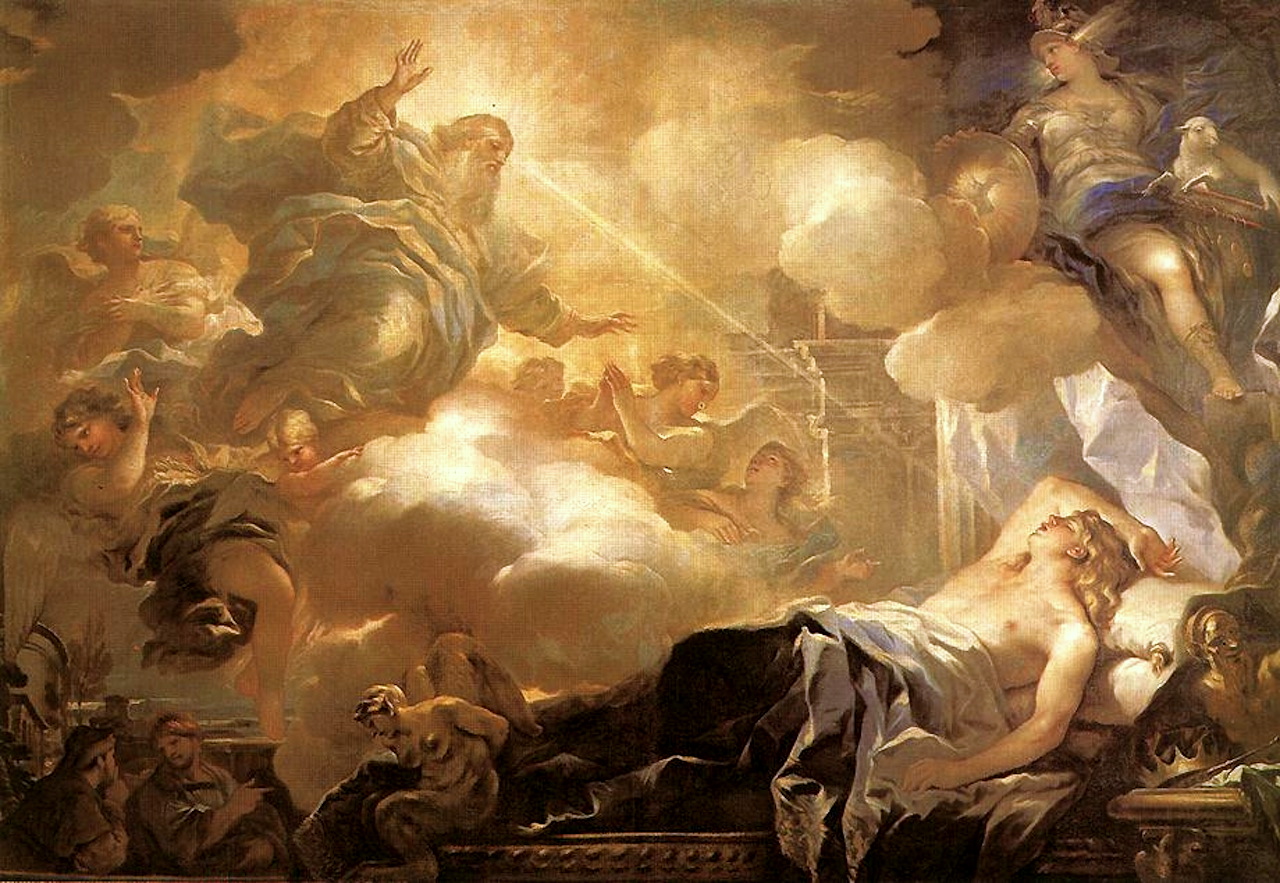
Image: Luca Giordano, The Dream of Solomon (c. 1694)

Monday, November 6, 2017

Epictetus, The Handbook 24: The Diversion of Influence


If it ever happens to you to be diverted to things outside, so that you desire to please another, know that you have lost your life's plan.

Be content then always to be a philosopher; if you wish to be regarded as one too, show yourself that you are one and you will be able to achieve it.

—Epictetus, The Handbook, Chapter 23 (tr Matheson)

I still remember quite a few of my elders, many of them with all the trappings of success, telling me that I had to read Dale Carnegie’s How to win friends and influence people if I ever wanted to amount to anything. Many people no longer know of this book, but for decades it was the best-selling primer for rising in the business and social world, and the beginning of so much of the modern self-help movement, which offers us various fixes, formulas, and lists for making it in this life.

Even at a tender age, the proto-Stoic within me was troubled just by the title. Are friends really things we “win”? And is “influencing” people really the right way to approach any relationship? I would have been more comfortable with a title along the lines of How to love your friends and respect people.

But I read the book, mainly out of curiosity, and as much as I tried to give Carnegie every chance, it confirmed that this was coming from a completely different view of the human good, and therefore of how we should relate to others. As the years went by, I began to see how entrenched Carnegie's approach actually was, both on a professional and personal level.

Carnegie suggested that we should change our own behavior to change the behavior of others, and by doing so we can win influence and benefits for ourselves. This seemed to me to be nothing more than manipulation, and later I understood Sinclair Lewis’ critique of the whole model: "smile and bob and pretend to be interested in other people's hobbies precisely so that you may screw things out of them.”

Despite all of my reservations, I still managed to misdirect years of my work life to this way of thinking. If I could find a way to please others, I thought this would circle back to me, and I would find all that professional security everyone was telling me was the end goal. I was warned that the nail that sticks out gets hammered down, that I should appear willing to please, and I then would one day end up with people willing to please me.

I fell for a similar trap personally. I was in love with a girl, who it so happens ended up becoming a master of the Carnegie Method, and I found myself always trying to find ways to please her. I think I saw other people thinking this was love, so I did much the same.

The dilemma was that if I thought or acted for myself, I was shunned, and would sheepishly return straight back to obedience. If I was obedient, I was met with a whole new and more demanding set of requirements. It never seemed to end, though I now realize I was expected to be doing my own manipulation while being manipulated, and the best manipulation would win.

I, for one, will stick with Epictetus. I should concern myself with being a good man, and I should never seek to define myself by how well I have won the respect of others. Such living is hardly selfish if I think of the good man as one dedicated to justice and service, and not to manipulation and profit. I need to prove this only to myself, in good conscience, and not to others.

As soon as I am concerned with impressing another, I will gladly sacrifice the actual reality of merit with the mere perception, and simply the appearance will be enough to get me what I selfishly want.

I remember a photograph from graduate school, where a number of my fellow students were gathered around an esteemed visiting scholar, and they were all laughing at one of his clever intellectual jokes. I was there that day, and I also remember how many of those same students in the photograph spoke freely about how much they disliked the professor, though they were willing to flatter him for their professional benefits. That same image was used for many years in university promotional materials, and it always made me sad.

I kept only one photograph of the lost love of my life, not as an object of adoration but as a warning reminder. My father and I were playing the traditional game of holiday chess on Easter Sunday, and the picture showed us duking it out as my beloved looked on with great interest. It was only years later that I realized how feigned that interest was, and that she was deliberately posing for the camera and for the record here in private, in exactly the same way she did at public events. I had foolishly ignored all the signs.

I have slowly learned not to resent my former colleagues or my lost friend, and only because I have had to struggle with exactly the same temptations in my own choices and actions.

Both these occasions remind me how easily drawn we all are to playing others to bolster ourselves. Like those old, successful men who told me I had to read Carnegie or perish, there was much to be found there in the world of wealth, influence, and appearance.

But I did have to learn the hard way that this will leave the mind and heart empty and cold. There can never be happiness and virtue when truth is compromised for appearance, or when love is sacrificed for convenience.

Written in 3/2007

Image: Jacques de L'Ange, Allegory of Pride (1642)

Sunday, November 5, 2017

Classic Cicero


Epictetus, The Handbook 23: Philosophers and Proud Looks


If you set your desire on philosophy you must at once prepare to meet with ridicule and the jeers of many who will say, 'Here he is again, turned philosopher. Where has he got these proud looks?'

No, put on no proud looks, but hold fast to what seems best to you, in confidence that God has set you at this post. And remember that if you abide where you are, those who first laugh at you will one day admire you, and that if you give way to them, you will get doubly laughed at.

—Epictetus, The Handbook, Chapter 22 (tr Matheson)

What defines the philosopher will mean different things at different times and to different people. For the Ancients, philosophy was seen primarily as a way of living, while for us Moderns it is primarily a professional exercise in academic circles. From the Stoic perspective, the former would be a transformation of daily practice, while the latter would, in itself, be only an exercise in theory for the attainment of office.

If a philosopher wishes to gain honor, then he would most certainly put on proud looks, much like a celebrity performer or a politician. But if he is interested only in improving his own wisdom and virtue, regardless of what others may think of him, he will be content to appear the fool.

Our mothers would often tell us to never mind those who mocked and ridiculed us, because they were only doing it out of jealousy. Now I hardly know if the bullies and the blowhards consciously wanted what I had, though I do think they were made deeply uncomfortable by anyone or anything that was different from them. In a world where the pursuit of pleasure, fame, wealth, and power are all too common, the philosopher, in practice and not just in theory, will certainly be very different, and he will certainly find himself the odd one out.

Plato spoke of the philosopher returning to the Cave, not to fall back into ignorance but to help others ascend to wisdom, and being thought insane by those who still perceived reality through impressions. I must consider the source when I untangle praise and blame.

We too often forget that our highest calling is to pursue what is right and to remain firm in that conviction, regardless of the obstacles. Nothing else is worthy of respect. I have lived many such instances of struggle and opportunity on a daily basis. Sometimes I have muddled through, and sometimes I have failed. How can I praise friendship, while at the same time betraying a friend? How can I honor truth, and tell lies out of convenience? How can I respect justice, while also taking what isn’t mine to take? How can I admire courage, and crawl into the corner at the first sign of danger?

It isn’t rocket science. I need only hold the post, and keep the watch. It matters little whether others give you commendations or reprimands.

Written in 7/1994

Image: Salvator Rosa, Portrait of a Philosopher (early 17th c.)


Saturday, November 4, 2017

Epictetus, The Handbook 22: Measures of Magnitude, and Gratitude


Keep before your eyes from day to day death and exile and all things that seem terrible, but death most of all, and then you will never set your thoughts on what is low and will never desire anything beyond measure.

—Epictetus, The Handbook, Chapter 21 (tr Matheson)

This is another one of those Stoic passages that may at first seem morbid or pessimistic. Remember that for the Stoic, neither death, nor exile, nor any other circumstance is evil; it is our own estimation of them that will make them seem evil. Rather we should keep death, and things that seem terrible, in mind not to complain about suffering, misfortune, and loss, but to put all things in their proper perspective.

If I can keep my eyes fixed on the defining landmarks, I won’t lose my way, and if I can remember the scope and scale of those crucial circumstances I must always be ready to face, I will hardly sweat the small stuff.

I often think of this in terms of an order or priorities, or what I call a measure of magnitude. Perspective can be a tricky thing. The objects closest to us seem the largest, and those furthest seem the smallest. But when I look through the appearance to the reality, I will recognize that the mountain on the horizon is far larger than the hand before my face.

So too, the little vanities and obsessions of my daily life are as nothing in magnitude to the defining milestones. Considering how I will react to the possibility of losing everything external, or the certainty of my own death, is far more important than worrying about petty offenses.

I can now be far more secure in myself, far more serene, far happier when I have prepared myself for all the impressions that seem terrible. I learn that they aren’t terrible at all if I will only chose to manage them rightly, and I will be troubled by the trifles of life even less. I shouldn’t think about death to remind myself that it is bad, but rather to remind myself about everything that is good.

Measures of magnitude can therefore be opportunities for gratitude. For myself, I can find so much greater peace when I think how silly so many of my concerns have been. When we are young, we are frustrated when those older and wiser tell us something we consider unbearable isn’t quite so bad after all, but yet we come to the exact same conclusion when we have seen more of life.

Surely death is something I shouldn’t worry about yet, something far in the future? It may be, or it could just as easily be something that will come to me right now. I think less about death being painful, or that it will end my existence, and far more about how the knowledge that there will be an end to this life asks me to consider how well I am living that life.

Am I being a good man? Have I acted out of wisdom, temperance, courage, and justice? Have I been inspired by love in all things? There is nothing as helpful as reflecting upon my mortality to help me get my house in order. If I haven’t been living as I know I should, then I can still change that right now, and since I know that clock is ticking, there is no time like the present.

To think of death, or of anything that seems a misfortune, is not to fear it; it is to see the larger perspective, and to be grateful for every opportunity I am given, whether in a long or a short life, to live with excellence. 

Written in 6/1994

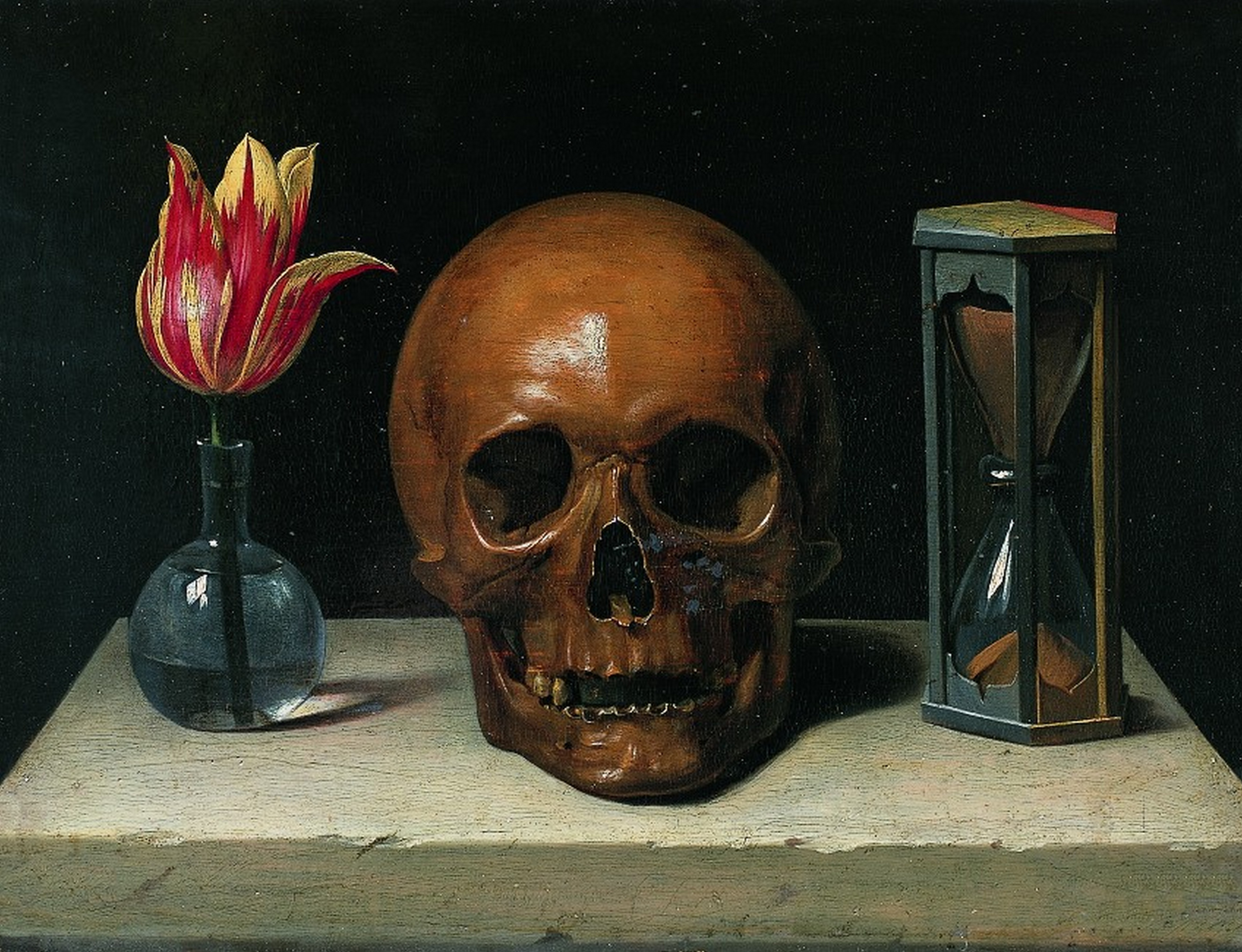
Image: Philippe de Champagne, Still-Life with Skull (1671)

File:StillLifeWithASkull.jpg

Friday, November 3, 2017

Epictetus, The Handbook 21: The Root of Outrage


Remember that foul words or blows in themselves are no outrage, but your judgment that they are so. So when anyone makes you angry, know that it is your own thought that has angered you.

Wherefore make it your first endeavor not to let your impressions carry you away. For if once you gain time and delay, you will find it easier to control yourself.

—Epictetus, The Handbook, Chapter 20 (tr Matheson)


I’ve been on this Earth long enough to see a slow but steady increase in our modern sensitivity. We are more and more easily shocked, offended, outraged, and insulted. We speak of all the things that are unacceptable and inappropriate. We become increasingly impermissive in all of our permissiveness, increasingly intolerant in all of our tolerance.

I knew this had hit critical mass in my early years of teaching, when a young man came to my office full of anger. We had just been reading Nietzsche’s The Anti-Christ in class, and he explained that he had been “elected” by a group of students to come and protest what we had discussed.

His concern? Nietzsche’s attitude toward women, and, if I understood him rightly, that the text seemed to ignore the needs of gay men.

I explained that I was no friend of Nietzsche myself, but that we were reading a wide range of modern philosophers to hopefully understand a wide variety of different arguments and conclusions. He would have none of it.

“I was offended, other students were offended, and we demand a public apology in class for you presenting an inappropriate text.”

It took all of my self-control to not tell him where he could stick his indignation, to not find offense at his being offended. I made it clear I would not apologize for encouraging him to think in ways unfamiliar to him, and he could complain all he wanted, but I would never compromise a commitment to an open mind or to academic freedom.

“Not everyone agrees in this world, you know,” I said. “I suggest the trick is learning to understand, not to condemn and censure.”

“No. We all need to fight intolerance,” was his reply.

I could hardly keep from breaking into hysterical laughter, once again barely managing my own frustration. Here was the pot calling the kettle black, though I’m sure if I had used that phrase, he would have accused me of being a racist, as well as being a sexist and a homophobe. The fellow was criticizing Nietzsche, yet being a little Nietzsche himself, the Will to Power in the form of upper class American entitlement.

Whenever I am offended or outraged, I have taught myself to stop time for but a moment. What is it all about? It usually has nothing to do with another person, or what that person said, but it does have everything to do with me. People, things, ideas, or words are not in themselves offensive. My estimation of them is the root of offense. 

I recall the politician who was fired a few years back for using the word “niggardly” in a press conference. No matter that he used the word in an entirely accurate way; it was all about the offense in public perception, an offense born of ignorance.

No one ever offends or outrages me. I choose to be offended or outraged. Another man may be a bully, a boor, or a moral cesspool, but my own estimation is what drives my response. Will I choose to angry, or will I choose to heal?

If someone for whom I have great respect speaks ill of me, I am hurt. If someone who is on a totally different moral compass speaks ill of me, I might even take it as a compliment. The same thing may have been said, but it is only my own judgment that makes the difference. I have been called a hateful fascist by liberals, and I have been called a bleeding-heart socialist by conservatives. The context of my understanding can allow me to navigate that storm.

There is only one way to avoid being constantly offended and outraged. Take a deep breath, and consider what all of it is about. There is no greater harm here than responding on instinct and feeling alone. I invariably find that my own thinking is the root of the blame.

Quite a few people I know now seem to think I am becoming senile, because I will now pause for a long period before answering a question. I may indeed be heading toward senility, but my silence comes from the fact that I will take my sweet time to think about what needs to be said.

And I’m sorry if what I think needs to be said outrages you. What I said is on me, but what you think about it is on you.

Written in 12/2009

Image: The Rage of Achilles, Giovanni Battista Tiepolo (1757)


Thursday, November 2, 2017

Epictetus, The Handbook 20: Invincible


You can be invincible, if you never enter on a contest where victory is not in your power. Beware then that when you see a man raised to honor or great power or high repute you do not let your impression carry you away.

For if the reality of good lies in what is in our power, there is no room for envy or jealousy. And you will not wish to be praetor, or prefect or consul, but to be free; and there is but one way to freedom—to despise what is not in our power.

—Epictetus, The Handbook, Chapter 19 (tr Matheson)

We assume we can acquire greater freedom by having more, when freedom is in fact found by having less. We think we become more secure by building ourselves up in the world, when security is in fact rooted in not caring for our place in the world. Freedom and security are never granted from the outside, but proceed from the inside.

I have become increasingly aware that most every single obstacle I face arises from allowing myself to be carried away by impressions. To succumb to anger, despair, jealously, fear, or lust is really nothing more than acting through a passion loosed from an understanding of what is good for me.

I have immediately allowed myself to be defeated once I permit this to happen, and getting out of such a pattern is much harder than falling into it. The trick to being invincible is learning to not even take the bait.

If I can understand what I should rightly desire, and therefore also what I should not desire, I will hardly be jealous or resentful when I do not receive the things I don’t even need. I can approach this from the inside out, by recalling what I truly require to be happy, or from the outside in, by recalling why the trinkets I crave won’t fill those requirements.

That a craving for externals, upon things outside of our own power, breeds jealousy is a sure sign that we are enslaving ourselves. I need only consider how the drive for money, power, or pleasure brings out the worst in all of us. But you will hardly see truly good men, and not the seekers of fame and reputation, squabble and bicker over their virtue and character. Resentment comes only when we define ourselves by the things that aren’t really ours to begin with.

If I am attracted to a person, to a position, or to a thing, I need to simply ask myself what good will come from my drive to possess them, or even if I can truly possess them at all? We want to get that girl, score that job, or own that car, but none of them will make me any better, or any happier. I am defined by my own actions, not by how I am acted upon.

I have repeatedly seen cigarette smokers, for example, driving themselves crazy because a long meeting is keeping them from their nicotine fix. The non-smokers simply can’t understand, because this isn’t something that they crave.

So it is with many things in life. The man enslaved to his circumstances will struggle to get a hold of what he cannot truly have, while the virtuous man simply walks away from such temptations. This isn’t because he is superhuman, or unfeeling, or gifted with a will of steel, but simply because he understands that he doesn’t need to want what he doesn’t already have.

He is invincible because he is free, and he is free because he seeks to possess only himself.


Written in 6/1997

Image: A Sea Harrier takes off from HMS Invincible. I can never resist an image of my favorite warplane or my favorite warship.

Wednesday, November 1, 2017

Epictetus, The Handbook 19: Quoth the Raven


When a raven croaks with evil omen, let not the impression carry you away, but straightway distinguish in your own mind and say, 'These portents mean nothing to me; but only to my bit of a body or my bit of property or name, or my children or my wife.

‘But for me all omens are favorable if I will, for, whatever the issue may be, it is in my power benefit from them.'

—Epictetus, The Handbook, Chapter 18 (tr Matheson)

The Ancients understood that what we call luck is merely our ignorance of causes, and that what we call good luck or bad luck is merely how we perceive a benefit or harm to us. The same could be said for fate, or destiny, or prophecy. Things are as they are, they will be as they will be, and the only difference to us will be what we will choose to make of those things.

I have long had a frustrating melancholic disposition, either imprinted in my nature or bred by nurture, to immediately see bad signs. My past will drag me down, my present will seem tenuous, and my future will appear empty.

This has made the practice of Stoicism all the more important to me, not just because I can begin to see some good in things, but because I can begin to see that all things, however they may at first seem, can be good for me if I but choose to understand them rightly. Stoicism rarely works in half measures.

This is true, first, because anything that can ever happen to me will only affect my circumstances, but nothing that can happen to me will determine my judgment, my will, and my own action. The core of my human identity remains intact, if I only so choose.

Second, my judgment and will can always choose to make something good of any condition, even if this means only doing anything good in the face of an evil.

This seems naïve to some, but I suggest this is only because we still assume, to some extent, that our circumstances make and define us. Even as I might instinctively see doom and gloom, I have had to accept, quite begrudgingly at first, that I was nothing more or less than what I made of myself.

This can actually be quite terrifying to face, since it means only I am accountable for myself, and I can no longer blame the world for what I perceive to be all the wrongs I thought I had suffered.

I am certain that this is not just a pleasant abstraction, because I have now been using this attitude to great benefit far more often than I can number. I have managed to transform a deepest betrayal into a commitment to trust, loneliness into self-reliance, poverty into a newfound assessment on the essentials of life, physical suffering into the practice of fortitude, hatred or indifference into countless opportunities to commit small acts of love.

I have reached a point, and will hopefully be able to continue along these lines, where as much as something may hurt or haunt me, I now no longer wish it had never happened, because I can no longer separate the progress I have made, however sparing and humble, from these experiences. I don’t really need fortune to spare or coddle me, whatever those impressions may at first be telling me.

When the raven croaks, I need not assume dark times are ahead. I can remember that I will lose little of significance, and I will gain another chance to think, choose, and act rightly, whatever the circumstance.

Written in 2/2009

Image: "The Twa Corbies", Arthur Rackham (1919)