The Death of Marcus Aurelius

The Death of Marcus Aurelius

Saturday, November 18, 2017

Epictetus, The Handbook 36: Prophecy and Trembling


When you make use of prophecy remember that while you know not what the issue will be, but are come to learn it from the prophet, you do know before you come what manner of thing it is, if you are really a philosopher.

For if the event is not in our control, it cannot be either good or evil. Therefore do not bring with you to the prophet the will to get or the will to avoid, and do not approach him with trembling, but with your mind made up, that the whole issue is indifferent and does not affect you and that, whatever it be, it will be in your power to make good use of it, and no one shall hinder this.

With confidence then approach the gods as counselors, and further, when the counsel is given you, remember whose counsel it is, and whom you will be disregarding if you disobey. And consult the oracle, as Socrates thought men should, only when the whole question turns upon the issue of events, and neither reason nor any art of man provides opportunities for discovering what lies before you.

Therefore, when it is your duty to risk your life with friend or country, do not ask the oracle whether you should risk your life. For if the prophet warns you that the sacrifice is unfavorable, though it is plain that this means death or exile or injury to some part of your body, yet reason requires that even at this cost you must stand by your friend and share your country's danger.

Wherefore pay heed to the greater prophet, Pythian Apollo, who cast out of his temple the man who did not help his friend when he was being killed.

—Epictetus, The Handbook, Chapter 32 (tr Matheson)

We might think we are now too scientific to appeal to a prophet. Fine, let us appeal to a financial advisor, a political consultant, a legal counselor, a marketing guru, or a statistician.  It’s quite the same idea, but just a different setting.

I am told that fortune-tellers will always make their predictions so vague that anything could fit into them, and that analysts are so dodgy that anything will make them a profit. I will hardly judge if anyone truly knows the future.

Let us assume, however, that a prophet or an analyst, like Isaac Asimov’s “psychohistorian” in the Foundation novels, can tell us what will be. We think this would make all the difference in our lives. I think Epictetus is telling us that it should make no difference at all.

What matters, of course, isn’t what happens, could happen, or even inevitably will happen. What matters is what I will choose to do with what happens, now or in the future. My circumstances, past, present, or future, are entirely indifferent. My choices about them will be what make all the difference.

I knew a fellow in middle school, and I think of him with compassion now, because I suspect he was quite troubled, who one day brought in a whole series of old black-and-white pictures depicting the Chinese practice of Lingchi, the Death of a Thousand Cuts. They showed a poor fellow being slowly dismembered as a form of punishment and execution, one part of his body after another being sliced away.

I was horrified, and I still suffer nightmares from it, not because I am squeamish, but because all I could think about was the pain this man must have suffered before he died, not just of the body, but also in his heart and mind.

I know I’m an odd fellow, but I thought about how I would feel if I were ever to suffer such a horror. They say that kindly people would slip huge doses of opium to the victim, or that a merciful executioner might stab the condemned in the heart before the dismemberment, but that hardly makes it any better.

My father owned a wonderful set of German books about World War II, complete with striking photographs I have never seen anywhere else. One photo always stood out to me. Crystal clear, it shows a young German soldier, running across a field somewhere on the Eastern Front, at the exact moment he is shot. There is a combination of shock and pain on his face.

He was barely a grown man. Here was one man among many millions, but he was still a man. He had parents who surely loved him as they raised him, he surely had friends, perhaps a girl back home. And here he was, dying in a foreign land, all alone, well before his expected time.

That photograph would make me cry, and I think of it whenever I get too bellicose, or think that any man should have to die for those powers and ideologies that care nothing for him.

I share these memories with myself not to disturb, but to enlighten. What if I knew I would suffer the agony of that poor Chinese man? What if I knew I would die in a forgotten field like that German soldier? I don’t mean a hunch, or an inkling, but let’s say I knew it with certainty. How would this change my life?

The weak man in me, the one who measures his life by all the externals, shrinks in terror. The little bit of a Stoic in me, that bit I wish to nourish, shrugs his shoulders. I will only care about when, or how I suffer, or when and how I die, if I measure my life in all the wrong ways.

Give me more or less time, more of less conveniences, more or less pleasure and pain, and I should still say that any and all of it is just there to give me a chance to live well. If I knew that last scene, however gruesome, it should not discourage me, but only encourage me to get it right.

One need not be a Christian to understand how Jesus must have felt at Gethsemane. Please take it all away, but if that can’t be so, I will face this with all that is within my power. There is nothing greater than a man who will give of himself completely to love his friends.

Written in 5/1999

Friday, November 17, 2017

Epictetus, The Handbook 35: Stoic Piety 2


. . . For every living creature has a natural tendency to avoid and shun what seems harmful and all that causes it, and to pursue and admire what is helpful and all that causes it.

 It is not possible then for one who thinks he is harmed to take pleasure in what he thinks is the author of the harm, any more than to take pleasure in the harm itself.

That is why a father is reviled by his son, when he does not give his son a share of what the son regards as good things; thus Polynices and Eteocles were set at enmity with one another by thinking that a king's throne was a good thing.

That is why the farmer, and the sailor, and the merchant, and those who lose wife or children revile the gods. For men's religion is bound up with their interest.

Therefore he who makes it his concern rightly to direct his will to get and his will to avoid, is thereby making piety his concern.

But it is proper on each occasion to make libation and sacrifice and to offer first fruits according to the custom of our fathers, with purity and not in slovenly or careless fashion, without meanness and without extravagance.

—Epictetus, The Handbook, Chapter 31 (tr Matheson)

When brothers fight over an inheritance, they are no longer acting as brothers. They demand what was never theirs.

We will all ask for what we think is good for us, and we will all ask to be relieved of what we think is bad for us. Whenever our desires and aversions overlap, we have the root of all conflict. Our usual solution, of course, is to fight it out, and to force our wants and fears upon others. If we don’t win, we sulk and complain.

The Stoic has a very different solution. Instead of insisting upon what I want, I can also simply change what I want. This isn’t a matter of limiting myself at all, but a matter of freeing myself of all the things in life that are completely unnecessary. This is only possible when I recognize what is rightly in my own realm, and what is rightly in the realm of others.

I will only blame God, and therefore be impious, when I think that God has taken something from me that I sincerely believe to be my own. The usual train of thought goes something like this:

I want this, but I don’t have it. Since God supposedly rules all things, it must be His job to give to me. He hasn’t given it to me. God is therefore unjust to me. I also therefore refuse to acknowledge Him.

Now how much does this sound like the bickering of spoiled children or the musings of jilted lovers?

This whole mess would be easily resolved if I properly understood what I should really want, and what the world really needs to give me. My own bubble of power grows bigger when I arrogantly insist on my way, and God’s bubble grows smaller, but it’s quite funny how I still blame God.

I regularly keep in mind that last recorded words of John the Baptist:

He must increase, as I must decrease.

We argue far too often about our own particular image of the Divine, which isn’t about God at all, but all about us. We love to relativize the Absolute. That is in itself a symptom of expanding our own bubbles, our arrogant spheres of influence.

Piety isn’t about how you cut your hair, or what books you have read, which direction of the compass you pray toward, or whether or not you wear a doily on your head. It begins only with reverence and humility. This comes from recognizing that we are a part of the Universe, and not the whole sum of it.

An old Jesuit once put it to me this way: “Be proud to be yourself, and bow to everything else.” 

Written in 3/1996
 
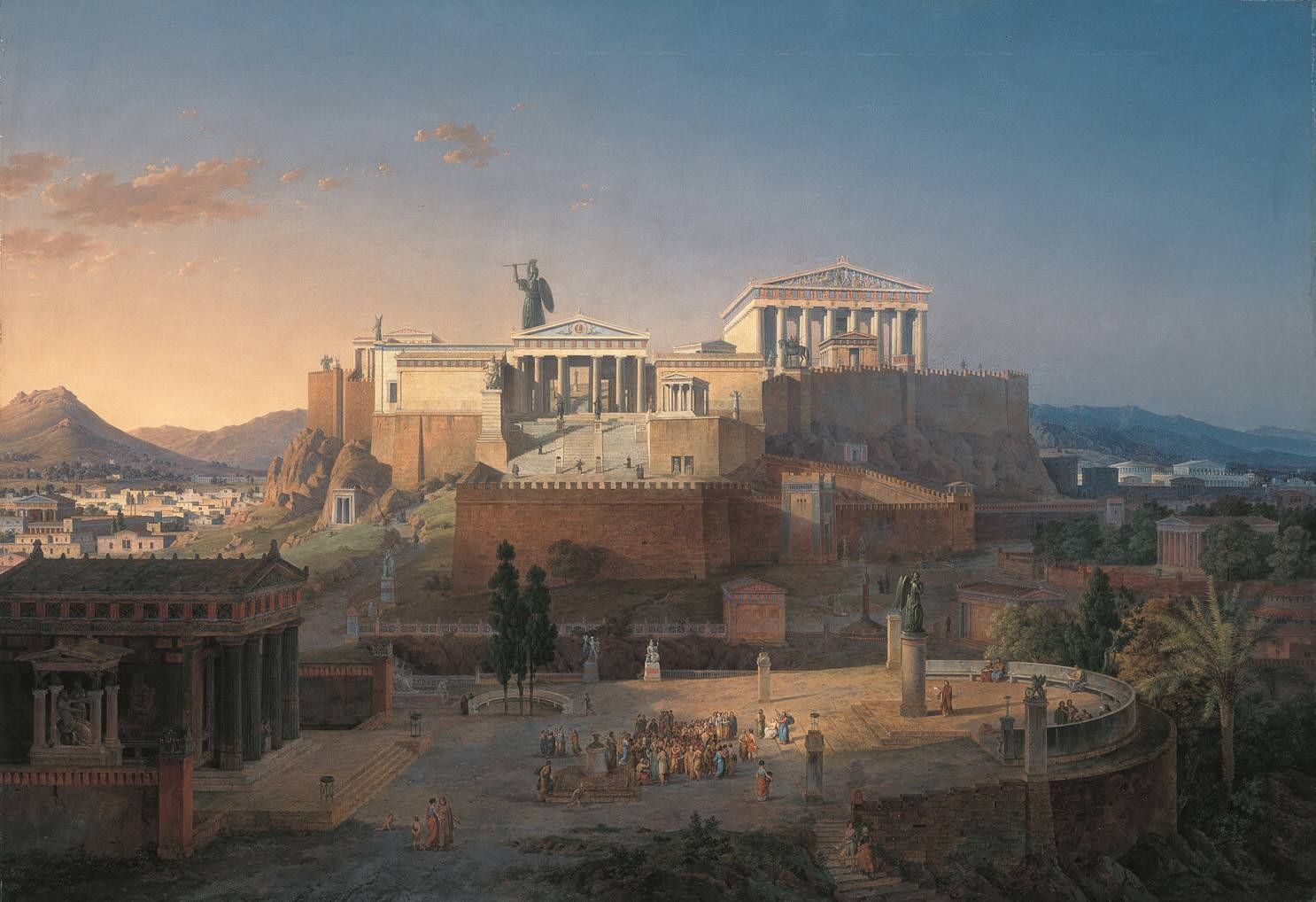
Image: Leo Von Klenze, Akropolis (1846)

Thursday, November 16, 2017

Brooklyn Funk Essentials: Blast It!

Stoic Self-Reliance in the form of funk, one of the Creator's most wonderful and joyous ways of expressing truth :-)

Written in 10/2016

Brooklyn Funk Essentials, "Blast It!" from Funk Ain't Ova (2015)

https://www.youtube.com/watch?v=mJ8zJWcgnro

You got to go through it
If you wanna get past it
Only way to do it
Move in and blast it

https://static1.squarespace.com/static/531df25ee4b00379baf3d379/t/5639f2dee4b03923f8ebe282/1446638307728/

Epictetus, The Handbook 34: Stoic Piety 1


For piety towards the gods know that the most important thing is this: to have right opinions about them—that they exist, and that they govern the universe well and justly—and to have set yourself to obey them, and to give way to all that happens, following events with a free will, in the belief that they are fulfilled by the highest mind.

For thus you will never blame the gods, nor accuse them of neglecting you. But this you cannot achieve, unless you apply your conception of good and evil to those things only which are in our power, and not to those which are out of our power.

For if you apply your notion of good or evil to the latter, then, as soon as you fail to get what you will to get or fail to avoid what you will to avoid, you will be bound to blame and hate those you hold responsible . . .

—Epictetus, The Handbook, Chapter 31 (tr Matheson)

As that pendulum of social and philosophical fashion swings back and forth, it can be difficult to live in a way that stresses virtue. Even the term itself seems alien to so many of us.

Much the same can be said for a life that values piety. Respect is, after all, something we prefer to receive, rather than to give.

But these ideals need not be obscure or foreign to us, if we only understand them rightly. Virtue is not the cold conformity to duty, but the joyful embrace of living well. Piety is not resignation or religious posturing, but giving right respect to the order of all things, and ultimately to the source and measure of that order.

For the Romans, piety was understood in the broad sense of proper reverence, whether for family, friends, or country, but culminating in reverence for the gods.  The very idea, however, can seem disturbing, since it seems to imply some sort of blind obedience to invisible powers. It doesn’t help when some distort the concept of piety from one of humility to one of power and superiority.

Stoicism can be of great assistance in redeeming these ideals of virtue and piety. If the fullness of human life is in how we think, what we decide, and what we do, then virtue or excellence will be the measure by which we must judge ourselves. Likewise, if the fullness of human life is only possible in harmony and right relation with all things around us, then piety or respect will be the measure by which we understand ourselves as being a part of that whole.

Put aside, for the moment, the question of how we are to describe and understand it, but use simple common sense to apprehend that Nature acts according to purpose. She admits of order, and all things, to different degrees, participate in this fullness of being. Call it the gods, God, the Absolute, Providence, or the Universe itself if you will, but admire how all the parts only make sense with regard to the whole, and how we are only parts, and never the whole itself.

Now apply some further Stoic principles to the matter. That I have freedom is not outside of this harmony, but a very necessary part of it. How should I go about acting with my own freedom? All things, of course, have their proper bounds and restraints.

If I refer to the basic truth of The Handbook, that some things are rightly within my power, and others rightly outside of it, I will begin to see the proper path of life. Let me find what is good for my own existence in those things that I can rule, my own thoughts, my choices, and my deeds. Let me simply respect others things beyond my power as they are, each in their own appropriate place, and never demand that they conform to me.

Insofar as it relates to my own particular good, only my own actions are good and bad for me. All other things must be indifferent to me, and they become good or bad only by my estimation or use of them.

If I complain, then, that the gods, or God, or the Absolute, or Providence, or the Universe itself, has acted wrongly toward me, I am very far off the mark. I have expanded the scope of my authority to something quite beyond my own authority. I have tried to make other things be as I would wish them, and I have then, quite ironically, made myself God, the ruler of Nature.

The Universe does not treat us poorly, or unfairly. We choose to treat ourselves well or poorly, fairly or unfairly, by deciding what we will make of everything the whole Universe offers us. I must learn, kicking and screaming, that I am not the master of all. That is the root of all humility, reverence, respect, and piety.

Stoicism offers the simplest and most beautiful solution to what philosophers call the “Problem of Evil.” God, however you choose to understand that absolute reality, will never do me wrong. I do myself wrong. I will only grasp this if I can perceive what is rightly my own, and what is rightly under the authority of other forces and things. Whenever I claim more for myself than is mine, I am on the path to resentment and misery.

“You stole my wealth, my property, my health, my honor, and you are about to steal my life! You have stolen my happiness!”

No, my wealth, my property, my health, my honor, or my very life can’t be stolen, because they were never mine to begin with. My happiness, on the other hand, was always mine. In the immortal words of Lynyrd Skynyrd, “they can’t take that away.”

Written in 3/1996

Image: Leo Von Klenze, Akropolis (1846) 

Wednesday, November 15, 2017

Epictetus, The Handbook 33: Right Relations


Appropriate acts are in general measured by the relations they are concerned with.

'He is your father.' This means you are called on to take care of him, give way to him in all things, bear with him if he reviles or strikes you.

'But he is a bad father.'

Well, have you any natural claim to a good father? No, only to a father.

'My brother wrongs me.'

Be careful then to maintain the relation you hold to him, and do not consider what he does, but what you must do if your purpose is to keep in accord with nature.

For no one shall harm you, without your consent; you will only be harmed, when you think you are harmed. You will only discover what is proper to expect from neighbor, citizen, or praetor, if you get into the habit of looking at the relations implied by each.

—Epictetus, The Handbook, Chapter 30 (tr Matheson)

In the bittersweet days of my youth, no party was ever complete without hearing Janet Jackson’s “What Have You Done for Me Lately?” Along with other phrases, such as “Where’s the beef?” and “Don’t have a cow, man!” they became the slogans for a whole decade.

The young, of course, are prone to feeling independent, headstrong, and demanding, but I saw the absurd reach of not only the phrase, but also the whole associated attitude, when, many years later, I asked a neighbor to move a car that had blocked me in. “Uh uh!” came the impassioned reply. “What have you done for me lately?”

Stoicism would remind us that we are tempted to define something by what is done to it, when we should rather define it by what it does. Grammarians also tell us that the active voice is usually stronger and clearer than the passive voice. When teaching political philosophy, I always asked students to distinguish between rights, what others owe to me, and responsibilities, what I owe to others.

Should I see any human relationship in terms of my entitlement to be treated a certain way, or my obligation to treat others a certain way? Remember that the former is outside of my power, and therefore should never be anything that determines or defines me. The latter is completely with my power, and does in fact determine and define how well or how poorly I have chosen to live.

A Stoic, understanding the priority of action over passion, and of how I think and act over how others think and act, will now have a very different view of what it means to be a parent, a spouse, or a friend.

I always knew deep down that my parents were some of the most caring and committed ones you could find, but that didn’t stop me from complaining about some of the things they asked me to do. What I was not seeing was that my own preferences hardly defined their responsibility as parents, and that what I wanted given to me was not necessarily what they needed to give.

My first attempt at finding that companion for life was marred by much the same problem. I remained in good graces as long as I did what was useful, and when this was no longer the case, I buckled under the weight of the loss. Note that each of us defined our relationship by what the other did.

A true friendship of any sort is based on the ability to give, and not just to receive, to love, and not just to be loved, and to follow through with a commitment that never has terms or conditions attached to it.

This is why I see red when anyone tells me that she is happy being a wife because her husband is faithful, or happy being a father because his son is so obedient, or happy being a friend to someone who always offers a shoulder to cry on. I rather ask myself if I could still be a good husband if my wife was disloyal, if I could still be a good father if my son was a delinquent, or still be a good friend to someone who wasn’t always reliable. 

I could indeed have an angry father, or a thoughtless wife, or an ungrateful son. None of that should determine whether I am a forgiving son, a dedicated husband, or a caring father. If a friend has treated me poorly, this hardly allows me to treat him poorly.

Stoicism asks me to live this way not just out of obligation, but assures me that this is also the path to true contentment. As always, I can be happy if I rule myself, and I make myself miserable when I let myself be ruled by others.

Written in 9/1999

https://images.genius.com/f9d6b36e758a94b534d9065b7269a4c7.500x492x1.jpg

Tuesday, November 14, 2017

Epictetus, The Handbook 32: Living by Full Measures


. . . Man, consider first what it is you are undertaking; then look at your own powers and see if you can bear it.

Do you want to compete in the pentathlon or in wrestling? Look to your arms, your thighs, see what your loins are like. For different men are born for different tasks. Do you suppose that if you do this you can live as you do now—eat and drink as you do now, indulge desire and discontent just as before?

No, you must sit up late, work hard, abandon your own people, be looked down on by a mere slave, be ridiculed by those who meet you, get the worst of it in everything—in honor, in office, in justice, in every possible thing.

This is what you have to consider: whether you are willing to pay this price for peace of mind, freedom, tranquility. If not, do not come near; do not be, like the children, first a philosopher, then a tax collector, then an orator, then one of Caesar's procurators.

These callings do not agree. You must be one man, good or bad; you must develop either your Governing Principle, or your outward endowments; you must study either your inner man, or outward things—in a word, you must choose between the position of a philosopher and that of a mere outsider.

—Epictetus, The Handbook, Chapter 29 (tr Matheson)

A good life will require action and effort. It only remains for us to decide what we consider good, and whether we think it worth the effort.

I have seen many of those philosophy majors over the years making their way in worldly success. As much as they might like to say so in their bios and resumes, there is absolutely no way that was the reason they made their way in the world.

Do not tell me you learned critical thinking to make yourself important. Do not tell me you learned to open your mind to make a financial profit. These things are in contradiction.

Study the inner man, or sell yourself to the things outside of you. There is absolutely no in-between.

“But I am rich, and also a good person.”

Perhaps you are, but your wealth and power will never make you a good person. It’s entirely an accident.

“But I am rich, and I help the community.”

Perhaps you do, but your wealth and power have nothing to do with the measure of your character.

“But I am rich, and if you’d only worked as hard as me, you’d be the same.”

Now there’s the rub. This is what they really mean. They already know what they want, and they already have their reward. Most of them earned their status on the coattails of others, but that is neither here nor there. The life they love is one of show. We all acquire the wealth we work for, but all that matters is what we think makes us truly rich, whether in body or in soul.

Consider what it means to have a life worth living. Will it be the trumpets and parades that come with fame and fortune? Or will it simply be the tranquility from just having acted with wisdom, temperance, fortitude, and justice?

You will have forgive the foul tongue of an Irish philosopher, but I can’t be half-assed about the truth. My actions will tell me exactly what I really care about, and there are no half measures, only full measures.

As soon as I think it fine to love truth but practice lies, I am no longer prudent.

As soon as I think it fine to praise modesty but practice lust, I am no longer temperate.

As soon as I think it fine to send others into the struggle, but hide behind my own position and ideology, I am no longer brave.

As soon as I think it fine to speak of fairness, but I screw my friends and neighbors, I am no longer just.

I must be one man, not two. I must either be a philosopher, in the true sense, or a man ruled by what is outside of me.

I cannot both be a philosopher and a tax collector.

Written in 6/2007

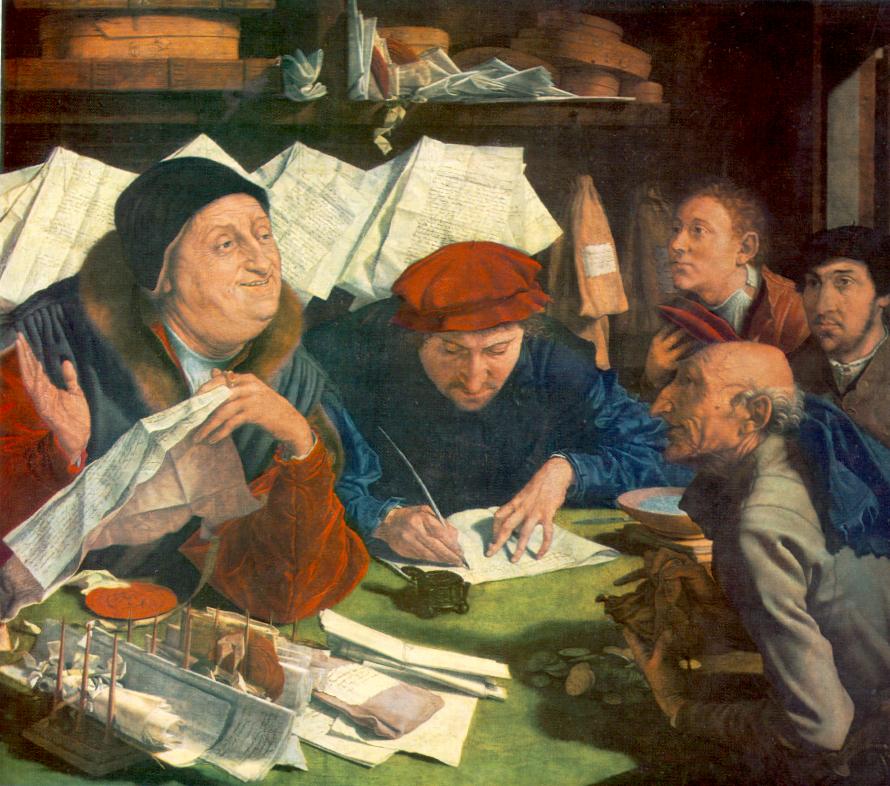
Image: Marinus van Reymerswaele, The Tax Collector (1542)

https://upload.wikimedia.org/wikipedia/commons/6/64/Marinus_van_Reymerswale_-_The_Tax_Collector_-_WGA19329.jpg


Monday, November 13, 2017

Epictetus, The Handbook 31: Living by Half Measures


In everything you do consider what comes first and what follows, and so approach it. Otherwise you will come to it with a good heart at first because you have not reflected on any of the consequences, and afterwards, when difficulties have appeared, you will desist to your shame.

Do you wish to win at Olympia? So do I, by the gods, for it is a fine thing. But consider the first steps to it, and the consequences, and so lay your hand to the work.

You must submit to discipline, eat to order, touch no sweets, train under compulsion, at a fixed hour, in heat and cold, drink no cold water, nor wine, except by order; you must hand yourself over completely to your trainer as you would to a physician, and then when the contest comes you must risk getting hacked, and sometimes dislocate your hand, twist your ankle, swallow plenty of sand, sometimes get a flogging, and with all this suffer defeat.

When you have considered all this well, then enter on the athlete's course, if you still wish it. If you act without thought you will be behaving like children, who one day play at wrestlers, another day at gladiators, now sound the trumpet, and next strut the stage.

Like them you will be now an athlete, now a gladiator, then orator, then philosopher, but nothing with all your soul. Like an ape, you imitate every sight you see, and one thing after another takes your fancy. When you undertake a thing you do it casually and halfheartedly, instead of considering it and looking at it all round.

In the same way some people, when they see a philosopher and hear a man speaking like Euphrates (and indeed who can speak as he can?), wish to be philosophers themselves. . .

—Epictetus, The Handbook, Chapter 29 (tr Matheson)

I must always look at myself with complete honesty. As soon as I hide behind the facade, and pretend I am something that I am not, I have not only deceived others, but I have more importantly deceived myself.

Who am I? What are my strengths? What are my weaknesses? What should I commit my life to? Am I willing to pay the price for that commitment?

Whims are not commitments. I assure you, that any real commitment will hurt, not because it costs me money, or time, or even effort, but because it costs me my whole being. However terrible that may sound, the price of a finite struggle is well worth an infinite reward.

This isn’t at all about just working hard, but rather about learning to work hard for all the right things. Many people will tell us how hard they have worked, but they neglect to tell us why it was worth working for.

Yet we are so often drawn to so many different things, like a cat in a roomful of flies. I may see something appealing, and I run after it. I see another thing that appeals to me, and I run after that. These are works of fancy, and not commitments. We are drawn by the sparkle, and then discouraged by the labor.

I think of all the projects I have begun, all the efforts I have embarked upon, and then left completely unfinished. There was nothing to blame but my own sloth, and my sloth came from my flightiness. I thought I wanted something, but I didn’t want to follow through.

I think that the way we acquire and dispose of our friends and lovers fits this pattern. We try people out, and when they no longer fit our immediate satisfaction, we dispose of them. We then try another, and another, like some perverse test drive, and care nothing for the consequences of our actions. We leave rubble behind us, and then claim a sick sort of victory.

Epictetus shouldn’t even have to tell us this, but there are really only two questions here: What is worth living for? How much am I willing to give for it?

So it is with philosophy. I don’t know whether to laugh or cry when I see people tell me they are “philosophers” because they have read a book or two, or taken a course or two. I have committed my life to philosophy for over twenty years, and I am still horrible at it. I suspect that the more things people claim competence in, the less they are competent in anything at all.

In my teenage years, one of my favorite geek movies was The Adventures of Buckaroo Banzai Across the Eighth Dimension. The titular hero was a top neurosurgeon, particle physicist, race car driver, rock star, and comic book hero. This is just fine in fantasy, but a millstone in real life. The jack-of-all-trades is the master of none.

Epictetus isn’t just speaking about our choice of trade or vocation, but about the very path of our lives. If anything is even worth a hill of beans, it won’t be satisfied by half measures. 

Written in 7/2007 


Depeche Mode: Walking in My Shoes


The true philosopher will never treat another differently than himself, and will always try to think and feel with another.

When this song first appeared, many people thought it was about making excuses for oneself. I always saw it as a cry for empathy, and an appeal to all of those people who are so quick to condemn.

Written in 1/1994

Depeche Mode, "Walking in My Shoes" from Songs of Faith and Devotion (1993)

https://www.youtube.com/watch?v=GrC_yuzO-Ss

I would tell you about the things they put me through
The pain I've been subjected to
But the Lord himself would blush
The countless feasts laid at my feet
Forbidden fruits for me to eat
But I think your pulse would start to rush

Now I'm not looking for absolution
Forgiveness for the things I do
But before you come to any conclusions
Try walking in my shoes

You'll stumble in my footsteps
Keep the same appointments I kept
If you try walking in my shoes

Morality would frown upon
Decency look down upon
The scapegoat fate's made of me
But I promise now, my judge and jurors
My intentions couldn't have been purer
My case is easy to see

I'm not looking for a clearer conscience
Peace of mind after what I've been through
And before we talk of any repentance
Try walking in my shoes

You'll stumble in my footsteps
Keep the same appointments I kept
If you try walking in my shoes
Try walking in my shoes


Epictetus, The Handbook 30: Led by the Nose


If any one trusted your body to the first man he met, you would be indignant, but yet you trust your mind to the chance comer, and allow it to be disturbed and confounded if he reviles you; are you not ashamed to do so?

Epictetus, The Handbook 28 (tr Matheson)

Socrates liked to challenge us to consider why we upend the order of priority in our own nature. Why do we care so much for the external goods of the body, which are conditional and temporary, and so little for the internal goods of the soul, which are unconditional and lasting?

Epictetus follows in the same spirit. How odd that we are not willing to hand over our bodies, our property, wealth, or influence to others, yet when it comes to the way we think and decide, we surrender ourselves without question? We allow ourselves to be led by the nose, and we agree blindly with the prevailing fashions in ideas.

Whenever I make such an observation, I am often met by one of two different responses. First that this is surely too negative a view, or second, that it is simply proof of how corrupt we have become since the times of the Ancients.

I think of something as negative if it only points to the problem without seeking a solution. Stoicism offers that solution in the very stating of the problem, in asking us to consider what defines us as human, and which goods are the greater.

Perhaps modernity sells its soul in a greater degree, but any authority, from any time and place, will tell you how confused human beings always have been about what matters more or less.

All of this is only to be a doomsayer or a reactionary if we see the evil without finding the good. That good should remain the recognition that, through my estimation of myself and my world, I can turn myself around, and I can see that my greatest freedom is to rule my own thoughts and deeds. I can realize, as Socrates had already taught, that any external good of the body is only as good as the inner wisdom and virtue which guides and orders it.

I think we all wonder why we can be so shallow, so petty, so vindictive, and so greedy to own and possess. From a Stoic perspective, I would suggest that this is, first, because man is free, and, second, because of the weight of habit.

As creatures of reason, this means we have free choice to act according to our own understanding. When I can do what I decide, there is always the opportunity to decide poorly. Sometimes the things that are worst for us appear so tempting.

With time, our actions become ingrained, and for good or for bad, acting with habit becomes acting with little effort. This can be a blessing if we act with the habit of virtue, and a terrible burden if we act with the habit of vice.

If I have followed the poor habits I see around me, and then I have developed my own, it may seem like fixing my life is too difficult. I think of Colonel Slade from Scent of a Woman:

Now I have come to the crossroads in my life. I always knew what the right path was. Without exception, I knew. But I never took it. You know why? It was too damn hard.

Now here's Charlie. He's come to the crossroads. He has chosen a path. It's the right path. It's a path made of principle that leads to character. Let him continue on his journey.

I know that feeling all too well. I’ve neglected the better side of me for the worse, the higher for the lower, even when I somehow knew I was going down the wrong path, because it just seemed easier to let myself be led by the nose. It seemed easier to follow all those glittering prizes.

Of course, it wasn’t easier at all. I started to protest when it didn’t work out the way I thought it would. I never had a right to protest, because the fault was mine, not the world’s, and my life was disordered because I had chosen not to rule myself in my mind, but to be enslaved through my body.

The beauty is that Colonel Slade did learn that through Charlie, and he is now finally choosing to take the right path.  So it is for all of us. We don’t need to trade the dignity that is within us for all the false glories that are outside us.

Written in 6/2007

Saturday, November 11, 2017

Epictetus, The Handbook 29: Keeping Our Aim


As a mark is not set up for men to miss it, so there is nothing intrinsically evil in the world.

—Epictetus, The Handbook, Chapter 27 (tr Matheson)

It is far too easy for me to say that a person, or a thing, or a circumstance is evil. This permits me to transfer my own responsibility onto others. It is not a person who is evil, but thoughts, choices, and actions may be evil. It is not a thing that is evil, but how I understand it may be evil. It is not a circumstance that is evil, but how I respond to it may be evil.

At the heart of a Stoic view rests the awareness that each and every thing, by its very being and purpose, exists as a part within the whole of Nature, and by doing so is good. We speak of evil only when something becomes out of harmony with other things, and thereby lacks what it should rightly have. In this way, the Stoic can agree with the wisdom of St. Augustine, that evil is never the presence of something, but the absence of what should be present.

If I can remember these truths, I need never fear failing in my purpose to live well, to lose my aim, to miss the mark. Each and every circumstance can always be an opportunity to practice what is right. The target is never out of my sight, though there are times when I may refuse to see it.

Let us say that I feel wronged. Perhaps another has chosen to act contrary to his nature, but this does not mean that I must act contrary to mine. The good life is still within range.

Let us say I believe I have suffered a misfortune. That situation will only be as good or bad I choose to make it, because my own estimation and action remain within my power. The good life is still within range.

I should not think of the “bad man” as some perverse blob of evil that has infected my world. I should rather think of him as a creature sharing in the same nature as mine. I can always still meet a wrong with a right, and I can try to help him do just the same.

My goal is never lost to me, because I can always choose to bring myself back into harmony with things around me. It was Zeno of Citium, the founder of the Stoic school, who is credited with saying:

Happiness is a good flow of life.

And,

The end may be defined as a life in accordance with Nature, that is, in accordance with our own human nature as well as that of the whole Universe.

I have at times acted in such a way, sometimes without even quite knowing what I was doing, where I lash out at something I see as bad, or shun and condemn someone I think is evil. It may seem a quick cure, but it only compounds my problem.

First, it was never that thing or person that was the problem, but rather my judgment, and second, I am adding even further disharmony. The way to remove an imbalance is to add a counterweight, and the way to fix something is hardly to break it even more.

When I allow myself to be convinced that someone or something is irrevocably evil, I have already thrown in the towel. I am closing my eyes to the target, and I am doing so only out of my own malice and stubbornness. As long as I still live, it is always within my power to restore the good to something that has gone wrong.

Written in 6/2007

Image: Japanese Archer with Targets (ink drawing, late 19th c.)

File:Japanese archer 1878b.jpg

Friday, November 10, 2017

Keeping Your Divine Part Pure


https://i.imgur.com/hr95qm7.jpg


Epictetus, The Handbook 28: Walk in Their Shoes


It is in our power to discover the will of Nature from those matters on which we have no difference of opinion.

For instance, when another man's slave has broken the wine-cup we are very ready to say at once, 'Such things must happen.' Know then that when your own cup is broken, you ought to behave in the same way as when your neighbor's was broken.

Apply the same principle to higher matters. Is another's child or wife dead? Not one of us but would say, 'Such is the lot of man'; but when one's own dies, straightway one cries, 'Alas! Miserable am I!'

 But we ought to remember what our feelings are when we hear it of another.

—Epictetus, The Handbook, Chapter 26 (tr Matheson)

Reality is hardly subjective, and the world is not what we would wish it to be. Yet we must understand how much our own impressions and judgments, unique to each of us, inform our perception of that reality.

What appears one way to my own experience may well appear quite differently when I see it experienced by another. There’s the rub. It is my responsibility to recognize that the pain or pleasure I may feel is hardly any different than the pain or pleasure another may feel, just because he is the one feeling it.

In a moment of complete despair, I once told the person I love the most that I would be walking away, and that she would be better off without all the baggage I had brought with me. It took some time of honest and humble reflection to realize how heartless I had been. I allowed my own self-pity to cloud my love. How might I feel if she had said that to me? I would immediately throw myself into the arena and fight her fight with her. I would never back away, I would never give up, because that is what it means to love another person.

Now why was I expecting that there was one standard for me, and another for her? Why would I think that I should not act in a way I would hope others would act? Why did I think my own experience was any less powerful than her own?

To think sympathetically, and even empathically, is to put oneself in the position of others, to think and feel like them, even to think and feel with them. We apply different measures, because we think we are somehow special. We aren’t. Everyone is special.

When I was a young pup, I felt like I was constantly going to funerals. Within a few years, two grandparents and two great-grandparents, all very dear to me, passed away. Some people say that children bounce back from loss easily, but that wasn’t true for me. Each one of those losses broke my heart, and that last one, the death of my Nana, my father’s grandmother, hit me the hardest.

I felt so miserable because she passed away over Easter, and I never had the chance to say goodbye to her. My father, quite wisely, had made sure I went to see her often, just to spend my time with her after school. She became like a newfound friend, because she listened to me, and I did my best to listen to her.

At her funeral, I battled through dozens upon dozens of people offering their condolences. I know they meant well, and I hold no grudges. But I quickly became tired of hearing the same tired statements. “She was such a good woman.” “I’m so sorry for your loss.” “You are in my prayers.” “God called her back.”

There was one fellow, and I have absolutely no idea who he was, that simply sat next to me in silence for some time. He put his hand on my shoulder, and when I turned to him, he simply said, “I know.” He squeezed my hand, and went on his way.

Now there was a man of sympathy, and of empathy. He was trying to see it as I saw it.

When my wife and I lost our first child, I was almost moved to violence when one person too many told me that it was all “for the best.” In one sense, this was quite right, because anything thrown at us by Nature and Nature’s God can be turned to good, if only we so choose. But that is hardly what someone who is grieving wants to hear.

I was boiling with anger, until I looked at it differently, another one of those Stoic Turns. Here was another human being, trying to give comfort. That I did not appreciate it as she intended it was entirely on me, not on her. I thought of all the clumsy ways I have tried to offer comfort myself, and I was able that time to say, with all sincerity, “thank you.”

I no longer think it is platitude to say that we should walk in someone else’s shoes.

Written in 5/2007

Image: Altobello Melone, The Road to Emmaus (c. 1516)


Thursday, November 9, 2017

Epictetus, The Handbook 27: Paying the Price


Has some one had precedence of you at an entertainment or a levée or been called in before you to give advice? If these things are good you ought to be glad that he got them; if they are evil, do not be angry that you did not get them yourself.

Remember that if you want to get what is not in your power, you cannot earn the same reward as others unless you act as they do. How is it possible for one who does not haunt the great man's door to have equal shares with one who does, or one who does not go in his train equality with one who does; or one who does not praise him with one who does? You will be unjust then and insatiable if you wish to get these privileges for nothing, without paying their price.

What is the price of a lettuce? An obol perhaps. If then a man pays his obol and gets his lettuces, and you do not pay and do not get them, do not think you are defrauded. For as he has the lettuces so you have the obol you did not give.

The same principle holds good too in conduct. You were not invited to some one's entertainment? Because you did not give the host the price for which he sells his dinner. He sells it for compliments, he sells it for attentions. Pay him the price then, if it is to your profit. But if you wish to get the one and yet not give up the other, nothing can satisfy you in your folly.

What? you say, you have nothing instead of the dinner?

No, you have this, you have not praised the man you did not want to praise, you have not had to bear with the insults of his doorstep.

—Epictetus, The Handbook, Chapter 25 (tr Matheson)

We all know that feeling, that sudden and instinctive pang of jealousy when we see someone earning a reward we think should be ours. There is no reason, of course, we cannot simply be happy for someone if he has received a good, and we hardly need feel envious if he has received an evil.

On a deeper level, I ask myself about the nature of these supposed benefits, and the price I would have to pay to receive them. Why should I even want to achieve office and prestige, and what would I have to do to myself to attain them? In the simplest sense, the man who wishes to win the world must sell his soul. This is hardly an exaggeration.

To bask in the glory of thieves and scoundrels I need to become a thief and scoundrel myself. To win power and fame I must practice flattery, duplicity, and manipulation. I have now given away the only thing that ever made me worthwhile, my ability to act with integrity, conviction, and justice.

The end itself is an empty vanity, and the means to that end is the road to perdition.

Whenever I feel a pang of envy or resentment, I need only remember what is truly worthwhile in life, and that some prices are just too high to pay.

I have noticed how in the gilded halls of power and fame people will play certain roles based on certain patterns. There are times to appear compassionate, principled, humble, outraged, or regretful. One puts on different masks for different occasions, and the wording follows a certain script. We surely all know this, yet we seem to fall for it every time. It doesn’t matter if we really mean it, but it matters if we appear to mean it.

Epictetus is asking us if we wish to pay that price, of selling our dignity for favors. I just need to remember that having a seat at a banquet of flattery and decadence isn’t something I should even want to begin with.

I once had an interview for a job I was uncertain about, but the work did seem like it could be worthwhile, and the pay would have been quite nice for a man with a new family. The fellow whose assistant I would have become ended our conversation by asking me what reasons I had for wanting the job. I gave what I thought was an honest answer, but he then asked the same question, worded slightly differently each time, over and over.

Obviously, the answers I was giving were not the ones he wanted to hear. I was only told after the fact that he was giving me an opportunity to tell him how much I wanted to work with him, and that I should have praised his insights and achievements. The fact that it did not occur to me at the time that this was all about personality, and not principle, shows you why I was never cut out to be in administration.

I certainly can’t be indignant about not getting those sorts of rewards if I’m not willing to pay that price. I can remember that I have something of far greater price if I maintain my honesty. You can take the lettuce, I will keep my obol.

Written in 5/2007

Image: silver obol with a depiction of Athena (Athens, 5th c. BC)

File:Athens 465-454 BC Obol.jpg