The Death of Marcus Aurelius

The Death of Marcus Aurelius

Tuesday, July 25, 2023

Tidbits from Montaigne 56


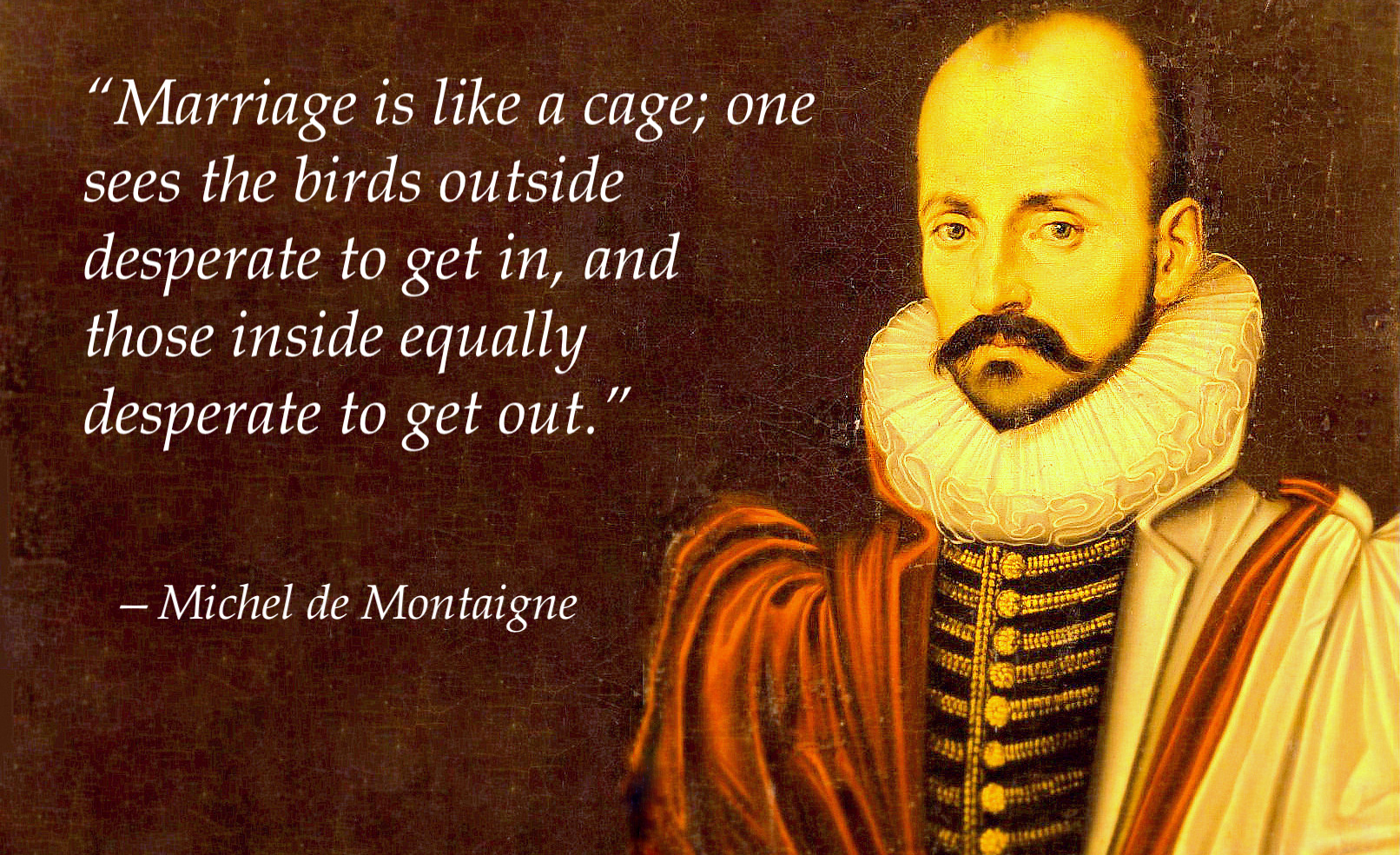
Marriage happens as with cages: the birds without despair to get in, and those within despair of getting out. 

—Michel de Montaigne, Essays 3.5 


Dhammapada 326


This mind of mine went formerly wandering about as it liked, as it listed, as it pleased; but I shall now hold it in thoroughly, as the rider who holds the hook holds in the furious elephant. 


Seneca, Moral Letters 53.3


Let us, therefore, rouse ourselves, that we may be able to correct our mistakes. Philosophy, however, is the only power that can stir us, the only power that can shake off our deep slumber. Devote yourself wholly to philosophy. You are worthy of her; she is worthy of you; greet one another with a loving embrace. Say farewell to all other interests with courage and frankness. Do not study philosophy merely during your spare time. 

If you were ill, you would stop caring for your personal concerns, and forget your business duties; you would not think highly enough of any client to take active charge of his case during a slight abatement of your sufferings. You would try your hardest to be rid of the illness as soon as possible. 

What, then? Shall you not do the same thing now? Throw aside all hindrances and give up your time to getting a sound mind; for no man can attain it if he is engrossed in other matters. 

Philosophy wields her own authority; she appoints her own time and does not allow it to be appointed for her. She is not a thing to be followed at odd times, but a subject for daily practice; she is mistress, and she commands our attendance.

Alexander, when a certain state promised him a part of its territory and half its entire property, replied: "I invaded Asia with the intention, not of accepting what you might give, but of allowing you to keep what I might leave." 

Philosophy likewise keeps saying to all occupations: "I do not intend to accept the time which you have left over, but I shall allow you to keep what I myself shall leave." 

—from Seneca, Moral Letters 53 

Now how can I go about recognizing my faults? What is the best way to keep my soul awake and alert? 
 
The media “culture” that surrounds me insists that I will feel best when I conform myself to the entire range of its products, yet would that not be an act of blind surrender, in place of a conscious discernment?
 
The politicians tell me to support their campaigns, and I am glad they at least advise me to be active, yet how am I to judge the righteousness of their many and changing causes? 
 
The economists say I should be clever about acquiring ever more money, yet should I buy and sell my neighbors to get it, or spend my winnings on anything that happens to tickle my fancy? 
 
The psychologists urge me to “follow the science”, yet behind the complex patterns to the behaviors, where is the distinction of the good from the evil in the underlying choices? 
 
The preachers demand that I just have faith, yet what sort of monster might I become if I commit my trust without first seeking the guidance of understanding? 
 
Whatever the discipline, regarding any possible aspects of life, I will need to develop the power of judging the true from the false, the right from the wrong, the beautiful from the ugly. For any art or science to function rightly, it must have a firm foundation in first principles. Whatever we endeavor to do, we rely upon philosophy to provide such an ultimate measure. 
 
No, I once again don’t mean philosophy as just another profession, but rather philosophy as a reasoned and ordered worldview, upon which the meaning and value of all our efforts depend. There can be no survey of “truths” where there is no yardstick for “Truth”. 
 
Politics, economics, psychology, or religion must operate within the purpose of the whole, and they require the direction of a moral compass. The relative, by its very definition, exists only within the context of what is absolute. Simply by thinking and by choosing, we are already philosophical creatures, and the only question is if we will judge well or judge poorly. 
 
The lesser is in the service of the greater, and so the wise man is happy to put aside the diversions to go straight to the source. Just as I ought to care for my health over going to the office, I am well-advised to work on the content of my character before I buy a new car. I’m a fool to get my wires crossed. 
 
And since philosophy is about what is universal and necessary, it does not admit of conditions, compromises, or equivocations. I can’t attempt to distract from philosophy by pointing to what is outside of the picture, because philosophy encompasses the entire picture. Philosophy will not wait upon me—I shall wait upon philosophy. 

—Reflection written in 4/2013 

IMAGE: Albrecht Dürer, Philosophia (1502) 


Monday, July 24, 2023

Sayings of Publilius Syrus 119


The greatest comfort is to be free from blame. 

Epictetus, Golden Sayings 170


When you visit any of those in power, bethink yourself that you will not find him in; that you may not be admitted; that the door may be shut in your face; that he may not concern himself about you. 

If with all this, it is your duty to go, bear what happens, and never say to yourself, "It was not worth the trouble!"  

For that would smack of the foolish and unlearned, who suffer outward things to touch them. 


Seneca, Moral Letters 53.2


When I finally calmed my stomach (for you know that one does not escape seasickness by escaping from the sea) and refreshed my body with a rubdown, I began to reflect how completely we forget or ignore our failings, even those that affect the body, which are continually reminding us of their existence—not to mention those which are more serious in proportion as they are more hidden.
 
A slight ague deceives us; but when it has increased and a genuine fever has begun to burn, it forces even a hardy man, who can endure much suffering, to admit that he is ill. 
 
There is pain in the foot, and a tingling sensation in the joints; but we still hide the complaint and announce that we have sprained a joint, or else are tired from over-exercise. 
 
Then the ailment, uncertain at first, must be given a name; and when it begins to swell the ankles also, and has made both our feet "right" feet, we are bound to confess that we have the gout.
 
The opposite holds true of diseases of the soul; the worse one is, the less one perceives it. You need not be surprised, my beloved Lucilius. For he whose sleep is light pursues visions during slumber, and sometimes, though asleep, is conscious that he is asleep; but sound slumber annihilates our very dreams and sinks the spirit down so deep that it has no perception of self.
 
Why will no man confess his faults? Because he is still in their grasp; only he who is awake can recount his dream, and similarly a confession of sin is a proof of sound mind. 

—from Seneca, Moral Letters 53 
 
An ailment may limit my capacities, and yet I hinder myself far more when I pretend that there is absolutely nothing wrong with me to begin with. As great as the pressure of the circumstances might be, it fades in contrast to the power of a mind to set its own attitude, for good or for ill. 
 
I suppose it is a function of my stubborn temperament, but I so dislike feeling sick that I will often try to simply wish my condition away: if I don’t acknowledge it, maybe it will magically disappear? 
 
This frustrates my wife to no end, and while there can be merit to a strong will, it ends up being a failing when divorced from a sound understanding. That determination would be better directed toward working with the facts, not against them. Contrary to what they say, what I don’t know can hurt me, and so resolve mixed with ignorance can only lead to pigheadedness. 
 
Those little aches and pains are surely telling me something is amiss, which ought to make me more attentive. If I wait until the suffering is overwhelming, it may be far too late to apply a remedy. While there is no need for panic, the reasonable man learns to observe what makes him tick, even in the in the tiniest of details. 
 
The danger is even greater in disorders of the soul than in those of the body, for the confusion in my very judgments makes it all the more difficult to discern my problems clearly. As the bewilderment increases, the focus of my awareness decreases.
 
It’s hard enough to think straight when I have a fever, even harder to think straight when I am stricken with fear, lust, or anger. I am mistaking a passion for a reason, like some drowsy fellow who takes the wrong pills because he has misplaced his glasses. 
 
Back in my Wilderness Years, I would often drink at night, so I wouldn’t have to remember my dreams. Passing out, however, is no cure for pain, and the deepest sleep still offers no escape from the weight of my vices. Waking up is the only way to restore sanity, to achieve some peace of mind. To finally fix myself I must first come to honestly know myself. 

—Reflection written in 4/2013 

IMAGE: David Ryckaert the Younger, Old Man Sleeping (c. 1642) 


Sunday, July 23, 2023

The Labors of Hercules 12


Hans Sebald Beham, Hercules Dragging Cerberus from the Underworld (1545) 

Francisco de Zurbaran, Hercules and Cerberus (1634) 

Peter Paul Rubens, Hercules and Cerberus (c. 1637) 

Johann Köler, Heracles Brings Cerberus from the Gates of Hell (1855) 


Maxims of Goethe 17


As little as you can stifle a steam-engine, so little can you do this in the moral sphere either. The activity of commerce, the rush and rustle of paper-money, the swelling-up of debts to pay debts—all these are the monstrous elements to which in these days a young man is exposed. 

Well is it for him if he is gifted by nature with a sober, quiet temperament; neither to make claims on the world out of all proportion to his position, nor yet let the world determine it. . . . 

But on all sides he is threatened by the spirit of the day, and nothing is more needful than to make him see early enough the direction in which his will has to steer. 


Seneca, Moral Letters 53.1


Letter 53: On the faults of the spirit 
 
You can persuade me into almost anything now, for I was recently persuaded to travel by water. We cast off when the sea was lazily smooth; the sky, to be sure, was heavy with nasty clouds, such as usually break into rain or squalls. Still, I thought that the few miles between Puteoli and your dear Parthenope might be run off in quick time, despite the uncertain and lowering sky. So, in order to get away more quickly, I made straight out to sea for Nesis, with the purpose of cutting across all the inlets. 
 
But when we were so far out that it made little difference to me whether I returned or kept on, the calm weather, which had enticed me, came to naught. The storm had not yet begun, but the groundswell was on, and the waves kept steadily coming faster. I began to ask the pilot to put me ashore somewhere; he replied that the coast was rough and a bad place to land, and that in a storm he feared a lee shore more than anything else.
 
But I was suffering too grievously to think of the danger, since a sluggish seasickness which brought no relief was racking me, the sort that upsets the liver without clearing it. Therefore I laid down the law to my pilot, forcing him to make for the shore, willy-nilly. When we drew near, I did not wait for things to be done in accordance with Vergil's orders, until

“Prow faced seawards” 

or 

“Anchor plunged from bow;” 

I remembered my profession as a veteran devotee of cold water, and, clad as I was in my cloak, let myself down into the sea, just as a cold-water bather should.

What do you think my feelings were, scrambling over the rocks, searching out the path, or making one for myself? I understood that sailors have good reason to fear the land. It is hard to believe what I endured when I could not endure myself; you may be sure that the reason why Ulysses was shipwrecked on every possible occasion was not so much because the sea god was angry with him from his birth; he was simply subject to seasickness. And in the future I also, if I must go anywhere by sea, shall only reach my destination in the twentieth year . 

—from Seneca, Moral Letters 53 

Certain hard-edged people, who are very much caught up in their circumstances, will regularly tell me that Stoicism is an “unrealistic” or “impractical” philosophy, and I can only suggest to them that where we choose to place our priorities will, in turn, determine what we consider to be either reasonable or convenient. 

I understand the root of the objection, and yet one can hardly claim that the Stoics are not acutely aware of the gritty details of common life, or of the way our impressions act upon us in incredibly powerful ways. Stoicism does not wish to brush aside everyday experience, but rather seeks to provide a meaningful context for what too often feels like a tangled mess of insistent passions. 

This letter opens with a more involved personal story than usual, and the way Seneca describes his frightful sea journey serves as a helpful reminder of how a Stoic attitude must ground us in this turbulent life. Why is this feeling so vivid? How can I go about discerning and correcting my weaknesses, so I will not be so easily tossed about the next time I confront an anxiety? 

Seneca started out on his voyage full of confidence, but Nature quickly showed him who was in charge. What began as a nausea in the gut became a sort of panic in the mind, and I imagine that all of us, even the most resilient, have known such a sense of helplessness. It can be awfully discouraging to face our limitations, especially when they catch us unawares. 

I do not have my father’s love for the sea, so I tend to stay clear of large bodies of water if I can help it, and this is the only reason why I have managed to avoid the discomfort of seasickness. Given how severely people describe it, I’m glad to have been spared. 

The closest I can come to Seneca’s plight is my fear of heights, which only showed up later in life, after a grueling ascent of a rock face with my uncle. He sternly told me not to look down, which, of course, I promptly did, and since then I feel paralyzed by most any drop. As the years have passed, it only seems to have gotten worse, and now even a balcony or a stairwell give me the jitters. 

As much as I would like to blame that mountain for messing with my perceptions, I must humbly admit that the problem is entirely in my head. Willpower alone has not been enough to cure it, and I continue to work on subtler ways I can best calm my nerves when I climb up a ladder. 

If such pains must come, what will I decide to do with them? The G.I. Joe cartoons of my youth told me that knowing is half the battle, and there is actually a profound wisdom to this. If I can’t remove the obstacle, I can still find a way to step around it, to work with it, to transform it into something of benefit. 

If I am first aware of my foibles, at least they won’t creep up on me! 

—Reflection written in 4/2013 


Saturday, July 22, 2023

Delphic Maxims 28


Φίλοις εὐνόει 
Be kind to your friends 


Aesop's Fables 68


The Hare and the Tortoise 

The Hare was once boasting of his speed before the other animals. "I have never yet been beaten," said he, "when I put forth my full speed. I challenge anyone here to race with me." 

The Tortoise said quietly: "I accept your challenge." 

"That is a good joke," said the Hare; "I could dance round you all the way." 

"Keep your boasting till you've beaten," answered the Tortoise. "Shall we race?" 

So a course was fixed and a start was made. The Hare darted almost out of sight at once, but soon stopped and, to show his contempt for the Tortoise, lay down to have a nap. 

The Tortoise plodded on and plodded on, and when the Hare awoke from his nap, he saw the Tortoise just near the winning-post and could not run up in time to save the race. 

Then said the Tortoise: 

"Plodding wins the race." 


Seneca, Moral Letters 52.7


Young men, indeed, must sometimes have free play to follow their impulses, but it should only be at times when they act from impulse, and when they cannot force themselves to be silent. 
 
Such praise as that gives a certain kind of encouragement to the hearers themselves, and acts as a spur to the youthful mind. But let them be roused to the matter, and not to the style; otherwise, eloquence does them harm, making them enamored of itself, and not of the subject. 
 
I shall postpone this topic for the present; it demands a long and special investigation, to show how the public should be addressed, what indulgences should be allowed to a speaker on a public occasion, and what should be allowed to the crowd itself in the presence of the speaker. 
 
There can be no doubt that philosophy has suffered a loss, now that she has exposed her charms for sale. But she can still be viewed in her sanctuary, if her exhibitor is a priest and not a peddler. Farewell. 

—from Seneca, Moral Letters 52 
 
Many people assume that Stoicism is about repressing the emotions, when it is really about providing order and balance to the emotions, but for someone who remains a slave to desire that will sound just as frightening. 
 
I spent far too long chasing after mere gratification, and the bitter irony was that I never even delighted in all those supposed pleasures, because my entire soul was in thrall to a frantic confusion. It was only when I started to tame myself that I actually began to experience happiness. 
 
Of course, there will be times when I cry out loud or jump for joy, and it would be a shame if I twisted a quest for calm into a life of cold and heartless drudgery. The adventure of youth is especially inclined to excitement, for all of that vitality demands a release, though I find with age that a serene satisfaction ends up running so much deeper. Yet whether my temperament is exuberant or reserved, the trick is to keep both hands firmly on the wheel. 
 
I have indeed found myself exhilarated by philosophical insights, but Seneca’s rule must be heeded, that I be moved by the truth of what is said, and not swept away by the charms of the one who says it. Understanding is the key to not permitting our impressions to hold us hostage, and so I should always attend to the why instead of being diverted by the allure of the how
 
For all its energy, a raucous crowd is an undisciplined crowd, which flies in the face of everything philosophy seeks to inspire. Beware of the fellow who tries to market philosophy as a flashy product, all wrapped up in clever slogans and alluring images, since he is not approaching you in good faith, and he will leave you with empty pockets to go along with your empty soul. 
 
While the sophist tries to astound you with his words, the philosopher works to instill a profound respect for what the words ought to signify. Piety has more power than pizzazz. Choose your teachers accordingly. 

—Reflection written in 4/2013 


Thursday, July 20, 2023

Nature 49


IMAGE by Paul Voie (2019) 


Sayings of Ramakrishna 216


There are two sorts of men. 

The Guru said to one of his disciples, "What I impart to you, my dear, is invaluable; keep it to yourself," and the disciple kept it all to himself. 

But when the Guru imparted that knowledge to another of his disciples, the latter, knowing its inestimable worth, and not liking to enjoy it all alone, stood upon a high place and began to declare the good tidings to all the people. 

The Avatâras are of the latter class, while the Siddhas are of the former. 


Seneca, Moral Letters 52.6


There should be a difference between the applause of the theater and the applause of the school; and there is a certain decency even in bestowing praise
 
If you mark them carefully, all acts are always significant, and you can gauge character by even the most trifling signs. 
 
The lecherous man is revealed by his gait, by a movement of the hand, sometimes by a single answer, by his touching his head with a finger, by the shifting of his eye. 
 
The scamp is shown up by his laugh; the madman by his face and general appearance. 
 
These qualities become known by certain marks; but you can tell the character of every man when you see how he gives and receives praise.
 
The philosopher's audience, from this corner and that, stretch forth admiring hands, and sometimes the adoring crowd almost hang over the lecturer's head. 
 
But, if you really understand, that is not praise; it is merely applause. These outcries should be left for the arts which aim to please the crowd; let philosophy be worshipped in silence. 

—from Seneca, Moral Letters 52 
 
Clapping our hands, stomping our feet, or yelling at the top of our lungs are not, in and of themselves, the problem. The Stoic understands how it is the convergence of the act with the intention that matters. 
 
What is my purpose? Am I being loud in order to make myself feel more important? Am I finding pleasure in the spotlight because it feeds my vanity? Be careful! 
 
There are few things nobler than a sincere offering of respect, and few things baser than hamming it up. 
 
I have always loved music, of so many varieties, and yet I am deeply uncomfortable with the way both “performers” and their “audiences” feel the need to play a ridiculous game of hysterical idolatry. 
 
I’ve seen it at the opera just as I’ve seen it at the club, and I fear it has little to do with appreciating beauty, and more to do with self-gratification. Music, I believe, is best played among friends, who have no need for pretensions. 
 
I find it very difficult to trust someone who likes to put on a show, and I do worry that I am too quick to judge. Nevertheless, by their fruits shall you know them; the exterior behavior is a fair indicator of the interior attitude. 
 
So the seducer likes to strut about, and the seductress knows how to give you that come-hither look. The pitchman slaps you on the back and then laughs all the way to the bank. The fellow consumed by resentment is bursting with bravado at the very moment he is doubting himself. 
 
I take special note of the demagogue, whose exaggerated words and gestures are a surefire warning that you are about to get screwed. 
 
In contrast, the thoughtful man, the loving man, the proper philosopher, will point to what is glorious, even as he does not think one bit of his own glory—he gains it precisely by not seeking it. 
 
And you wonder why this strange Stoic fellow is now finding so much of worth in the teachings of Taoism . . . 

—Reflection written in 4/2013 


Wednesday, July 19, 2023

Stoic Snippets 204


Not in passivity but in activity lie the evil and the good of the rational social animal, just as his virtue and his vice lie not in passivity but in activity. 

—Marcus Aurelius, Meditations 9.16 


Tuesday, July 18, 2023

Stockdale on Stoicism 36


My bedside table on the ship was stacked not with busywork to impress my boss, but with Stoic readings: the Discourses, Xenophon's Memorabilia, recollections of Socrates, and of course, the Iliad and the Odyssey. Epictetus expected his students to be familiar with Homer's plots. 

The Stoics were the ultimate warriors. The Roman Stoics coined the formula, Vivere Militare!—Life is being a soldier. Epictetus said in the Discourses

"Do you not know that life is a soldier's service? One must keep guard, another go out to reconnoiter, another take the field. If you neglect your responsibilities when some severe order is laid upon you, do you not understand to what a pitiful state you bring the army in so far as in you lies?" 

 in the Enchiridion:

"Remember, you are an actor in a drama of such sort as the Author chooses—if short, then in a short one; if long, then in a long one. If it be his pleasure that you should enact a poor man, or a cripple, or a ruler, see that you act it well. 

"For this is your business—to act well the given part, but to choose it belongs to Another. . . . Every one of us, slave or free, has come into this world with innate conceptions as to good and bad, noble and shameful, becoming and unbecoming, happiness and unhappiness, fitting and inappropriate. . . . If you regard yourself as a man and as a part of some whole, it is fitting for you now to be sick and now to make a voyage and run risks, and not to be in want, and on occasion to die before your time. 

"Why, then, are you vexed? Would you have someone else be sick of a fever now, someone else go on a voyage, someone else die? For it is impossible in such a body as ours, that is, in this Universe that envelopes us, among these fellow creatures of ours, that such things should not happen, some to one man, some to another." 

—from James B. Stockdale, Master of My Fate: A Stoic Philosopher in a Hanoi Prison 


Dhammapada 325


If a man becomes fat and a great eater, if he is sleepy and rolls himself about, that fool, like a hog fed on wash, is born again and again. 


Seneca, Moral Letters 52.5


For what is baser than philosophy courting applause? Does the sick man praise the surgeon while he is operating? In silence and with reverent awe submit to the cure. Even though you cry applause, I shall listen to your cries as if you were groaning when your sores were touched. 
 
Do you wish to bear witness that you are attentive, that you are stirred by the grandeur of the subject? You may do this at the proper time; I shall of course allow you to pass judgment and cast a vote as to the better course. Pythagoras made his pupils keep silence for five years; do you think that they had the right on that account to break out immediately into applause? 
 
How mad is he who leaves the lecture-room in a happy frame of mind simply because of applause from the ignorant! Why do you take pleasure in being praised by men whom you yourself cannot praise? 
 
Fabianus used to give popular talks, but his audience listened with self-control. Occasionally a loud shout of praise would burst forth, but it was prompted by the greatness of his subject, and not by the sound of oratory that slipped forth pleasantly and softly. 

—from Seneca, Moral Letters 52 
 
I know I may come across as some deluded crackpot, obsessed with a single conspiracy theory, but I can’t help pointing out how so many of our problems arise from a fetish for play-acting. We assume our worth is determined by appearances, and so we turn life into an elaborate theater production. It does not end well for any of us. 
 
It starts because we feel empty on the inside, and so we seek assurances from the outside. It continues when we beg the approval of others by crafting an image. It comes to a sad conclusion with an existence ruled by a desperate deception. 
 
By our instincts we are pack animals, and by our reason we wish to share awareness with others, and yet all of this should proceed from who we are, not from how we seem. During most of the day, however, we are busy pretending, from bragging about our professional achievements to forcing those smiles for the family photos. 
 
Just observe what happens to the people in a room as soon as someone takes out a camera. Similarly, I have recently noticed both students and colleagues who can’t spend an hour without checking how many “likes” they have accumulated on social media. 
 
Instead of trying to impress all the worst people, thereby surrendering to the vices, I think it wiser to focus on the virtues, thereby acting in solidarity with all the best people. If I am worried first and foremost about looking good, I will be quick to take shortcuts in truly being good. 
 
When someone demands praise, I should rather pity him; he simulates confidence while actually betraying his insecurities. If I strive to be a man of principle, neither the giving nor the receiving of applause will make me any better. I have gradually learned that silence is often a wonderful sign of genuine reverence, and hooting and hollering are often the mark of the charlatan. 
 
Philosophy, rightly understood, is a cure for life’s deepest ills, and so it should hardly be treated like some trivial amusement—if it’s doing its job, it will hurt as it heals. Once a teacher basks in the attention, and the student is ready to pile on the flattery, rest assured that there is no learning taking place, only a whimpering of fragile egos. 
 
There is crying out at a moment of profound insight, which stems from a love of the truth, and then there is making a boastful noise, which is a merely about striking a pose. I will know the difference as soon as I examine my intentions. 

—Reflection written in 4/2013