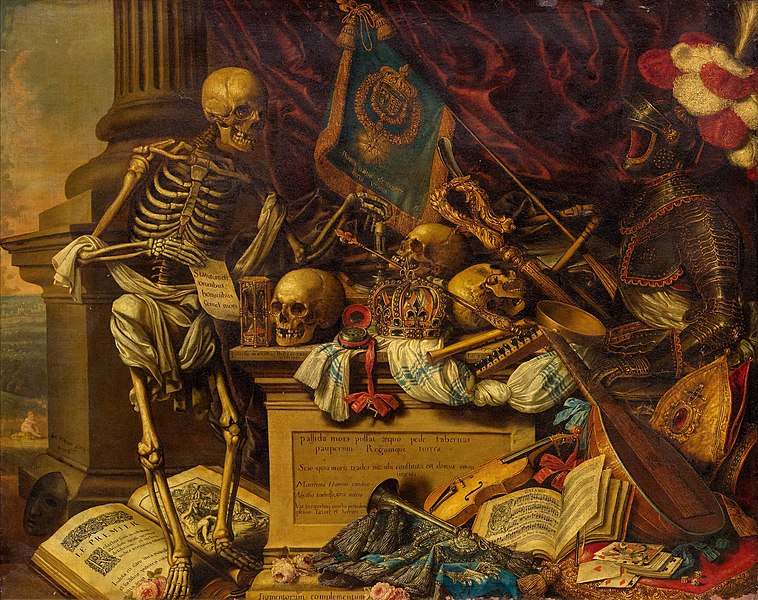
The Death of Marcus Aurelius

The Death of Marcus Aurelius

Tuesday, June 9, 2020

Seneca, On Peace of Mind 11.4


For by looking forward to everything that can happen as though it would happen to him, he takes the sting out of all evils, which can make no difference to those who expect it and are prepared to meet it. Evil only comes hard upon those who have lived without giving it a thought and whose attention has been exclusively directed to happiness.

Disease, captivity, disaster, conflagration, are none of them unexpected: I always knew with what disorderly company Nature had associated me.

The dead have often been wailed for in my neighborhood. The torch and taper have often been borne past my door before the bier of one who has died before his time. The crash of falling buildings has often resounded by my side. Night has snatched away many of those with whom I have become intimate in the forum, the Senate-house, and in society, and has sundered the hands which were joined in friendship.

People like to argue about nature vs nurture, as if who we are is made by either what we were born with or what others do to us. It is a false dichotomy to begin with, as both will equally influence us.

It is also beside the point, since such conditions are only material causes. Our own free choices, informed by our own judgments, are the efficient causes.

In a similar manner, people like to argue whether the glass is half full or half empty. They say that some people expect the best, and that other people expect the worst, and that our initial attitudes will determine how we interpret things.

They are quite right in one sense. The glass is, of course, just a glass, and it so happens to have within it some water. Whether that glass, however, contains more than I want or less than I want depends on my estimation. If it is filled to the half, it filled to the half; anything else speaks to my own desires.

They are quite wrong in another sense. Is it not possible to simply say that being filled to the half is neither better nor worse? Can I not be indifferent to the glass and to the water? It is what it is, and I am what I am. It is a mistake to confuse the two.

So it also is when folks try to tell me that Stoics are too negative, and they always expect the worst. No, a Stoic is open to expecting anything at all, and he won’t call it “worse” or “better” until he has had the chance to make something of it.

Does he accept that he could, like Job, lose all his property, and his health, and his loved ones, within a single moment? Yes, he does, but not because he is a pessimist. He knows that it may come, and so he is prepared for it to come.

Does he accept that he could, like Job once again, win back all of his property, and his health, and his loved ones, within a single moment? Yes, he does, but not because he is an optimist. He knows that it may come, and so he is prepared for it to come.

“Good” or “bad” are not determined by the scope of our conditions, and that is the root of our misunderstanding. Expect neither good nor bad, because the conditions are in themselves never good or bad; we are either good or bad.

I am quite ready, of course, to be open to the possibility of wealth and fame. My problem is that I crave such things because I think they will make me happy. I am not at all ready to be open to the possibility of poverty and disrepute. My problem is that I avoid such things because I think they will make me unhappy.

It never seems to occur to me that it has nothing to do with what I was born with, or what has happened to me. It never seems to occur to me that the only thing “full” or “empty” is the quality of my own soul.

With apologies to Roy Batty, I have seen things you wouldn’t believe. Some have lifted me up to the highest highs, and some have dragged me down to the lowest lows. I am learning to become accustomed to them all, knowing that I should expect them all. They should neither elevate me nor lower me, since they do not make me.

Seneca speaks here of what we consider to be the lows, I suspect, because we fear them so very much. There is no need to fear what we know must be.

Written in 11/2011

IMAGE: John Martin, The Seventh Plague (1823)

Tidbits from Montaigne 10


The day of your birth leads you to death as well as to life.  

—Michel de Montaigne, Essays 1.20

Monday, June 8, 2020

Seneca, On Peace of Mind 11.3


"We dislike gladiators," says Cicero, "if they are eager to save their lives by any means whatever: but we look favorably upon them if they are openly reckless of them." You may be sure that the same thing occurs with us: we often die because we are afraid of death.

Fortune, which regards our lives as a show in the arena for her own enjoyment, says, "Why should I spare you, base and cowardly creature that you are? you will be pierced and hacked with all the more wounds because you know not how to offer your throat to the knife. Whereas you, who receive the stroke without drawing away your neck or putting up your hands to stop it, shall both live longer and die more quickly."

He who fears death will never act as becomes a living man, but he who knows that this fate was laid upon him as soon as he was conceived will live according to it, and by this strength of mind will gain this further advantage, that nothing can befall him unexpectedly.

Even as I have a power over my own judgments, my very life had to be given to me, and it will most certainly be taken away. It too, in this sense, is on loan, and it is not for me to decide when it will come and when it will go.

Keeping in mind that the duration of my existence is temporary, I can now treat it like any of the other things I have borrowed, here for a certain time, and due to be returned at a moment’s notice. Just as I should not be clinging to money, or to pleasures, or to fame, I should not insist on clinging to my life.

This seems quite contrary to our usual assumption, that the instinct for survival is our most basic drive. A Stoic model, however, looking more deeply into human nature, suggests that it is not living alone that is good, but living well. The issue is not about the quantity of our time, but the quality of what we do with our time.

This is why the brave man thinks first of the dignity of his actions, and cares far less about the duration of his years. He is more afraid of falling into wickedness than succumbing to death. He understands where his true worth lies.

All those things I think are somehow good in themselves are not good in themselves, but they rather become good for me when informed by virtue. I may prefer them one way or another, but I do not at all need them to be one way or another. This includes not only the amount of my property, or the degree of my reputation, but also the length of my very life.

I am the steward of all that comes my way, never the proprietor. I always remind myself that this is not a limitation, but a liberation. I can now commit myself to what is mine, the dignity of my own thoughts and actions, while I still have them available to me.

Fortune has an uncanny way of hitting back whenever we try to fight her. She is quite likely to make it harder for us when we want it to be easier, and she will give us less when we stubbornly demand more. This isn’t because the Universe is some chaotic mess, or due to Nature being vindictive. It is a wonderful, and frustrating, way of putting us back on track.

“None of this is who you are. Look back within yourself, and rediscover what you were made for.”

I am not a violent man, and I have never found any satisfaction in blood sports. Yet what Cicero says isn’t just about gladiators fighting in the ring, but about all of us.

I don’t save my life by merely preserving it. I save my life by spending it in the best way, in doing what my conscience informs me to be right. I am going to die, one way or another, and the only remaining concern is whether I go about doing it standing up, willing to take the blows, or on my knees, begging for another chance.

I don’t need another chance; the first one was perfectly good to begin with, and I have now wasted it by surrendering and demanding to go again. There is a contradiction here: I’m ready to be a good man, but I’m not yet ready enough to actually be one.

I will only fear death when I expect that life must still give me something else. If, on the other hand, I look only to what I am able to give, death will not be so frightful.

Once I expect to immediately give everything back, whenever it is necessary, I will not fret over anything coming to an end. It’s what goes in between the beginnings and endings that makes the difference.

Written in 11/2011

Dhammapada 80


Well-makers lead the water wherever they like; fletchers bend the arrow; carpenters bend a log of wood; wise people fashion themselves. 

Sunday, June 7, 2020

Seneca, On Peace of Mind 11.2


Yet he does not hold himself cheap, because he knows that he is not his own, but performs all his duties as carefully and prudently as a pious and scrupulous man would take care of property left in his charge as trustee.

When he is bidden to give them up, he will not complain of Fortune, but will say, "I thank you for what I have had possession of: I have managed your property so as largely to increase it, but since you order me, I give it back to you and return it willingly and thankfully. If you still wish me to own anything of yours, I will keep it for you. If you have other views, I restore into your hands and make restitution of all my wrought and coined silver, my house and my household.

“Should Nature recall what she previously entrusted us with, let us say to her also: 'Take back my spirit, which is better than when you gave it me: I do not shuffle or hang back. Of my own free will I am ready to return what you gave me before I could think: take me away.'"

What hardship can there be in returning to the place from where one came? a man cannot live well if he knows not how to die well. We must, therefore, take away from this commodity its original value, and count the breath of life as a cheap matter.

Does this mean I have nothing? Not at all, I have myself, right here and now. Why do I give so little value to the most precious thing I possess? Let me qualify that statement, since I am not just the most precious thing I possess, but I am actually the only thing I possess, however temporary it may be.

Being a fellow with an unfortunately melancholic bent, always struggling with the bad habit of finding what is worst, I might claim that owning myself isn’t worth very much at all. Look at what others have thought of me, have said of me, have done to me.

The fellow who replaced me for the affections of the lost love of my life once sent me a letter, back when we would still write letters, and he made it entirely clear what he thought of me, and what his new beloved thought of me. I’m not sure why I ever saved that old letter, but I suspect the darker side of me was still trying to come to terms with it.

“Do you even know how ridiculous you are? You’re a waste of human life, a total failure, and we laugh about you all the time. Did you really think you could do anything to make her happy? I do things for her you could never do. You need to have the decency to fuck off and die.”

I took that to heart, as I did so many other perceived slights, and I wasted many years trying to do exactly that, just going off and dying.

How mistaken I was in taking that path.

Did she care? Did he care? Clearly not at all. Did any of that matter? Clearly not at all, if only I’d had my wits about me.

My deepest affection, my most profound caring, came from a mistaken assumption, that I am what others say I am.

I am not what others say I am. I am not the sum total of how I am perceived. I am not ridiculous, or wasted, or a failure because someone else has said so.

As insignificant as I may feel, I am worth something. I am worth something just by being human, yet I can also add to that. I can act with understanding and love, whatever else may come my way, and so I can then make something better of myself.

I am not cheap. I may cringe to say it, but yes, I can actually be priceless.

It all boils down to a simple concept: anything I have ever had, or felt, or loved has never been “mine” at all. It was lent to me for a time. The pretty girl was never mine, the proper job was never mine, and the fancy house was never mine. I was offered a sort of care over them for a brief moment, but they were never mine.

I still recall a phrase my family constantly used, and I hated it so much then, but I get it so much now:

The Lord giveth, and the Lord taketh away. Blessed be the Name of the Lord!

Instead of my constant whining and complaining, here is a better way for me to live:

Thank you for this chance to be responsible for what happened to be in my custody. It has been a privilege, and not a right.

Thank you for taking any of it away at the proper time. I tried to manage it well, and I will pass it on gladly.

Thank you for the time I have been provided, however long or short, whatever the circumstances. I recognize that my very existence was a gift. I did my best with all of it.

I might say I hope it was enough, but that has depended entirely on me.

Written in 11/2011

IMAGE: Balthazar Nebot, Allegory of Fortune (c. 1730)

Pilgrims


Thomas Cole, The Pilgrim of the Cross at the End of His Journey (1846)


Thomas Cole, The Pilgrim of the World at the End of His Journey (1847)


Epictetus, Golden Sayings 122


If any be unhappy, let him remember that he is unhappy by reason of himself alone. For God has made all men to enjoy felicity and constancy of good. 

IMAGE: Tintoretto, Allegory of Happiness (c. 1564)

Saturday, June 6, 2020

Seneca, On Peace of Mind 11.1

These remarks of mine apply only to imperfect, commonplace, and unsound natures, not to the wise man, who needs not to walk with timid and cautious gait: for he has such confidence in himself that he does not hesitate to go directly in the teeth of Fortune, and never will give way to her.

Nor indeed has he any reason for fearing her, for he counts not only chattels, property, and high office, but even his body, his eyes, his hands, and everything whose use makes life dearer to us, no, even his very self, to be things whose possession is uncertain; he lives as though he had borrowed them, and is ready to return them cheerfully whenever they are claimed.

Confidence? By all means. Weakness? Quite unacceptable.

Most people would gladly insist on such principles, especially those folks caught up in the world of earning money, of winning status, and of acquiring influence. Think of all those inspirational phrases you will hear about the attitude of the winner, about never being second best, or about taking what you know you deserve.

And the meaning in all of that depends on our standards of winning and losing. It is admirable to be confident, but in what should I have confidence? It is shameful to be weak, but what actually makes me weak?

There is a vast difference between two models of success, between being more and getting more. What we mean by confidence or weakness hinges upon which model we choose.

The Stoic attitude is quite natural, in that it derives from who we essentially are as human beings, but it is also quite radical, in that it asks us to go against the grain of all the artificial habits we have acquired.

Is it reasonable to expect that the world will give us external rewards in proportion to what we do, that we will be fulfilled by the acquisition of things as a consequence of our efforts?

I have been told that for all of my life, and I do not wish to be crude, but I call bullshit. For each hard-working man who gets rich, another one remains poor. For each lazy man who rots in the gutter, another one hits the jackpot. In this sense, life is hardly fair at all.

Now consider it from a different perspective. Why should those circumstances, which are ultimately quite outside of our control, define who we are? There is another option, and it is completely within our control. Let our own thoughts and deeds define who we are, entirely for their own sake. In this sense, life is totally fair.

Hence the wise man is confident when he relies on his own actions, and he is weak when he relies on the actions of others. In contrast, the fool thinks he is confident when he worries about what he receives, and he thinks he is weak when he worries about what he might give.

To be confident in myself is not to make myself the center of the Universe; it is simply to make me a center for myself. I take what I have been offered, and I nurture it, and I make it grow. I can still be humble, since I know that my own worth fits within the worth of the whole.

When I fall into weakness, it has nothing to do with being worse than anyone else; it has everything to do with being worse than what I alone am able to be. My weakness comes from my requirement to define myself by everything except myself.

If I can remember that, and not just conceive it but actually live it, Fortune has no control over my happiness. I am the one who decides whether I will take it or leave it. I can be confident in that.

Why should Fortune hurt me, when everything she lends me was never mine to begin with? If I am truly myself, then I will care little for the rest. To lose property, or gratification, or reputation only causes such deep pain when I claim them as my own, and they cease to be such a burden when I no longer think of them as something to which I am entitled.

Was Dives happier than Lazarus? The only way to answer that question is to further ask who the better man was, the one who relied upon his own virtues or the one who relied on his situation. Who was really strong or weak? Who was really living on table scraps? 

Written in 11/2011

IMAGE: Luca Giordano, Dives and Lazarus (c. 1680)

Aesop's Fables 22


The Frog and the Ox 

"Oh Father," said a little Frog to the big one sitting by the side of a pool, "I have seen such a terrible monster! It was as big as a mountain, with horns on its head, and a long tail, and it had hoofs divided in two."

"Tush, child, tush," said the old Frog, "that was only Farmer White's Ox. It isn't so big either; he may be a little bit taller than I, but I could easily make myself quite as broad; just you see." So he blew himself out, and blew himself out, and blew himself out. "Was he as big as that?" asked he.

"Oh, much bigger than that," said the young Frog.

Again the old one blew himself out, and asked the young one if the Ox was as big as that.

"Bigger, Father, bigger," was the reply.

So the Frog took a deep breath, and blew and blew and blew, and swelled and swelled and swelled. And then he said: "I'm sure the Ox is not as big as ——" But at this moment he burst. 

Self-conceit may lead to self-destruction.


Friday, June 5, 2020

Boethius, The Consolation of Philosophy 4.36


“Wherefore high Providence has thus often shown her strange wonder, namely, that bad men should make other bad men good.

“For some find themselves suffering injustice at the hands of evil men, and, burning with hatred of those who have injured them, they have returned to cultivate the fruits of virtue, because their aim is to be unlike those whom they hate.

“To divine power, and to that alone, are evil things good, when it uses them suitably so as to draw good results from them.

“For a definite order embraces all things, so that even when some subject leaves the true place assigned to it in the order, it returns to an order, though another, it may be, lest anything in the realm of Providence be left to random chance.”

—from Book 4, Prose 6

This remains one of my favorite passages in the Consolation, and I have pretty much learned it by heart, not because I am any good at memorizing anything, but because I have turned to it so many times when I feel beaten down by circumstances.

It encapsulates so much of what this wonderful text is about, and so much of what life is ultimately about.

I repeatedly make the mistake of judging what is “good” or “bad” by incomplete measures. I look only to the immediate presence of pleasure or pain, of prosperity or poverty, of honor or dishonor. It feels this way right here and now, and so I take that to be all that there is.

I fail to see that such states do not constitute the goods of human nature, and that their presence or absence are in turn only beneficial or harmful in relation to the cultivation of my own moral worth.

I also fail to see that my own good is necessarily bound up with the workings of the whole, with the order of Providence. This hardly makes my own happiness irrelevant, but it does mean that I should only consider such a happiness in the context of everything else around me, with and through the fulfillment of all other creatures.

And so what can happen, quite remarkably, is that I will begin to discern how even the most painful situations can become the means to something far better, that Providence transforms every suffering or loss into the opportunity for a more profound blessing or gain.

Has my neighbor acted poorly? At first it appears to be a grave injustice, quite unforgivable, and I may blame not only his actions, but even God himself for allowing it all to occur.

But what has actually been taken away, and what else has accordingly been given? A decrease on the outside is now the chance for an increase on the inside. The goods of the body come and go, and in each and every case those variations are calling for the greater cultivation of the goods of the soul. There is absolutely no “losing” here at all, if only I perceive it rightly.

One man uses his freedom to practice vice, and Providence turns it upon itself, allowing another man to use his freedom to practice virtue. I see the evil in it, and I struggle with it, and I may boil with resentment over it, and then I stumble across something I did not at first expect; how might I improve upon it, instead of merely suffering from it? Isn’t that the very reason we are given freedom to begin with, to discover the good of our own accord?

What of that poor fellow who did me wrong, who first slipped into ignorance? Is he just cast aside? Not at all; that exact same moment of epiphany is open to him from his end, to correct his wrong, and to become better. Nothing is wasted at all, since everyone is granted the option of redemption.

Providence has already taken into account the path of our choices, and even as the whole pattern appears to deviate from the way things should be, it inevitably comes right back around again to the same place, though by a different route. 

Written in 12/2015 

Thomas a Kempis, The Imitation of Christ 3.14


Of meditation upon the hidden judgments of God, that we may not be lifted up because of our well-doing

1. You send forth Your judgments against me, O Lord, and shake all my bones with fear and trembling, and my soul trembles exceedingly. I stand astonished, and remember that the heavens are not clean in your sight. If You charge Your angels with folly, and did spare them not, how shall it be unto me? Stars have fallen from heaven, and what shall I dare who am but dust? They whose works seemed to be praiseworthy, fell into the lowest depths, and they who did eat Angels' food, them have I seen delighted with the husks that the swine do eat.

2. There is therefore no holiness, if You O Lord, withdraw Your hand. No wisdom profits, if You leave off to guide the helm. No strength avails, if You cease to preserve. No purity is secure, if You protect it not. No self-keeping avails, if Your holy watching is not there. For when we are left alone we are swallowed up and perish, but when we are visited, we are raised up, and we live. For indeed we are unstable, but are made strong through You; we grow cold, but are rekindled by You.

3. Oh, how humbly and abjectly must I reckon of myself, how must I weigh it as nothing, if I seem to have nothing good! Oh, how profoundly ought I to submit myself to Your unfathomable judgments, O Lord, when I find myself nothing else save nothing, and again nothing! Oh weight unmeasurable, oh ocean which cannot be crossed over, where I find nothing of myself save nothing altogether! Where, then, is the hiding-place of glory, where is the confidence begotten of virtue? All vain-glory is swallowed up in the depths of Your judgments against me.

4. What is all flesh in Your sight? For how shall the clay boast against Him that fashioned it? How can he be lifted up in vain speech whose heart is subjected in truth to God? The whole world shall not lift him up whom Truth has subdued; nor shall he be moved by the mouth of all who praise him, who has placed all his hope in God. For they themselves who speak, behold, they are all nothing; for they shall cease with the sound of their words, but the truth of the Lord endures for ever.

IMAGE: William Blake, The Casting of the Rebel Angels into Hell (1808)

Wednesday, June 3, 2020

World Party, "Ship of Fools"

I suspect he meant it as an insult, but a guy back in college once yelled at me that I looked exactly like "that faggot" from World Party.

I took it as a compliment, and I had absolutely no beef with him. He didn't know what to do when I smiled and gave him a thumbs up.

I tend to forget how old this song is now, and how forgotten the music of my youth is now. No matter. It still speaks to me, and perhaps it can still speak to others.

I won't dare to speak for Karl Wallinger, but this tune makes a very clever reference to the old Medieval image of the Ship of Fools, those swept away by their vanities and illusions, in turn a reference to an allegory from Plato's Republic.

It is a timeless picture, precisely because human failures never really change.

Written in 3/2014

World Party, "Ship of Fools" from Private Revolution (1987)

https://www.youtube.com/watch?v=B2nCugGQZO

We're setting sail
To the place on the map from which no one has ever returned
Drawn by the promise of the joker and the fool
By the light of the crosses that burn


Drawn by the promise of the women and the lace
And the gold and the cotton and pearls
It's the place where they keep all the darkness you need
You sail away from the light of the world on this trip baby


Pay, you will pay tomorrow
You're gonna pay tomorrow
You will pay tomorrow


Save me, save me from tomorrow
I don't want to sail with this ship of fools, no no
Oh, save me, save me from tomorrow
I don't want to sail with this ship of fools, no no
I want to run and hide
Right now


Avarice and greed are gonna drive you over the endless sea
They will leave you drifting in the shallows
Drowning in the oceans of history
Travellin' the world, you're in search of no good
But I'm sure you'll build your Sodom like I knew you would
Using all the good people for your galley slaves
As your little boat struggles through the the warning waves


But you will pay, you will pay tomorrow
You're gonna pay tomorrow
You gonna pay tomorrow


Save me, save me from tomorrow
I don't want to sail with this ship of fools, no
Oh, save me, save me from tomorrow
I don't want to sail with this ship of fools, no


Where's it comin' from or where's it goin' to?
It's just a, it's just a ship of fools


All aboard


Musonius Rufus, Lectures 10.9


How much better a figure does the philosopher make so conducting himself as to deem worthy of forgiveness anyone who wrongs him, than to behave as if ready to defend himself with legal procedure and indictments, while in reality he is behaving in an unseemly manner and acting quite contrary to his own teaching.

To be sure he says that a good man can never be wronged by a bad man; but nevertheless, he draws up an indictment as having been wronged by bad men, while claiming to be accounted a good man himself.

A thoughtful fellow I once knew suggested that I could get a good sense of what most people cared for by what they were willing to pay for it.

It wasn’t the noble speeches of the politicians, or the sentimental soundbites in the advertising, or the impassioned stories in the media that told us all about the world’s priorities: in which direction was the cash flowing?

I remember rolling my eyes, asking if this meant that medicine and law were what we all wanted the most.

“Exactly! People want to live forever, and people want to get back at the other people who rub them the wrong way.”

I may not have shared his intense social outrage about it all, but he made a good point. There I was, earning less than minimum wage for my time as a teacher, in all of my salaried glory, and my classmates who had gone to law school were charging for every minute they thought about a case while sitting on the can.

And how we enjoy going to court. We have a disagreement, and we get stubborn, and so we file a lawsuit.

We look down with disgust at the fellow who made a critically bad choice at exactly the wrong time, and we wish for the state to lock him up for life, or maybe even kill him, while we wave signs of our own hatred outside of his prison.

I know full well that I must pay for my mistakes, in all sorts of ways; I am doing so right now, and I will do so for as long as I live.

If I can recognize that within myself, why would I still insist on hurting those who have hurt me? Is justice about my own lust for satisfaction, or might it be about offering others a chance for redemption?

Love, mercy, and forgiveness are deeply wonderful things, because they look to the good of the whole, not just to the profit of one part. They are not outside of justice, but they are rather what perfects all of justice.

It will be pointless, however, if I only speak such fine words from my mouth, while my hands are busy writing a check for my lawyer.

If I really believe that the content of character is the goal, then I will not waste my time with the pursuit of vengeance.

If I am really committed to the Socratic principle that no better man can be harmed by any worse man, then I will learn to not take offense where there is no offense, to reach out a hand instead of a fist.

Written in 10/1999

IMAGE: William Hogarth, The Bench (1758)

Hans Holbein, The Dance of Death 12: The Bishop


Tuesday, June 2, 2020

The Sins as Beasts


The Seven Deadly Sins, floor mosaics at the Basilica of Notre-Dame de Fourviere, Lyon. 


Musonius Rufus, Lectures 10.8


And in this they were quite right. For to scheme how to bite back the biter and to return evil for evil is the act not of a human being but of a wild beast, which is incapable of reasoning that the majority of wrongs are done to men through ignorance and misunderstanding, from which man will cease as soon as he has been taught.

But to accept injury not in a spirit of savage resentment and to show ourselves not implacable toward those who wrong us, but rather to be a source of good hope to them is characteristic of a benevolent and civilized way of life.

It is certainly a part of our human nature to feel, but we too easily make the mistake of assuming that the passions should be the measure of our actions. We allow our judgments to be ruled by our passions, instead of insisting that our passions be ruled by our judgments.

I may receive something that I take to be good, and so I feel pleasure. I may receive something that I take to be bad, and so I feel pain. I may expect that something will be good, and so I feel desire. I may expect that something will be bad, and I so feel fear.

Yet I am also endowed with reason, by which I am not merely moved about by an impression, but by which I can freely choose according to my understanding of what things truly are. What any passion means to me, how I will make something of it, and whether I encourage it or discourage it follows from my estimation.

In the simplest of terms, how I will feel proceeds directly from how I will judge about what is good or bad in my world of experience. Though it is hardly a popular thing to say in the current fashion, our passions become disordered when they are informed by false judgments.

I may feel joy when I see virtue, and that comes from my correct thinking that virtue is to my benefit. I may feel rage when I am insulted, and that comes from my mistaken thinking that being defamed does me harm.

An emotion is only as good for us as the awareness that stands behind it. It may seem too powerful, so terribly overwhelming, but a key to finding peace of mind is recognizing that my own decisions are what have made it so. If I work on changing the habits of my mind, however slow and arduous the progress may be, I will also be changing the habits of my feelings.

Anger seems an especially potent force, in my own experience equaled only in its fierceness by the consumption of sexual lust. I suppose this is because they are both a form of excessive desire, a fiery longing to cause harm to someone in the first case, a fiery longing to possess someone in the second.

I can dress up my anger in fancy clothes, and make all sorts of excuses for it, just as I can so easily do with any kind of lust, for blood, or flesh, or gold. In the end, however, it is nothing but passion divorced from reason.

There is a good reason we say that the enraged man or the lustful man have turned themselves into something more like an animal. They have thrown away a mastery of their own understanding, the power that makes them distinctly human.

Has another acted poorly? This stems from the harm he has done to his own soul, and it need not do any harm to my soul. Why has he done this? Because he does not understand right from wrong. Is there anything I can do to make this better? I could help him to understand.

How will inflicting pain improve him? It will certainly not improve me. What benefit comes from seeing him suffer? I will only have turned into the very thing that so offended me to begin with.

“But we have such different views of right and wrong!”

Indeed, but the battle is already half won when such measures are actually being considered. Our reactions are now informed by the head, not by the gut.

All of this stems from understanding that only virtue is good for us, and only vice is bad for us, and all other things are indifferent.

From this perspective, civilization is not about big granite banks, or cocktail parties, or summer holidays in Maine. Being civilized means being fully human, and that comes from a respect for others, which in turn comes from understanding others. My resentment and rage are not just bad manners, they are the symptoms of a twisted soul.

Written in 10/1999

Vanitas 13


Carstian Luyckx, Memento Mori Still Life (c. 1650)

Not Birds


Francisco de Zurbaran, St. Francis Contemplating a Skull (c. 1635)


Monday, June 1, 2020

Wisdom from the Bhagavad Gita 15


21. Without hope, the body and mind controlled and all possessions relinquished, he does not suffer any evil consequences, by doing mere bodily action. 

22. Content with what comes to him without effort, unaffected by the pairs of opposites, free from envy, even-minded in success and failure, though acting, he is not bound.

23. Devoid of attachment, liberated, with mind centered in knowledge, performing work for Yajna alone, his whole Karma dissolves away.

24. The process is Brahman, the clarified butter is Brahman, offered by Brahman in the fire of Brahman; by seeing Brahman in action, he reaches Brahman alone. 

25. Some Yogis perform sacrifices to Devas alone, while others offer the self as sacrifice by the self in the fire of Brahman alone.

26. Some again offer hearing and other senses as sacrifice in the fire of control, while others offer sound and other sense-objects as sacrifice in the fire of the senses.

 27. Some again offer all the actions of the senses and the functions of the vital energy, as sacrifice in the fire of control in self, kindled by knowledge.
  
28. Others again offer wealth, austerity, and Yoga, as sacrifice, while still others, of self-restraint and rigid vows, offer study of the scriptures and knowledge, as sacrifice.

 29. Yet some offer as sacrifice, the outgoing into the in-coming breath, and the in-coming into the out-going, stopping the courses of the in-coming and out-going breaths, constantly practicing the regulation of the vital energy; while others yet of regulated food, offer in the Prânas the functions thereof. 

Bhagavad Gita, 4:21-29