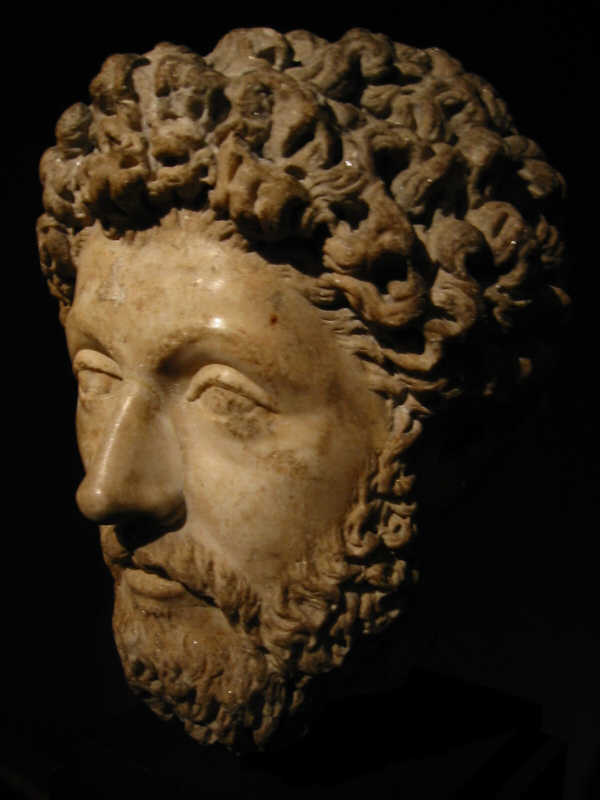
The Death of Marcus Aurelius

The Death of Marcus Aurelius

Tuesday, June 13, 2017

Stoic Music 3


I was just beginning to take the possibility of a Stoic life seriously, not simply as a theory but as an everyday practice, and the blokes in my favorite band band, Marillion, had to release this tune. Those insightful bastards. My wife and I had just lost our first son. I was beginning to understand that I had made truly horrible professional choices, and even more severe personal ones, for my entire adult life.

St. Augustine said that when you sing, you pray twice. I also think that when you hear truth, not only in words but also in music, you are twice blessed.

Marillion, "Rich". from marillion.com (1999)

https://www.youtube.com/watch?v=7x2B5AhcKXs

Reality is something that you rise above
We don't see things as they are, we see them as we are
Avoiding danger is no safer in the long run
The fearful fall foul of fate as often as the reckless

You don't need money to be rich anyhow
Spending yourself is what it's all about

No tears
No lies
No pain
No doubt
No darkness
No confusion
No loneliness, despair
No more, no more
It's all illusion

If you have made mistakes
There's always another chance for you
You can start over again at any moment
Any little time you choose

Talk about failure
To fall is not to fail
Failure isn't about falling down
Failure is staying down

Energy makes energy anyhow
Spend yourself and get rich right now

No tears
No pain
No lies
No doubt
No darkness
No confusion
No loneliness, despair
No way, no how
It's all illusion

Reality is something that you rise above
We don't see things as they are, we see them as we are
There's always another chance for you
You can start over again
Start over again
Over again
Any little time you choose
Get rich right now

Written on 8/01/2010


Monday, June 12, 2017

Living in the best way 12

. . . "But if you will, receive also a tenth present from the leader of the Muses, Apollo, and it is this: that to expect bad men not to do wrong is madness, for he who expects this desires an impossibility. But to allow men to behave so to others, and to expect them not to do you any wrong, is irrational and tyrannical."

--Marcus Aurelius, Meditations, Book 11 (tr Long)

I at first found it odd that Marcus Aurelius saved this not only as his last principle, but marks it as an even greater gift than the first nine, granted not simply by the Muses, but by their master, Apollo.  Wouldn't there be a more profound pinnacle to Stoic living, such as the recognition that no one harms us but ourselves, or that we should try to understand that all men seek the good, or that the false things we grasp for are fleeting and insignificant?

Consider, however, that this tenth principle brings together all the previous ones, not simply on a theoretical basis, but in a very practical way. Can it not be said that the greatest obstacle to inner peace is expecting what is unreasonable, and what could be more unreasonable than thinking that the world should go my way?

Most all of us have heard the old saying that 'life isn't fair', and for those of us with high ideals this rubs us the wrong way. But the simple fact, perhaps the most difficult one to face, is that the world is not fair, at least not in the way that I would wish it to be.

If by fairness, I mean that no one will act poorly toward me, and that I can always expect to be treated with justice, that is deeply foolish. It is also deeply arrogant to assume that the circumstances of the world will conform to me.

If by fairness, however, I mean that even an injustice done to me can be transformed into what is right by my own judgment and action, and can therefore still be brought into harmony with Nature, then there is still the most important fairness. My life can not be fair in what happens to me, though it can be fair in what I do.

That is a hard lesson, deeply humbling, and I wonder if Marcus Aurelius elevates it to the last of his principles precisely because of our great difficulty in accepting this down-to-earth reality.

People have wronged us, and will continue to do so. That is not an indication for despair, but a call to character. I can see why it is reserved as Apollo's gift.

It is so easy to become a pessimist if I wish to accept human weakness for what it is, yet still being able to find the good in all the obstacles is a very part of the whole enterprise.

I sense we are in a time where many of us are all the more easily offended, and therefore we are the sort of people who expect the world to treat us fairly. We are also very ready to offend others in return, and therefore make ourselves exempt from the very behavior we expect of others.

As the years have passed, I have seen more and more how the ability to practice this tenth principle is a hallmark of the true Stoic, and never of the angry or hypocritical man. The difficulties we face in both thinking and using this rule are an indication of its deepest significance.


Written in 11/2002 


Saturday, June 10, 2017

Stoic Music 2

A song that literally saved my life back in 1995. Based upon Max Ehrmann's Desiderata.

Mother Earth, "Look to the Light", from Stoned Woman (1995)

https://www.youtube.com/watch?v=KYlQfsnc68c

Desiderata

Go placidly amid the noise and haste,
and remember what peace there may be in silence.
As far as possible without surrender
be on good terms with all persons.
Speak your truth quietly and clearly;
and listen to others,
even the dull and the ignorant;
they too have their story.
Avoid loud and aggressive persons,
they are vexations to the spirit.
If you compare yourself with others,
you may become vain and bitter;
for always there will be greater and lesser persons than yourself.
Enjoy your achievements as well as your plans.

Keep interested in your own career, however humble;
it is a real possession in the changing fortunes of time.
Exercise caution in your business affairs;
for the world is full of trickery.
But let this not blind you to what virtue there is;
many persons strive for high ideals;
and everywhere life is full of heroism.

Be yourself.
Especially, do not feign affection.
Neither be cynical about love;
for in the face of all aridity and disenchantment
it is as perennial as the grass.

Take kindly the counsel of the years,
gracefully surrendering the things of youth.
Nurture strength of spirit to shield you in sudden misfortune.
But do not distress yourself with dark imaginings.
Many fears are born of fatigue and loneliness.
Beyond a wholesome discipline,
be gentle with yourself.

You are a child of the universe,
no less than the trees and the stars;
you have a right to be here.
And whether or not it is clear to you,
no doubt the universe is unfolding as it should.

Therefore be at peace with God,
whatever you conceive Him to be,
and whatever your labors and aspirations,
in the noisy confusion of life keep peace with your soul.

With all its sham, drudgery, and broken dreams,
it is still a beautiful world.
Be cheerful.
Strive to be happy.

Written om 4/15/2010

Stoic Music 1


Call it Providence, Karma, or the order of the Universe. Call it God, if you will. Each and every thing plays its part, each and every part acts within the whole. There are no accidents. We all get what we deserve. . .

Marillion, "Deserve", From marillion.com (1999)

https://www.youtube.com/watch?v=0CYFKbizAas

They got money, they got sun
They look like they're havin' fun
Don't it seem it's so unfair
They know something you don't know
They've got a better place to go
They're thin and rich and they don't care

We get the dreams that we deserve
The magazines that we deserve
Page one and three that we deserve
The joy and the pain that we deserve
The sun and the rain that we deserve
The material gain that we deserve
We get what we deserve

They got tension, they got stress
They got their lives in the press
The whole world stares as they undress
Sold their friends to get ahead
They do therapy instead
They've got demons in their bed

We get the toys that we deserve
The quiet and the noise that we deserve
The girls and the boys that we deserve
We get what we want if we really want it
We get what we want if we're really honest

You know what you are
You know what you want
You know what you deserve

We get the seas that we deserve
The flowers and the trees that we deserve
The spores on the breeze that we deserve
We get what we want if we really want it
We get what we want if we're really honest

You know what you are
You know what you want
You know what you deserve
You deserve
We get what we deserve
We deserve

Written on 8/01/2010

Michael Leunig 5


Living in the best way 11

. . . "Remember these nine rules, as if you had received them as a gift from the Muses, and begin at last to be a man while you live. But you must equally avoid flattering men and being vexed at them, for both are unsocial and lead to harm.

"And let this truth be present to you in the excitement of anger, that to be moved by passion is not manly, but that mildness and gentleness, as they are more agreeable to human nature, so also are they more manly; and he who possesses these qualities possesses strength, nerves and courage, and not the man who is subject to fits of passion and discontent.

"For in the same degree in which a man's mind is nearer to freedom from all passion, in the same degree also is it nearer to strength: and as the sense of pain is a characteristic of weakness, so also is anger. For he who yields to pain and he who yields to anger, both are wounded and both submit." . . .

--Marcus Aurelius, Meditations, Book 11 (tr Long)

There will still be one final principle of Stoic practice, a tenth value that will both flow from and inform all the others, but for a moment, Marcus Aurelius pauses. What unites everything we have learned is our willingness to have reason rule our passions. None of this a denial or suppression of our feelings. It all rests on the realization that I only rule myself when I act according to sound judgment, and order my emotions with and through that judgment.

Sometimes I am pulled toward the one emotional extreme of giving and receiving flattery. This is the life of the the prideful and manipulative man, the one who loves the false appearances of esteem and status. It is ultimately a concupiscible life, one ordered by a desire for pleasant feelings.

Sometimes, I am pulled toward another emotional extreme of anger and resentment. This is the life of the forceful man of conflict, the one who revels in opposition and conquest. It is ultimately an irascible life, one ordered by the desire for aggressive feelings.

We may lean toward one or the other, or we swing from one to the other, but again, we are missing the mean. We are missing the fact that man, as rational, is rightly sociable, and is made to live in harmony with his brothers and sisters. Neither the want of struggle nor the want of pleasure and position should distract us from the rightful human balance.

I don't think of the reference to manliness here to be some sort of macho toughness, the one that gives Stoicism a bad rap. I think of it as being genuinely human, being mild, gentle, and self-controlled.

It is a strength that does not come from forcibly ruling others, but from ruling oneself. I am weak when I am a victim of my feelings alone, truly strong when I am the master of my passions. There you have a Stoic.

Don't ever think that the strong person is the one who can manipulate the feelings of others, or impose his will by force. He is adamant, hard as steel, not in his coldness, but in his love of right.

Written in 11/2002 


Friday, June 9, 2017

Living in the best way 10

"Ninth, consider that a good disposition is invincible, if it be genuine, and not an affected smile and acting a part.

"For what will the most violent man do to you, if you continue to be of a kind disposition towards him, and if, as opportunity offers, you gently admonish him and calmly correct his errors at the very time when he is trying to do you harm, saying, 'Not so, my child: we are constituted by nature for something else: I shall certainly not be injured, but you are injuring yourself, my child.'

"And show him with gentle tact and by general principles that this is so, and that even bees do not do as he does, nor any animals which are formed by nature to be gregarious.

"And you must do this neither with any double meaning nor in the way of reproach, but affectionately and without any rancor in your soul; and not as if you were lecturing him, nor yet that any bystander may admire, but either when he is alone, and if others are present, without drawing attention."

--Marcus Aurelius, Meditations, Book 11 (tr Long)

Just over a decade ago, one of my college professors offered an observation that seriously changed my thinking. He asked us what it meant to be a good person. The answers, as in any college classroom, were all over the place, some blunt and unclear, others almost baroque in their complexity. When I became a teacher myself only a few years later, I had to learn how to listen to such responses critically, but also respectfully. That is not always an easy task.

His own suggestion was that we assume that the 'good' person is a 'nice' person, and by 'nice' we too often mean someone who does things the way we would like them, someone who is convenient to us for our wants.

Instead, he argued, the Classical model offered that the good person was, first and foremost, virtuous. This meant always showing a concern and respect for the dignity of others, but ultimately doing what was right, regardless of whether it was popular or easy.

I consider that to be how Marcus Aurelius defines having a good disposition. I understand this to mean, quite simply, always acting with love for others. I try to not to confuse love, or genuine kindness, with merely seeking favor. I know that a well-disposed man is one who will never act with anger, impatience, or malice. He seeks what is good for his neighbor, and he does so with an open mind and a big heart.

This principle can only meet with success if it is followed without any ambiguity or deception, Each and every one of us knows those people who can speak with great eloquence about character, and appear to act with great charity, but in the end, they are trying only to be 'nice', not to be truly good. They are trying to play us. The hypocrite comes nowhere close to being a good man. He simply puts on a mask.

I have seen the players in politics, in business, in law, and in academia. I have both laughed and squirmed, been amused and enraged, when I see goodness confused with the thirst for power and influence. Yet I must be very careful. I myself will not have a good disposition if I allow my disapproval to control me. I must practice charity and patience.

I must treat others as I too would wish to be treated. I don't like to be lectured, threatened, or talked down to. I don't like to be manipulated or coerced. Why should I act toward another in this way? That's more about pleasing my own resentment that helping someone.

I can use reason with firmness but also with kindness, I can offer a good example without any desire for display, and I can just have the decency to listen, and to show another person that he is loved, regardless of how he thinks, or what he has done.

Each and every day, I see people trying to make their way through the world by engaging in conflict and strife. The best way, really the only way, to face such an affront to Nature is not being that way myself. Once I lie to the liars, bully the bullies, or play the players, I've sold myself. I've become what I despise. I will only be hurt by a bad man if I myself become bad in reply.

Written in 11/2002 


Thursday, June 8, 2017

Pharrell Williams, "Happy"


I have never had much interest in music that is considered 'popular'.  My poor students will ask me if I know of any recent music. "Yes," I say, "I just bought Marillion's new album."  They are deeply confused by this.

I care little for the popular drama. Yet Pharrell's "Happy" has become my Stoic anthem for the year. It tells me everything I need to know, and it does so with class.

The man's taste in hats is more than sufficient ;-)

"Here come bad news, talking this and that
Well, give me all you got, don't hold it back
Well, I should probably warn ya, I'll be just fine
No offense to you, don’t waste your time
Here's why...
Because I'm happy
Clap along if you feel like a room without a roof
Because I'm happy
Clap along if you feel like happiness is the truth
Because I'm happy
Clap along if you know what happiness is to you
Because I'm happy
Clap along if you feel like that's what you wanna do."

Written on 12/23/2014

https://www.youtube.com/watch?v=y6Sxv-sUYtM

Living in the best way 9

. . . "Eighth, consider how much more pain is brought on us by the anger and vexation caused by such acts than by the acts themselves, at which we are angry and vexed." . . .

--Marcus Aurelius, Meditations, Book 11 (tr Long)

This insight does not even need theory to prove it right, even as the simple apprehension of our human nature should be enough to indicate that a man is measured by his deeds, and not by what is done to him. No, the school of hard knocks, the practice of everyday life, should be evidence enough.

 I need only look back at experience of my own life. What has caused me pain? More fully, what sort of pain did I find to be the most severe, the sort I thought I could never bear?

I find that I caused it for myself. It wasn't forced upon me. 

I have seen physical pain, which exists for a very natural purpose, destroy some people, and lift up others. The severity didn't seem to be the difference, but the estimation made all the difference. The hurt is what it is. Now what will I make of it, and how will I use it, either to my benefit or detriment?

I recently knew a fellow, a man who seemed the paragon of toughness, take his own life as soon as he learned he had been diagnosed with an inoperable brain tumor. It was the very thought of the pain that would eventually come that he simply could not bear.  I can hardly condemn him, because I have sometimes felt the same way.

Many years earlier, I saw my grandmother dying of stomach cancer. Each and every day, she became weaker and more frail. Her eyes showed me everything I needed to know, even at my young age. I cannot even imagine the extreme agony she felt. Yet I remember how deeply it changed her soul, and how much it made her better. I still don't readily share the last things she ever told me, because they were so powerful. She was little more than a skeleton when she died, but she was full of more love, and yes, even joy, than I had ever seen.

A victim of the 'Black Dog', I'm sadly quite experienced in emotional and mental pain. I would never wish that intensity of suffering on anyone. I have tried to wish it away, pray it away, bargain with God, ignore it, or give into it. I have learned that the only thing that works in practice is owning myself.

And here I need to be brutally honest with myself. The hurt of losing my best friend, the shock, the sadness, the despair, was as nothing compared to the pain I gave myself by dwelling upon those circumstances. I never saw it at the time, but most everything that made me miserable was the fact that I allowed my passions to rule me, instead of ruling them.

If someone has done me wrong, I can give in, or I can stand up. I can allow something to take me down, or I can find the good even in the worst of conditions. I am the one who decides, and no one else decides, how I manage my pain.

Good judgment doesn't remove pain, but it does order it toward our benefit. I feel like I should slap myself silly for the simple fact that 90% of my suffering came from my own choice of despair. Very little of what hurt me had anything to do with anyone else, but had to do with my own thinking, my own anger and vexation.

There can be no use in magnifying our suffering by making more of it on our own heads and hearts. By transforming myself, I can make even the worst of experiences beneficial to my own character. What someone else has done has nothing to do with me. I have to 'do' with me.

Written in 11/2002 


Wednesday, June 7, 2017

Maximilian Kolbe


Living in the best way 8

. . . "Seventh, that it is not men's acts which disturb us, for those acts have their foundation in men's ruling principles, but it is our own opinions which disturb us.

"Take away these opinions then, and resolve to dismiss you judgement about an act as if it were something grievous, and your  anger is gone.

"How then shall I take away these opinions? By reflecting that no wrongful act of another brings shame on you: for unless that which is shameful is alone bad, you also must of necessity do many things wrong, and become a robber and everything else." . . .

--Marcus Aurelius, Meditations, Book 11 (tr Long)

 With the seventh principle, we arrive at the real heart of the Stoic matter. I can't blame others for my problems. They may be wrong in their actions, but the only measure of my own happiness is if I am right in my actions.

I always begin with a simple example. A man looks at me the wrong way, snubs me, insults me, or cheats me. I then feel that I have been wronged, and I fret about this injustice. But what if I were to not allow myself to be affected by his action? I am the one who will decide how much it matters.

Surely it matters quit a bit if he steals my property, or my reputation, or my livelihood? No, because none of those things need to matter to me, unless I choose to let them do so. If I define my value as a person by such externals, I will indeed be miserable. But if I define my value as a person by my own actions, these things need not concern me.

Not only will such things not harm me at all, but they will also give me the opportunity to act with character myself. The offender loses, because he destroys himself; the victim can actually triumph, because he turns an evil into a good.

Everything simply depends upon how I estimate a situation. I can always be successful, because I can always choose to find the good in anything and everything that happens to me. Only my judgment determines this.

Even if I up the ante to far more serious situations, when a man threatens my very life, the same rule applies, not with any less force, but all the more. The stakes are higher, and the reward of choosing rightly is therefore simply greater.

Maximilan Kolbe gave his life, freely and without complaint, during the horrors of war, simply so that he could act with love for others. He did not complain about the injustice of his state, though he clearly recognized it. He did not cast blame, because he recognized himself in others. He did not consider his circumstances unfair, because he knew that he could produce joy even in the midst of the greatest of misery.

I always remember his words: "A single act of love makes the soul return to life."

He understood that his own happiness had nothing to do with what people did to him. He knew it depended on what he did in the face of evil.

The only war that matters is the one within my own soul. I won't win it by giving hatred for hatred, violence for violence, or injustice for injustice. I will only win when I offer love whenever I am confronted by hatred, violence, or injustice.

Written in 11/2002 


Tuesday, June 6, 2017

Living in the best way 7

. . . "Sixth, consider when you are much vexed or grieved, that man's life is only a moment, and after a short time we are all laid out dead." . . .

--Marcus Aurelius, Meditations, Book 11 (tr Long)

 I once took expressions of this sort as morbid and pessimistic They made me feel as if nothing mattered, and that everything in life was fickle and fleeting. I assumed this meant that a sad resignation was the only solution.

My judgment, of course, said much more about myself than about my understanding of Stoicism. At no point is Marcus Aurelius, or any other Stoic, asking me to simply give up on life, and accept that everything is nasty, brutish, and short.

He isn't saying life doesn't matter; he's reminding us about those certain things in life that don't really matter. This leaves us with precisely those things that are lasting and unassailable.

The first time I re-read the passage with actual care, I understood. If I am troubled, what is the source of my trouble?

If I am the source, I need only change my thinking, and there is no vexation.

Is it something external to me, my fellows and my circumstances? These are not the measure of my happiness, so why am I allowing them to drag me down? It is only when I remember that the things I believe matter actually don't matter at all, that I can get a hold of my situation. That's not pessimism, that's sound and productive thinking.

I have considered it in the following way. What worries me? My possessions, reputation, position, or the satisfaction of my pleasures? Yet all of these things are entirely beyond my power, they are fleeting, they will come and go, and, in the end, whether or not I called them mine, they will make absolutely no difference.

What makes my life worth living is simply by how well it is lived, by wisdom and virtue. I may think that a richer man, or a more popular man, or a man who lives a few years longer, is better off. He is not, because the quantity of our circumstances is only as good as the quality of our character.

It may seem unfair that he has more money, or better friends, or the blessings of health. These differences may seem vast if we are fighting for scraps, but they are nothing at all when measured by Providence. The things that must pass, the things sadly cared about by the world, will inevitably end, sooner or later, and all of it will be but the blink of an eye in the order of all things.

In the end, the only thing I ever possessed was how I chose to think, love, and act. Mortality makes a wonderful equalizer, regardless of whether we are buried in a mausoleum or in a pauper's grave.

'Dying with the most toys', as they say, makes absolutely no difference once one is dead, and it didn't really matter much when we are alive, either. The only measure is how well I lived in the very short time I had.

Written in 11/2002 


Monday, June 5, 2017

Michael Leunig 4


Living in the best way 6

. . ."Fifth, consider that you do not even understand whether men are doing wrong or not, for many things are done with a certain reference to circumstances. And in short, a man must learn a great deal to enable him to pass a correct judgement on another man's acts." . . .

--Marcus Aurelius, Meditations, Book 11 (tr Long)

I must always be aware of the swing of the pendulum, the danger of moving from one extreme to another, without halting at the mean that is in between.

I may previously have hated my fellows, because I thought them to be lesser than myself. If I have rightly considered stages one through four, then I now understand that others are no better or worse than myself. This is because we all share the same human strengths and weaknesses. I have hopefully become able to think this way because I can try to understand the reason and motives behind the actions of others. They are really no different than my own.

Careful. I may now become conceited. I may now think that I can easily grasp how and why people do what they do. I will think of myself as the great genius, the one who immediately knows the inner workings of anyone and everyone.

I barely understand my own workings. Marcus Aurelius is quite right to ask me to think with and through others, but he hardly means that I can know their own minds in each and every way. It is one thing to show an understanding for the behavior of others. It is quite another to now make myself the master of their thinking.

The virtue ethics of Aristotle and St. Thomas Aquinas offers a helpful measure. Consider not only the action itself, but also the intention behind the action, and the circumstances surrounding the action.

I may know, for example, that the act of theft is wrong. Now let me also ask what a man intended by taking what was not his. Let me also ask under what conditions or circumstances he did so. Suddenly, if I think with an open mind, I cannot be too quick to judge. Is the man who steals from greed different from the man who steals from need? Do starvation or profit make the situation different? Is one compulsion more justifiable than another?

Life will throw us many odd experiences. I once knew a fellow who quite innocently asked me if I had a crowbar in the trunk of my car. I did, but I asked him why he needed it. After much back and forth, he admitted he was intending to break into his former place of work that night, and steal the cash box. Why? He was angry, and he was greedy. He wanted revenge on his boss, and he was low on money, because he hadn't been granted unemployment insurance

A few years earlier, I was working in social services, and an attorney contacted me about one of our clients, a young man who had struggled with heroin addiction for ten years. He had been clean for almost two years. He sadly slipped, and the fellow had just been arrested helping someone try to hold up a liquor store.

I immediately offered to  be a character reference, and I appeared in court to help explain the desperation this young man felt. Nothing excused what he did, but I was happy to help a judge understand where our client was coming from. I had spent many hours consoling him, praying with him, and crying with him. His action was deeply wrong, but his heart was right, and his circumstances were beyond what most of us would possibly bear.

Which of these two was the better man? The first, of course, actually did nothing, even though he desired to do harm. The second did harm, but had absolutely no intentions of malice. Neither was better. I can only speak about both cases because I knew both men so well, and understood their intentions and circumstances a bit more fully than I would those of a total stranger.

It may be a truism, but I must try try to walk in someone else's shoes for a moment. I must attempt to think what he must be thinking, and put myself in his very specific conditions.

I am deeply saddened when anyone claims to fully understand the motives and circumstances of anyone else, especially of someone he does not know. How would I feel, what would I think, what would I decide, what would I do if I was in that situation? I cannot, in good conscience, throw stones, and I will not dispose of others because of my weak judgment.

Many people have hurt me, and I have also hurt many people. I cannot condemn the other, while also justifying myself.

I can love my neighbor far more fully when I am open to his situation, than when I close myself to his humanity.

Written in 11/2002 


Sunday, June 4, 2017

Living in the best way 5

. . . "Fourth, consider that you also do many things wrong, and that you are a man like others; and even if you do abstain from certain faults, still you have the disposition to commit them, though either through cowardice, or concern about reputation, or some such mean motive, you abstain from such faults."

--Marcus Aurelius, Meditations, Book 11 (tr Long)

The order of Marcus Aurelius' principles of action follows a natural progression. These are hardly a random set of suggestions, but are rather a clear sequence, where each follows from the other.

First, I must remember that men are made for one another, and never to oppose one another. This may seem so simple, yet it is so radical. I challenge anyone to claim that he has always lived in this manner.

Second, I must consider not simply what men do, but why they might do it. The harmony of human nature will only become apparent when all of our goals are understood together.

Third, I must understand that we choose evil because we do not truly or fully understand what is good. This may help us look at others with compassion, and not with dismissal or hatred.

And now, at the fourth and next stage of our exploration, after putting myself in my proper place of perspective, I must accept that I am really no better, and no worse, than anyone else. The weakness I perceive in the man I resent is nothing more than the weakness inside myself.

Surely, though, I think that I can say that I am better? I have not lied, stolen, slandered, or damaged others in the same way that my enemy has done to me. I would like to think of myself as the better man, precisely because I have not acted as he does. If I'm not worthy of more merit, what would be the point of moral judgment?

Precisely because once I think that moral judgment makes me worth more than someone else, I have already thereby resigned my right to make such a judgment. For all of my differences from others, my human nature is no different than that of anyone else. As soon as I have cast away another, I have cast away myself.

I must clarify. I can no longer count the number of times I have treated another person with disrespect. Yet now I wish to judge another for acting as I have done, time and time again? What sort of hypocrisy is that?

Let us, for the sake of argument, assume that I have changed my ways.  I no longer act in this way. No, there are still, even now, those times when I still do, because I allow my passions to rule my reason, and I disorder Nature. And even when I do not, is it really such a far cry for me to know exactly how and why my neighbor has lived poorly?

I must remind myself, even then, how quickly I can become the same once again. Just a single change in my thinking, one small alteration, and my life will slip back to vice. No, I cannot think of myself as better. Either I have been, or I so easily could, be exactly like the person I resent.

I must also remind myself that far too often I have done a good deed, but for all of the wrong reasons. There is no merit in that, either. If I have been kind to be liked, I haven't been kind. If I have been humble because I am afraid, I haven't been humble.  If I have been magnanimous to gain influence, I haven't been magnanimous. How often may I claim a purity of motive? I may not, then, demand it of another.

I may not be a bad man, right here and now, but I have been, and I could be once again very easily, 'but for the grace of God'. No, I am no better.  I am constantly tossed and turned by my passions for pleasure, fortune, fame, power, or wealth. How can I condemn another for the exact same things I struggle with each and every day?

Call this old Stoic an old hippie, and I won't mind a bit. Only love is the law. If I can figure that out, I'm moving into the fourth stage of discernment about my thinking and living.

Written in 11/2002 


Saturday, June 3, 2017

Living in the best way 4

. . . "Third, that if men do rightly what they do, we ought not to be displeased; but if they do not right, it is plain that they do so involuntarily and in ignorance.

"For as every soul is unwillingly deprived of the truth, so also is it unwillingly deprived of the power of behaving to each man according to his deserts.

"Accordingly men are pained when they are called unjust, ungrateful, and greedy, and in a word wrong-doers to their neighbors." . . .

--Marcus Aurelius, Meditations, Book 11 (tr Long)

Philosophers have long discussed the problem of moral weakness.  Can a man truly do something wrong, even while also knowing that it is wrong? Surely, if he knows it is not beneficial, will he not try to avoid such an action?

Plato argued that all vice came from ignorance, hence the solution was education, not punishment. Aristotle argued that men will indeed do wrong knowingly, but that their knowledge is clouded and hindered, and hence they do not choose to apply in practice what they know to be true in theory. The solution is the regular application of good habits and the development of character.

I have never assumed a dichotomy between these two positions. The deeper, theoretical questions about the relationship of the intellect and the will are indeed worthy questions, and for that I have the greatest respect.

I view the exercise of Stoicism, however, in a more immediate and practical light. I ask myself, in each and every particular instance, what is happening in my own judgment. I have long ago learned never to speak for another, but I have, with time and effort, learned to speak for myself.

My own failures have almost invariably involved something like this: I may have an apprehension that greed, deception, or vanity are some of the deepest vices. Yet that apprehension is vague and incomplete, and has no relation to my living. It is as if I was thinking in one world, and acting in another.

My thinking, therefore, is entirely removed from my living, an exercise in two different realms. I have come to recognize it in myself as a form of hypocrisy. I have freely chosen to accept two completely separated, and contradictory, standards. I think about one, and use the other. My will was already hindered by my poor judgment to begin with.

A man may know that the complete and unconditional love of his wife is right and good, and that this follows the order of Nature. But he surrenders his reason to his passions. At that moment, and at that time, he has completely and freely judged that adultery is a greater good than love. He no longer 'knows', in any true sense, what is good, because he has chosen a totally different apprehension of the good, at that instance of his decision.

Don't look back and justify or excuse it. Own it, and choose to make it better. Fix what you have broken, and show compassion when other people break their own lives, or try to break yours. 'They know not what they do.'

Describe the relation, in abstract principle, as you will. I will not debate for the sake of conflict or of being proven right. But I can indeed describe my own weakness in any instance. I have not known, in any true sense, what was right whenever I have acted with vice. I have replaced true dignity with the service of the self, and I have somehow convinced myself I am doing one, when I am actually doing the other.

I suggest that Plato was right. Vice does arise from ignorance. I also suggest that Aristotle was right. Ignorance admits of many causes and degrees, but it is still a form of ignorance. 

In practice, it means I need to look at my fellows, especially those who act against me, and humbly ask why they might do what they do. In some form or another, they do not know what is right and good.

And if I see this weakness in another, a weakness I have often had myself, will I cast blame and speak with condemnation? Or could I perhaps simply ask myself how I might help my fellow man understand what is right and good, a meaning and purpose he has always shared with me?

To change my judgment changes everything about how I perceive my neighbor. I need to fix myself first, and worry less about judging others.

Written in 11/2002 


Honorary Stoicism 16


Living in the best way 3

. . . "Second, consider what kind of men they are at table, in bed, and so forth: and particularly, under what compulsions in respect of opinions they are; and as to their acts, consider with what pride they do what they do." . . .

--Marcus Aurelius, Meditations, Book 11 (tr Long)

After considering how we are always made for one another, and never to oppose one another, I can next ask myself not only what sorts of actions men perform, and what habits drive them, but especially what it is that may motivate them to such actions. What are they thinking? What purpose are they aiming at?

This may, at first seem an exercise in breeding resentment. I could fill myself with all the false appearances of terrible malice and evil intentions, but if I only choose to reflect clearly, I will surely see that others most likely don't think as I imagine that they do. We are all seeking what we perceive to be a good, however ignorant it may be, and to perceive this simple fact can begin to bridge the divide between us.

If someone seeks fame, fortune, or pleasure, I shouldn't assume he's rubbing his hands will glee at the death and destruction he pursues. He simply thinks that fame, fortune, and pleasure are the goods he was made to appreciate.  He judges them to be natural.

Now how often have I done the same thing, by pursuing a mistaken good? If I can understand my own motivations, the pride I sought, I can now better understand my fellows.  They no longer need to be the 'other', the opponent, the adversary. He is in error, but I have surely thought and desired that same error.

Practice thinking with and through other men, and I will begin to understand them more fully. Once I understand them more fully, I can order my own words and actions toward helping them out of their worries and bonds, not adding to them.

Written in 11/2002 


Friday, June 2, 2017

Living in the best way 2

"If any have offended against you, consider first: What is my relation to men, and that we are made for one another; and in another respect, I was made to be set over them, as a ram over the flock or a bull over the herd.

"But examine the matter from first principles, from this: If all things are not mere atoms, it is nature which orders all things: if this is so, the inferior things exist for the sake of the superior, and these for the sake of one another."

--Marcus Aurelius, Meditations, Book 11 (tr Long)

First, Marcus Aurelius asks us to always remember that we live not in isolation from or in opposition to others, but through and with them. Men are made for one another, some to be greater and some to be lesser in different ways, but all for one another.

It is Nature itself that has made it so. Nature is not merely the random assembly of matter, but in each and every aspect reveals purpose. All of us participates in that purpose.

This realization needs to be a first principle of action, not merely a pleasant platitude. After all these years of seeing how petty and vindictive some people can be, I am still amazed at the assumption that I must be in constant competition with my fellows, and when I have been wronged, I should do wrong in return. Where there should be harmony and cooperation, we too often find struggle and conflict.

The mere appearance of solidarity won't suffice, for what we then all too easily do is to smile in public, but plunge the knife in private. I have often thought of this as speaking or acting sideways. None of Marcus Aurelius' nine other principles will be of any use if we cannot, with humility, justice, and charity embrace the natural fellowship of all persons.

By all means, I may feel sadness, dejection, or anger when someone has acted against me. It can be my judgment, however, to deliberately order my thoughts and feelings always for benefit, and never for harm. That crucial decision is always within my power.


Written in 11/2002