The Death of Marcus Aurelius

The Death of Marcus Aurelius

Thursday, September 9, 2021

Cicero, Tusculan Disputations 1.18


M. We will pass over Dicaearchus, with his contemporary and fellow-disciple Aristoxenus, both indeed men of learning. One of them seems never even to have been affected with grief, as he could not perceive that he had a soul; while the other is so pleased with his musical compositions that he endeavors to show an analogy between them and souls. 


Now, we may understand harmony to arise from the intervals of sounds, whose various compositions occasion many harmonies; but I do not see how a disposition of members, and the figure of a body without a soul, can occasion harmony. He had better, learned as he is, leave these speculations to his master Aristotle, and follow his own trade as a musician. Good advice is given him in that Greek proverb,


“Apply your talents where you best are skilled.”


I will have nothing at all to do with that fortuitous concourse of individual light and round bodies, notwithstanding Democritus insists on their being warm and having breath, that is to say, life. 


But this soul, which is compounded of either of the four principles from which we assert that all things are derived, is of inflamed air, as seems particularly to have been the opinion of Panaetius, and must necessarily mount upward; for air and fire have no tendency downward, but always ascend; so should they be dissipated that must be at some distance from the earth. 


But should they remain, and preserve their original state, it is clearer still that they must be carried heavenward, and this gross and concrete air, which is nearest the earth, must be divided and broken by them; for the soul is warmer, or rather hotter, than that air, which I just now called gross and concrete: and this may be made evident from this consideration—that our bodies, being compounded of the earthy class of principles, grow warm by the heat of the soul.


Cicero now briefly returns to the theories of some earlier thinkers, keeping in mind how a consideration of the intelligible, in which the human soul by definition participates, draws into question any claim that the heart, or the brain, or the blood can in themselves account for what we call human life. 


Whenever someone tells me, with a great confidence in what he calls “science”, that his identity is nothing more than the firing of nerve cells, I immediately duck for cover. I don’t do this because I am an expert in neurobiology, but because I can see that his judgment depends upon the very consciousness he so vehemently denies.


It is much the same as when folks refute free will, while using their own free will to choose to refute it. 


It also reminds me of a conference I once attended, where a presenter offered a thoughtful argument for why our lives should rely on faith alone, at the exclusion of reason. When I asked if it seemed contradictory to use reason to deny reason, I was simply told that my faith was not yet “sufficiently mature” for me to understand. 


“Yes, but you’re asking me to understand that what you say does not need to be understood. Perhaps I am missing something, but that sounds like trying to have it both ways.”


“That’s because you don’t have enough faith.”


Jesus wept, though he apparently didn’t have any knowledge of what he was doing. 


So when someone like Dicaearchus claims that he doesn’t have a soul, even as he lives, breathes, and ponders that point, or that he doesn’t have feelings at the moment that he is feeling, I can only shrug. 


And when someone like Aristoxenus claims that the parts define the whole, even as the whole defines the parts, my head spins around and around.


Stick to what you know best, Cicero suggests, and don’t assume that what you don’t know works by a weak analogy to what you do know. Be a brilliant musician, by all means, while understanding that the music is but one aspect of this life, not the totality of this life. 


If you have at all wandered about in the world of academia, you have, for example, met a Democritus: “Everything is reducible to tiny particles, and though we don’t really know how they work, that is surely all that can exist. I know this because all I study is tiny particles.”


Show me how to ride a horse by giving me a recipe to bake a cake. 


The mind, that pinnacle of the human soul, can contemplate, however poorly, those particles, and so it has the power to rise above those particles. As St. Thomas taught me, a thing cannot receive what it already contains. 


Consciousness has something more to it than a random conglomeration of bits and pieces of matter; yet this is the new cosmology of our age, preached by the new prophets like Carl Sagan, Richard Dawkins, or Bill Nye, the Science Guy. 


I’ll take a Mr. Rogers over a Bill Nye on any day. 


Mr. Rogers may not have known the difference between a muon and a gluon, but he knew the difference between love and hate. This was because he nurtured his soul, something that can always, without exception, rise up to the highest highs, and is never subject to the law of gravity. 

Written in 3/1996


Wednesday, September 8, 2021

Tuesday, September 7, 2021

The Art of Peace 75


Failure is the key to success;
Each mistake teaches us something.


Sayings of Publilius Syrus 14


Bitter for a free man is the bondage of debt. 

Cicero, Tusculan Disputations 1.17


M. But I return to the ancients. They scarcely ever gave any reason for their opinion but what could be explained by numbers or definitions. It is reported of Plato that he came into Italy to make himself acquainted with the Pythagoreans; and that when there, among others, he made an acquaintance with Archytas and Timaeus,  and learned from them all the tenets of the Pythagoreans; and that he not only was of the same opinion with Pythagoras concerning the immortality of the soul, but that he also brought reasons in support of it; which, if you have nothing to say against it, I will pass over, and say no more at present about all this hope of immortality.


A. What, will you leave me when you have raised my expectations so high? I had rather, so help me Hercules! be mistaken with Plato, whom I know how much you esteem, and whom I admire myself, from what you say of him, than be in the right with those others.


M. I commend you; for, indeed, I could myself willingly be mistaken in his company. Do we, then, doubt, as we do in other cases (though I think here is very little room for doubt in this case, for the mathematicians prove the facts to us), that the earth is placed in the midst of the world, being, as it were, a sort of point, which they call a κέντρον, surrounded by the whole heavens; and that such is the nature of the four principles which are the generating causes of all things, that they have equally divided among them the constituents of all bodies; moreover, that earthy and humid bodies are carried at equal angles by their own weight and ponderosity into the earth and sea; that the other two parts consist, one of fire, and the other of air? 


As the two former are carried by their gravity and weight into the middle region of the world, so these, on the other hand, ascend by right lines into the celestial regions, either because, owing to their intrinsic nature, they are always endeavoring to reach the highest place, or else because lighter bodies are naturally repelled by heavier; and as this is notoriously the case, it must evidently follow that souls, when once they have departed from the body, whether they are animal (by which term I mean capable of breathing) or of the nature of fire, must mount upward. 


But if the soul is some number, as some people assert, speaking with more subtlety than clearness, or if it is that fifth nature, for which it would be more correct to say that we have not given a name to than that we do not correctly understand it—still it is too pure and perfect not to go to a great distance from the earth. 


Something of this sort, then, we must believe the soul to be, that we may not commit the folly of thinking that so active a principle lies immerged in the heart or brain; or, as Empedocles would have it, in the blood.


Looking for something other than legends about spirits, philosophers attempted to further employ reason in understanding the workings of the world. 


Is it possible to interpret our experience using more precise terms, identifying the parts by their very essences? Can the study of mathematics help to provide measure and order to the patterns of nature? It is still the same old sense of wonder, though it also adds a longing for more comprehensive explanations, where evidence and proof give a firmer foundation than a feeling and a hunch. 


I do wish I had more of a gift for mathematics, but what I can manage is enough to show me how the relationship in quantities reveals so much about the qualities of the universe we observe. A disciplined consideration of numbers, beginning with clear definitions and proceeding by valid demonstrations, tells me that what may initially seem jumbled and chaotic is actually an expression of profound balance and harmony. 


In my case, it was working through Euclid’s Elements on my own that finally made it “click” for me. I had struggled for many years in the usual math classes, and I felt frustrated that many others saw the connections, where I only saw the drudgery of memorization. I suppose I can’t blame my teachers for giving up on me, so I eventually decided I would have to knock myself into better shape. My father told me to go straight to the source, not mess about with watered-down textbooks, though he warned me it might hurt at first. 


It did hurt, and I imagine that was a necessary initiation. There came a moment, quite suddenly, where I saw a larger sense of what Euclid was doing, and then all of those definitions, axioms, postulates, and propositions came together. It was something beautiful now, not just a hodgepodge of lines and letters. 


I am not qualified to speak about any historical influence the Pythagoreans may have had on the philosophy of Plato, as Cicero here describes, and yet I immediately draw a link in my own thinking between the way an abstract awareness of numbers clears the path to grasping universal concepts and principles about reality. 


I cannot see or touch an idea directly, even as my apprehension of an idea ends up being precisely what gives meaning to whatever I see or touch. Once I have risen to the level of the intelligible realm, everything in the sensible realm now looks like a pale imitation. It was in this manner that Euclid helped me to appreciate Plato. 


Now once again, the ideas of physics presented here will come across as raw and ridiculous to many moderns; I will not bicker with them, as I believe that they do not quite understand how science is an evolving process, not a fixed set of doctrines. Note simply how a worthy attempt is being made to distinguish between the different elements out of which the world is composed, and to describe how these constitutive parts behave in very distinct ways. 


What is heavier appears to descend, and what is lighter appears to ascend, and by extension we can ask whether the soul, as the first principle of life, is more like something with greater or lesser substance. If we are to speak of the soul as breath, or as similar to fire, would it not make more sense to argue that soul will be lifted up into the heavens when freed from the body, instead of being dragged down into the earth? 


Such speculation may not even be necessary, however, if the soul is considered to have an immaterial existence, like that of a number or of an idea, or if it is made from a totally different type of matter, one which is not directly evident to our senses. Then it would not be subject to the forces of the other elements at all, and it would also not be bound to this one point in space and time. 


Call it childish if you must, but I would be mightily impressed by a child who questions in such a way, and I would expect great things from him. He is already peeking his head out from under the veil of mere opinion. 

Written in 3/1996

IMAGE: The Flammarion Engraving (1888)


Monday, September 6, 2021

Sayings of Heraclitus 49


The hidden attunement is better than the open.


Sayings of Ramakrishna 110


The true religious man is he who does not do anything wrong or act impiously when he is alone, that is, when there is none to look after and blame him.


Cicero, Tusculan Disputations 1.16


M. But as we are led by nature to think there are Gods, and as we discover, by reason, of what description they are, so, by the consent of all nations, we are induced to believe that our souls survive; but where their habitation is, and of what character they eventually are, must be learned from reason. 


The want of any certain reason on which to argue has given rise to the idea of the shades below, and to those fears which you seem, not without reason, to despise; for as our bodies fall to the ground, and are covered with earth (humus), from whence we derive the expression to be interred (humari), that has occasioned men to imagine that the dead continue, during the remainder of their existence, underground; which opinion has drawn after it many errors, which the poets have increased; for the theater, being frequented by a large crowd, among which are women and children, is wont to be greatly affected on hearing such pompous verses as these,


“Lo! here I am, who scarce could gain this place,

Through stony mountains and a dreary waste;

Through cliffs, whose sharpen’d stones tremendous hung,

Where dreadful darkness spread itself around.”


And the error prevailed so much, though indeed at present it seems to me to be removed, that although men knew that the bodies of the dead had been burned, yet they conceived such things to be done in the infernal regions as could not be executed or imagined without a body; for they could not conceive how disembodied souls could exist; and, therefore, they looked out for some shape or figure. This was the origin of all that account of the dead in Homer. This was the idea that caused my friend Appius to frame his necromancy; and this is how there got about that idea of the lake of Avernus, in my neighborhood,


“From whence the souls of undistinguish’d shape,

Clad in thick shade, rush from the open gate

Of Acheron, vain phantoms of the dead.”


And they must needs have these appearances speak, which is not possible without a tongue, and a palate, and jaws, and without the help of lungs and sides, and without some shape or figure; for they could see nothing by their mind alone—they referred all to their eyes. 


To withdraw the mind from sensual objects, and abstract our thoughts from what we are accustomed to, is an attribute of great genius. I am persuaded, indeed, that there were many such men in former ages; but Pherecydes the Syrian is the first on record who said that the souls of men were immortal, and he was a philosopher of great antiquity, in the reign of my namesake Tullius. 


His disciple Pythagoras greatly confirmed this opinion, who came into Italy in the reign of Tarquin the Proud; and all that country which is called Great Greece was occupied by his school, and he himself was held in high honor, and had the greatest authority; and the Pythagorean sect was for many ages after in such great credit, that all learning was believed to be confined to that name.


An instinct may point the way, and then reason tries to follow along the path, though oftentimes we find that the intellect struggles with the limit of its powers. We work with what the imagination at first provides, and so we still find ourselves bound to an incomplete awareness or a weak analogy. This is true when we wonder about a life after death, just as it is with so many inquiries in this life. 


The fact that our bodies are buried in the ground, or that they decay into the soil, may lead us to think that the soul, as the identity of the individual, somehow continues its existence underneath the earth. Earlier, the Auditor was dismissive of such an idea, finding it primitive and superstitious, but we must remember that the mind will make use of the most immediate and vivid images to discern some sort of meaning. 


I have myself stood by a grave, believing that a person I miss is beneath that slab, or held an object once possessed by someone I loved, feeling thereby closer to him, or looked into the eyes on a photograph, and taken them to be as if they were actual eyes. 


If I reflect in a less attached and more abstract manner, I might suspect that these things are not literally true, even as the figurative presence seems quite real to me. In such a case, the association can be something helpful to me for my own inner workings, and a danger will only arise if I start confusing how it feels to me right now with how it must be in and of itself. Then, what had been an aid to understanding becomes a hindrance to understanding.


Consciousness is grounded in the experience of the senses, and so it should come as no surprise that we regularly return to our first impressions as points of reference. If it exists for us, it seems most substantial if it has a physical form, and presents itself in a certain place, or appears with a particular shape. 


My thinking will only remain small, and therefore narrowly superstitious, if I do not examine beneath and beyond the images. This can sometimes be of great difficulty, where a step must be taken from the sensible to the intelligible. After all, if there is a being, I assume it must be visible, and if there is life, I assume it must have flesh and blood, and if a thought is expressed, I assume there must be spoken words by which it is uttered. 


Cicero here gives praise to Pherecydes and Pythagoras for being among the thinkers who encouraged us to have our minds rise above the material appearances alone, to make a transition, as we might say nowadays, from mythical symbols to scientific definitions. It makes it possible to ask whether the souls of the dead are like the stories about shades in the underworld, or whether it would be more accurate to speak of their existence in terms that are very different from the properties of our current experience. 


The senses perceive at one level, and the mind comprehends at another level. 

Written in 3/1996

IMAGE: Gustave Doré, Charon Herds the Sinners onto his Boat (1857)


Saturday, September 4, 2021

Tidbits from Montaigne 31


The sage says that all that is under heaven incurs the same law and the same fate.

—Michel de Montaigne, Essays 2.12

Knot


M.C. Escher, Knot (1966)


Friday, September 3, 2021

Epictetus, Golden Sayings 145


Remember that not only the love of power and wealth sets us under the heel of others, but even the love of tranquillity, of leisure, of change of scene—of learning in general, it matters not what the outward thing may be—to set store by it is to place yourself in subjection to another.

Where is the difference then between desiring to be a Senator, and desiring not to be one: between thirsting for office and thirsting to be quit of it? 

Where is the difference between crying, "Woe is me, I know not what to do, bound hand and foot as I am to my books so that I cannot stir!" and crying, "Woe is me, I have not time to read!" As though a book were not as much an outward thing and independent of the will, as office and power and the receptions of the great.

Or what reason have you, tell me, for desiring to read? For if you aim at nothing beyond the mere delight of it, or gaining some scrap of knowledge, you are but a poor, spiritless knave. 

But if you desire to study to its proper end, what else is this than a life that flows on tranquil and serene? And if your reading secures you not serenity, what profits it?

"No, but it does secure it," says he, "and that is why I repine at being deprived of it."

And what serenity is this that lies at the mercy of every passer-by? I say not at the mercy of the Emperor or Emperor's favorite, but such as trembles at a raven's croak and piper's din, a fever's touch or a thousand things of like sort! 

Whereas the life serene has no more certain mark than this, that it ever moves with constant unimpeded flow.


Stoic Snippets 98


Return to your sober senses and call yourself back; and when you have roused yourself from sleep and have perceived that they were only dreams which troubled you, now in your waking hours look at these things about you as you did look at those dreams.

—Marcus Aurelius, Meditations 6.31

Epictetus, Discourses 1.10.4


What is my conclusion? Are we elders alone indolent and sleepy? 


No, the fault is much rather with you young men. For indeed, we old folk, when we see young men playing, are only too eager and ready to join their play. 


Much more, if I saw them thoroughly awakened and eager to share my studies, should I be eager myself to take my studies seriously too.


It is uncomfortable and unpopular to say it, and yet it is important to be reminded of our vanities: so much of the work we do is hardly work at all, but rather only busywork.


There are the few who help to provide the things we need, and then there are the many who create new tasks and positions for themselves, so that they might feed their sense of self-importance. These are the ones who spend their energies on advancement in Rome, in whatever time or place they happen to live. 


And as inconvenient as it may at first appear, it is my responsibility to resist that temptation. There may be a nagging urge to want to become an important man, when all I really need to worry about is trying to become a good man. 


When I see it all around me, it is so easy either to submit, or to just wish to go back to sleep. Nor will there be any benefit from stewing in anger, or scheming my sweet revenge, because then I have myself become the very thing I claim to despise.


Yes, it frustrates me when I look at the organizational chart for an institution I have grown to love, where there are dozens of vice presidents, directors, and managers crowded at the top, while those who get the actual job done are down in one of the bottom corners.


Yes, I do sometimes wonder whether the politicians, board members, or bishops are even aware of how their power games affect the lives of real people. 


Still, no good ever comes from pointing fingers, and the only way to even start making the world a bit better is by starting to make myself a bit better. We never make other people to be who they are, though we most certainly influence other people to choose who they are. 


I could blame the old men, for example, whether they are in their granite banks or their ivory towers, for having failed us, though I am forgetting that they are as likely to imitate the young as the young are to resent the old. I am still relatively young, and so I have it within myself to contribute my own vitality. Instead of saying how wrong they are, have I encouraged any of them to follow what is right? 


I am also old enough, however, to know that age has a way of making us feel irrelevant. Is it any wonder that an old man loses heart, when the young man pays no attention to him? If he saw the young man driven to improving his own character, instead of lying around or tilting at windmills, might he be inspired to share something of what he has to offer? 


So, what have I done today to ask that old man to tell me his story? He won’t speak if I won’t bother to listen, and then we all just end up being shallow and lazy, doing as the Romans do. 

Written in 11/2000


Thursday, September 2, 2021

Dhammapada 151


The brilliant chariots of kings are destroyed, the body also approaches destruction, but the virtue of good people never approaches destruction—thus do the good say to the good.


The Choice of Hercules 11


Thomas Sully, The Choice of Hercules (1819)


Epictetus, Discourses 1.10.3


And yet how can their business be compared in importance with ours? If you attend to what they are doing you will see the difference. 


They do nothing all day long except vote, dispute, deliberate about a handful of corn or an acre of land, and petty profits of this sort. 


Is there any resemblance between receiving and reading a petition such as this: “I beg you to let me export a little corn”, and a petition such as, “I beg you to inquire from Chrysippus how the Universe is governed and what position the rational creature holds in it; inquire too who you are and what is good for you, and what is evil?”


What have these petitions in common? Do both demand the same attention? Is it equally shameful to neglect one and to neglect the other?


There is surely a great contrast between crunching the numbers on a balance sheet and estimating the good in the soul, insofar as the one is completely pointless without a reference to the other. Some people get busy with the trappings of living, and other people get busy with the actual living. We have our priorities backwards when we say that the banker is being so useful to society, and then go on to say that the sage is of no use at all. 


Yes, the objects of concern are different, as the lesser is distinct from the greater, or what is on the surface is distinct from what is in the depths, and yet there must also be a difference in method, where what is purely technical is treated in another manner than what is profoundly sacred. 


If you don’t believe me, observe how you can find accountants who still keep the measure of human dignity in mind, and, conversely, intellectuals who seem to forget that all their research and writings ought to be in the service of the virtues. A small-minded technocrat is only a nuisance, while a petty scholar is a wretched curse unto his people. Don’t just attend to the best things, learn to attend to the best things rightly. 


When I was first dragged, kicking and screaming, into the world of administration, I assumed I was just too lazy to do all of the dreary paperwork. Now there are many things wrong with me, but it turns out that sloth isn’t one of them, as I am always at my best when I know that I am doing something helpful. 


Was it, perhaps, that I was being too proud, thinking that such efforts were below me? No, it didn’t seem to be that either, since I often find great satisfaction in taking on the tedious work that no one else will touch. 


What was it, then? Why was I so miserable writing reports about learning outcomes, which, as it turns out, are not at all the same as learning objectives, something the Higher Learning Commission is quick to remind you of when they send you back the forms? 


It was because there was no context, none at all, of the true, the good, and the beautiful to any of it. It was a way to earn a paycheck, a means for a promotion, and an opportunity to feel important while making a PowerPoint presentation. If you were lucky, there was a picture of you shaking hands with some bigwig printed in the school bulletin. This supposedly made it all worthwhile. 


It makes nothing worthwhile, as is evident from that sucking sound, as our convictions are replaced by conveniences. 


Please do throw yourself into the grueling labors, as a miner, or a factory worker, or a trucker must also do, but don’t do any of it without a sense of meaning and purpose. You need not make philosophy your trade, but your trade must be informed by your philosophy. 

Written in 11/2000


Wednesday, September 1, 2021

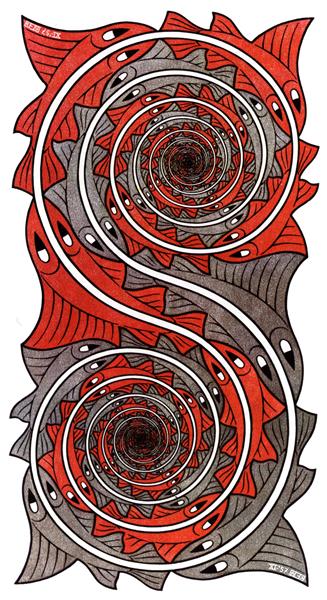
Whirlpools


M.C. Escher, Whirlpools (1957)


Aesop's Fables 43


The Shepherd's Boy

There was once a young Shepherd Boy who tended his sheep at the foot of a mountain near a dark forest. It was rather lonely for him all day, so he thought upon a plan by which he could get a little company and some excitement. 

He rushed down towards the village calling out "Wolf! Wolf!" and the villagers came out to meet him, and some of them stopped with him for a considerable time. 

This pleased the boy so much that a few days afterwards he tried the same trick, and again the villagers came to his help. 

But shortly after this a Wolf actually did come out from the forest, and began to worry the sheep, and the boy of course cried out "Wolf! Wolf!" still louder than before. 

But this time the villagers, who had been fooled twice before, thought the boy was again deceiving them, and nobody stirred to come to his help. 

So the Wolf made a good meal off the boy's flock, and when the boy complained, the wise man of the village said:

"A liar will not be believed, even when he speaks the truth."


Sayings of Publilius Syrus 13


Age conceals the lascivious character; age also reveals it. 

Epictetus, Discourses 1.10.2


What conclusion do I draw? Do I say that the creature man is not to be active? Heaven forbid! 


But what is it that fetters our faculty of action? Take myself first: when day comes, I remind myself a little as to what lesson I ought to read to my pupils. 


Then in a moment I find myself saying, “But what do I really care what sort of lesson I give to this man or that? The first thing is for me to sleep.”


To the anxious man, who is always seeking out war, the serene man, who is always seeking out peace, will appear as if he has achieved nothing at all. 


“What does he do all day? He hasn’t shamed his enemies, or made a name for himself, or won any spoils. He is wasting his life!”


It isn’t, however, that the philosopher doesn’t act, but rather that the nature of his activity is incomprehensible to one who only defines himself by externals. While the former pursues an action for its own sake, regardless of any further rewards, the latter wishes to be gratified, to be compensated, to be recognized. There is a world of difference between improving oneself and making demands of others. 


The go-getters, those who are working their way up the corporate ladder, or accumulating influence in the halls of government, or employing their talents to attract attention, suffer from a terrible affliction, that of thinking that they become better by acquiring more. Don’t hate them, have compassion for them. 


Yet the philosophers should not think themselves free from danger, because they are also subject to temptations and diversions. They might not be so concerned with building an empire for themselves, but they will still worry about whether their words and deeds are making any difference at all. Why keep doing all these things, when it would be so much easier to just pull away from the world entirely?


I have never been a teacher anywhere close to the caliber of Epictetus, though I have certainly experienced something of the lethargy he describes. With all those hours of careful preparation, at best I will find myself completely ignored, and at worst I will have managed to offend someone’s tender insecurities. Why bother? It is still dark out, and the blankets are so inviting. 


Now even though I may believe that I am nothing like the go-getters, I have fallen into a similar trap, that of assuming that my actions are measured by whether others will pay me any heed. The corporate lawyer barks all the louder when he doesn’t win the case, and I whimper pathetically when I feel that I am irrelevant. 


The sleepy philosopher can also be as confused as the fellow who seeks his advancement in Rome, on account of pursuing his contentment in the wrong place, in the fruit of the act instead of the merit of the act. 

Written in 11/2000

IMAGE: Francesco Novelli, The Sleeping Philosopher (c. 1800)