Building upon many years of privately shared thoughts on the real benefits of Stoic Philosophy, Liam Milburn eventually published a selection of Stoic passages that had helped him to live well. They were accompanied by some of his own personal reflections. This blog hopes to continue his mission of encouraging the wisdom of Stoicism in the exercise of everyday life. All the reflections are taken from his notes, from late 1992 to early 2017.
The Death of Marcus Aurelius
Monday, May 11, 2020
Sayings of Ramakrishna 27
The landlord may be very rich, but when a poor cultivator brings a humble present to him with a loving heart, he accepts it with the greatest pleasure and satisfaction.
Seneca, On Peace of Mind 10.2
In
every station of life you will find amusements, relaxations, and enjoyments;
that is, provided you be willing to make light of evils rather than to hate
them.
Knowing
to what sorrows we were born, there is nothing for which Nature more deserves
our thanks than for having invented habit as an alleviation of misfortune,
which soon accustoms us to the severest evils. No one could hold out against
misfortune if it permanently exercised the same force as at its first onset.
I will
regularly hear people tell me how certain things in this world are boring, or offensive,
or frustrating. In response to an unpleasant state of affairs, the solution
will often be to hammer away at the circumstances until they are more
gratifying, or, if all possible convenience has been extracted from them, to
discard things entirely and replace them with new diversions.
This only
seems reasonable as long as we are under the illusion that the world will bend to
our wills. As soon as it becomes clear, as it must inevitably, that this is
hardly the case, all that remains is our own dissatisfaction. We grow accustomed
to having our happiness given to us by Fortune, and so we are then quite
helpless in providing it for ourselves from Nature.
I will
look quite the fool when I insist that nothing is boring but our own disinterest,
that nothing is offensive but our own irritability, and that nothing is
frustrating but our own resentment; if I allow that to annoy me, then I am just
failing to follow my own advice. When I discover value in whatever has come my
way, I can be at peace, but if I impose my demands and conditions upon events,
I will forever be restless.
Such a
shift of attitude, from working with Nature instead of against Nature, does not
come easily, and it does not come quickly. It will be the deliberate
strengthening of habit that brings order to impressions that are at first so
overwhelming, and this may take some time. Old inclinations and routines must
be broken down, and new ones built up in their place.
Once
again, it will be up to me whether I think of the effort as worthy or wasted, if
I take joy in the progress or find fault with the obstacles. What makes good
habits so uplifting, and bad habits such a heavy burden, is the force of repetition,
that the many small actions work together with an ever-increasing momentum.
Have I taken too many steps in the wrong direction? I can always start by
taking just one step back in the right direction, and the improvement has
already begun.
How many
times have I thought a task impossible, only later to laugh at my own doubts? Nature
gave me this power, by granting me my own reason and choice, and making me able
to give firm direction to my own purpose.
I may
once have said it was unbearable, but I needed only a bit of fortitude and practice,
and now I can actually navigate my way through the hardship, tame the trouble, and
harness the aggravation. The world doesn’t change for me, but I change myself. It
isn’t magic, but the forging of my own character.
Written in 10/2011
Sunday, May 10, 2020
Sayings of Socrates 36
Knowledge is the food of the soul; and we must take care, my friend, that the Sophist does not deceive us when he praises what he sells, like the dealers, wholesale or retail, who sell the food of the body; for they praise indiscriminately all their goods, without knowing which are really beneficial or hurtful.
—Plato, Protagoras 313c
Stoic Snippets 24
Men seek retreats for themselves, houses in the country, sea-shores, and mountains; and you too are wont to desire such things very much. But this is altogether a mark of the most common sort of men, for it is in your power whenever you shall choose to retire into yourself.
—Marcus Aurelius, Meditations 4.3
Saturday, May 9, 2020
Tao Te Ching 61
What makes a great state is its being like a low-lying, down-flowing stream; it becomes the center to which tend all the small states under heaven.
To illustrate from the case of all females: the female always overcomes the male by her stillness. Stillness may be considered a sort of abasement.
Thus it is that a great state, by condescending to small states, gains them for itself; and that small states, by abasing themselves to a great state, win it over to them. In the one case the abasement leads to gaining adherents, in the other case to procuring favor.
The great state only wishes to unite men together and nourish them; a small state only wishes to be received by, and to serve, the other. Each gets what it desires, but the great state must learn to abase itself.
Seneca, On Peace of Mind 10.1
Suppose,
however, that your life has become full of trouble, and that without knowing
what you were doing you have fallen into some snare that either public or
private Fortune has set for you, and that you can neither untie it nor break it.
Then
remember that fettered men suffer much at first from the burdens and clogs upon
their legs: afterwards, when they have made up their minds not to fret
themselves about them, but to endure them, necessity teaches them to bear them
bravely, and habit to bear them easily.
When
there are troubles, people will often tell you to hang in there, to wait it out,
to hope for something better. “It will pass,” they say. “Everything will work
out in the end.”
I hate to
be the one to point this out, but that is not always the case. For many of us,
the situation is not going to improve; it is just as likely to become more
painful as it is to become more pleasant. Though it might offer a temporary comfort,
the promise of better conditions just around the corner is still the kind of
thinking that makes a life dependent on the whims of Fortune.
Sometimes,
I will be dealt a hand that offers me no chance of winning that game we all
like to play. I can bluff all I want and try to delay the inevitable, but I am
going to walk away from the table with empty pockets. There will be no wishing
it away.
We surely
all know that moment, where we are so vividly aware that this is not going to end the way that we would like. It will be irrevocable. Some of us
are going to lose all we possess in the world, to suffer long and hard, to be
cast aside and forgotten, to be crippled in body or in spirit, to face the certainty
of an inglorious death.
It will
also be a moment that offers the opportunity for complete self-realization. The
illusions fall away. There remains only the awareness that the circumstances
are entirely beyond my control, even as my own judgments are still completely within
my power. The world will act as it will, but I can also act as I will. I can
think of this as a limitation, or I can think of it as a liberation.
I am
reduced to what is purely myself, and if I only so choose, I can firmly hold
onto this for whatever time is given me, in whatever surroundings I may find
myself. There is never a need to surrender what is absolutely my own. The
hardship can now become a vehicle for courage and conviction, and the act of
standing firm now builds a strength of habit.
I no
longer tell people that everything will get better, but rather that they have
been given a chance to become better. I think this a kindness and not a
cruelty, because it encourages them to uncover the beautiful dignity that is
within them. It replaces a reliance upon what is done to us with a reliance on
what we do with ourselves.
Written in 10/2011
Friday, May 8, 2020
The Wisdom of Solomon 4:1-9
[1] Better than this is childlessness with virtue,
for in the memory of virtue is immortality,
because it is known both by God and by men.
[2] When it is present, men imitate it,
and they long for it when it has gone;
and throughout all time it marches crowned in triumph,
victor in the contest for prizes that are undefiled.
[3] But the prolific brood of the ungodly will be of no use,
and none of their illegitimate seedlings will
strike a deep root
or take a firm hold.
[4] For even if they put forth boughs for a while,
standing insecurely they will be shaken by the wind,
and by the violence of the winds they will be uprooted.
[5] The branches will be broken off before they come to maturity,
and their fruit will be useless,
not ripe enough to eat, and good for nothing.
[6] For children born of unlawful unions
are witnesses of evil against their parents
when God examines them.
[7] But the righteous man, though he die early, will be at rest.
[8] For old age is not honored for length of time,
nor measured by number of years;
[9] but understanding is gray hair for men,
and a blameless life is ripe old age.
Seneca, On Peace of Mind 9.6
Thus
in the houses of the laziest of men you will see the works of all the orators
and historians stacked upon bookshelves reaching right up to the ceiling. At
the present day a library has become as necessary an appendage to a house as a
hot and cold bath.
I
would excuse them straightway if they really were carried away by an excessive
zeal for literature; but as it is, these costly works of sacred genius, with
all the illustrations that adorn them, are merely bought for display and to serve
as wall furniture.
Is it
bad for me to love my books? Not at all. What matters is why I love them, and
toward what end I will put them to use. It will be similar with most every
other thing I come across in this world, in that I must decide where I will find
its meaning and value, and how I will go about respecting what is good within
it.
Some
people treat a job as a way to increase their influence, and other people treat
it as a way to be of service. Some people consider possessions to be ends, and
other people consider them to be means. Some people will look at their friends
and ask what they can receive, and other people will look at their friends and
ask what they can give.
So it also
is with learning in general, and with books in particular. The inner life of a
man will become clearer by observing how he relates to the power of understanding,
whether he employs it to glorify himself, or to glorify the truth.
I seem
to notice more and more how certain people are engrossed in playing a grand
role in life; what is important to them is not who they are or what they are doing,
but how they are perceived and what they are seen to be doing.
It is common
not just in the world of entertainment, but in business, politics, and academics
as well, where acting skills are thought of as more profitable than living
skills.
I have
become so conscious of the tendency that I will often go out of my way not to deliberately
promote or advertise myself. As much as I enjoy being admired and recognized, I
think it more important to first practice integrity; I should be in the business of
working on my merits, not the selling of impressions. Perhaps I am too weak,
but it is too easy for me to get these things confused, to flip necessity with
preference.
If a man
is a liar in his trade, I think it likely that he will also be a liar in the
other aspects of his life, and so I am hesitant to trust him. It is the danger
of what my daughter calls being “such a fake”, of failing to be true to others
because one can’t even be true to oneself.
My own library
is hardly extensive, and I am at the point where a volume must be passed on to
someone else before a new one might be added, but there are still times when
someone will look at my shelves and ask, “Have you read all of these books?”
That is
what the books are for, I tell myself, and I suppose I could take offense at
the question, but I need to remember that books, like framed diplomas, are decorations
for most people, sometimes even symbols of vanity.
They
will really only matter to me if I read them, not in public but in private, and
if they help me to improve myself, not in my appearance but in my character.
“If you
see any with a layer of dust on them, you are free to take them. I ask only
that you not sell them, and that you not let them stay dusty.”
Written in 10/2011
Thursday, May 7, 2020
Wednesday, May 6, 2020
The Art of Peace 52
To injure an opponent is to injure yourself.
To control aggression without inflicting injury is the Art of Peace.
Musonius Rufus, Lectures 9.12
These things I used to repeat to
myself and I say them to you now. If you are wise, you will not consider that
exile is a thing to be dreaded, since others bear it easily, but that evil is to
be dreaded. It makes wretched every man in whom it is present.
And neither of the two necessary
alternatives is a just cause for repining. For either you were banished justly
or unjustly.
If justly, how can it be right or
fitting to feel aggrieved at just punishment?
If unjustly, the evil involved is
not ours, but falls upon those who banished us—if in fact you agree that doing
a wrong (as they have done) is the most hateful thing in the world, while
suffering a wrong (as has been our fate) in the eyes of the gods and of just
men is held a ground not for hate but for help.
What I
have come to call “making a Stoic turn” is a fundamental shift of priorities,
far more transformative than changing a career, or finding new friends, or
moving to a new town. It involves a complete rebuilding of the self, from the
bottom up, based upon living with Nature instead of following mere convention,
caring for what I do more than what is done to me, and defining myself by the
goods of the soul over the goods of the body.
I will
only understand what Musonius tells me if I look at my life from this
perspective. Others will surely find me ridiculous, but I will have found for
myself a source of unassailable happiness, confident that while anything around
me can change or be taken away, I will still possess power over my own
character.
Musonius
would remind himself that he should fear evil within his own soul far more than
any form of exile, and I hope I am in good company when I cling to this same
principle, each and every day.
Another rule
I keep ready to hand, one that has helped me more often than I can count, is to
directly confront my eagerness to complain. When I do not enjoy a situation, I
will feel frustration, and when I am angry, I am inclined to cast blame.
“If only
this had not happened, or if only that person had acted differently, my life
would be so much better!” Careful. If I am brutally honest with myself, I will
remember that I am the only one who determines how I choose to live, and so I
am the only one who is responsible for my happiness.
Keeping
this in mind, all the incrimination can pass away. Either it is something I
can fix for myself, so I should get down to it, or it is something I
can do nothing about, so my resentment affects only my own serenity.
Say that
I have been exiled or cast aside, and I am tempted to point the finger for my perceived
loss. There are really only two options for the situation I find myself in, and
neither one justifies anxiety or despair. I can’t help but smile at how
Stoicism always puts me in win-win situations, if only I take the time and
effort to understand myself correctly.
First, I
may have done wrong myself, in which case I should rightly pay a just retribution
for my errors, and take up the opportunity to redeem myself. If it is a punishment
for my sins, let me use exile as a means for undoing what I have done. A
penalty is only unbearable when I do not embrace my need to return what I owe.
Second, another
may have done wrong to me, in which case the weight does not rest upon me. I
can still find in my struggle the chance to become more just myself, even as
someone else may have treated me unjustly, and so I may transform his vice
into my own virtue. Who is truly hurt? I have lost my fortune, but he has lost
his character.
I admittedly
have obscure and eccentric interests when it comes to narratives, but I am
drawn to them not because they are unknown, but because I think they contain
wisdom that should be more widely known.
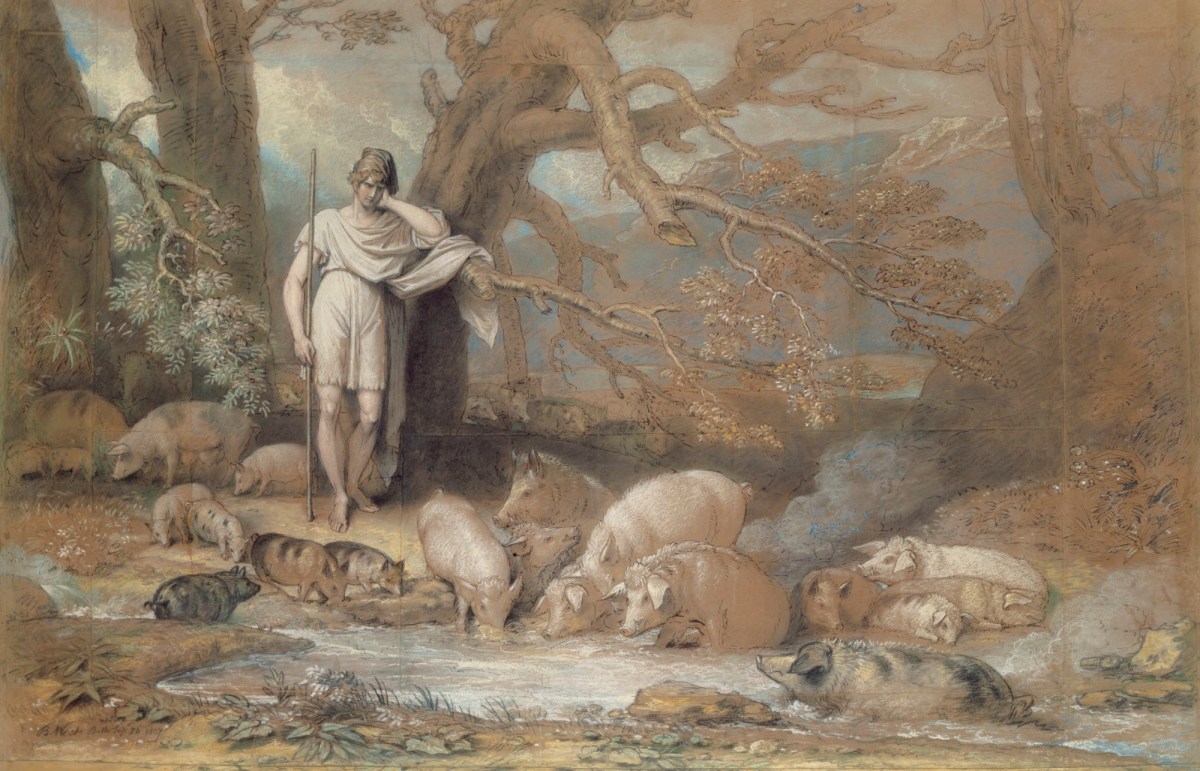
One of
these is the legend of Bladud, a prince in ancient Britain who was set to
inherit the crown from his father. He contracted leprosy, however, and was
exiled from the kingdom, reduced to becoming a swineherd in the wilderness,
separated from all he had previously known.
He
noticed that his pigs would roll about in the mud by some hot springs, and that
this seemed to cure any ailments they had. He bathed in the water himself, only
to find that that his leprosy had disappeared. Later, after assuming the throne,
he established the city of Bath on the site of the springs, in gratitude for
his healing, and for the health of his people.
Yes, it
has the happy ending, where the hero’s rights are in this case restored, but
what always struck me about the story is the way exile gave the young Bladud
not only the opportunity to heal his body, but also to improve his soul, to use
his experience to be of service to others.
If Bladud
could become a better man by spending some time with pigs in the mud, so can
any one of us. Blessings and curses are not in events themselves, but in our
estimation of events.
Written in 12/2016
IMAGE:Benjamin West, Bladud in Exile (1807)
Monday, May 4, 2020
The Death of Seneca in Art
Peter Paul Rubens (1613)
School of Gerard van Honthorst (c.1625)
Jacques de l'Ange (c.1650)
Luca Giordano (c.1685)
Noel Halle (1750)
Jacques-Louis David (1773)
Manuel Dominguez Sanchez (1871)
Fragments of Parmenides 7
Come now, I will tell you—and do you hearken to my saying and carry it away—the only two ways of search that can be thought of.
The first, namely, that It is, and that it is impossible for it not to be, is the way of belief, for truth is its companion.
The other, namely, that It is not, and that it must needs not be—that, I tell you, is a path that none can learn of at all.
Musonius Rufus, Lectures 9.11
The reflections that I employ for
my own benefit so as not to be irked by exile, I should like to repeat to you.
It seems to me that exile does
not strip a man entirely, not even of the things which the average man calls
goods, as I have just shown. But if he is deprived of some or all of them, he
is still not deprived of the things which are truly goods.
Certainly the exile is not
prevented from possessing courage and justice simply because he is banished,
nor self-control, nor understanding, nor any of the other virtues which when
present serve to bring honor and benefit to a man and show him to be
praiseworthy and of good repute, but when absent, serve to cause him harm and dishonor
and show him to be wicked and of ill-repute.
Since this is true, if you are
that good man and have his virtues, exile will not harm or degrade you, because
the virtues are present in you which are most able to help and to sustain you.
But if you are bad, it is the evil that harms you and not exile; and the misery
you feel in exile is the product of evil, not of exile. It is from this you
must hasten to secure release rather than from exile.
On my bad days, I am tempted to feel a resentment toward
those who are so proud to offer empty advice. Sometimes they insist that they
can provide the rules of success and happiness, even as they speak nothing
about Nature, and offer no measure of right and wrong. At other times they tell
me all about how the world really works, though they are quite oblivious to the
immediate circumstances that most people must face.
But why grow angry at them for what they don’t
know? I recall that whenever I am terribly mistaken, no amount of condemnation has
ever helped me. Encouragement has helped me, compassion has helped me, being
taught by example has helped me.
I am accordingly grateful for the advice of Musonius,
so different from most any of the advice I have heard before. I obviously never
met the man, but from what he tells me, I suspect that I can trust him.
He shows me that he has a moral compass, that he
views the worth or our lives through the characteristics that define us as
human, the powers of reason and choice. He also shows me that he is grounded in
the real world, that he is acutely aware of the struggles of everyday living. His
theory and his practice fit together, and he points straight to the simple essence
of human happiness.
So concerned that my contentment must rely upon the
things that happen to me, I will worry that any sort of hardship, like poverty,
or disease, or the exile discussed in this lecture, will make it impossible for
me to live a good life. It may seem so obvious, but I will still neglect to
address the critical questions: what really is good for me, and what place do
my circumstances play in that good?
Musonius first reminds me that some changes in my situation
might be drastic, but this does not mean that they will necessarily reduce my
fortune. I may lose some worldly possessions, but I may also gain others, and
my own resourcefulness and self-reliance will make the biggest difference.
Events are never good and bad in themselves, but become good or bad by how I
learn to use them as an opportunity.
Yet given that so many of my conditions are ultimately
beyond my power, what am I to do when they stubbornly refuse to conform to my
preferences? Here is where Musonius offers his second, and more fundamental, point:
it will hardly matter if I lose what I prefer, because that is not what will
make or break me.
Nothing can stop me from practicing the virtues,
from being understanding, brave, temperate, and just, and so nothing can infringe
on what defines my very humanity. Whether the externals come or go, their value
depends entirely on the content of my character. Wealth will not make a wicked
man good, just as poverty will not make a good man wicked.
What is lower becomes worthy through its conformity
to the higher, and so my circumstances do not make something of me, but I make
something of my circumstances.
I have a vivid memory from childhood of seeing a
painting of Napoleon, on board a ship taking him into final exile on St.
Helena. I was only a pup, but I gazed at it for quite some time, and I wondered
what that man was thinking, and whether the British officers behind him were
being curious or contemptuous.
How must it have felt for Napoleon to lose
everything he had worked for? You may think of him as a hero or as a villain,
or as someone in between, but the entire scene just screams of loss.
I have faced my own losses as the years passed by,
and while I have never been sent to a rock in the middle of the Atlantic, I
have seen people I love turn away, and things I desire kept from me. There were
many times I thought I could no longer bear it. And then some basic insights
about life started to turn it all around for me.
Losing persons, places, or things wasn’t the issue
at all, since they were not mine to lose. Losing myself was the issue, and that
was entirely up to me.
How would Napoleon have taken to such advice? Could
he still have learned to revere the beauty of his own soul, instead of the
glory of an empire?
Written in 12/2016
IMAGE: William Orchardson, Napoleon on Board the Bellerophon (1880)
Sunday, May 3, 2020
Saturday, May 2, 2020
Sayings of Heraclitus 26
Man kindles a light for himself in the night-time, when he has died but is alive. The sleeper, whose vision has been put out, lights up from the dead; he that is awake lights up from the sleeping.
Boethius, The Consolation of Philosophy 4.32
“God
looks forth from the high watchtower of His Providence, He sees what suits each
man, and applies to him that which suits him. Hence then comes that conspicuous
cause of wonder in the order of Fate, when a wise man does that which amazes
the ignorant. For, to glance at the depth of God's works with so few words as
human reason is capable of comprehending, I say that what you think to be most
fair and most conducive to justice's preservation, that appears different to an
all-seeing Providence.
“Has
not our fellow-philosopher Lucan told us how ‘the conquering cause did please
the gods, but the conquered cause pleased Cato?’ What then surprises you when
done on this earth, is the true-guided order of things; it is your opinion
which is perverted and confused.
“But
if there is any one whose life is so good that divine and human estimates of
him agree, yet he must be uncertain in the strength of his mind; if any
adversity befall him, it may always be that he will cease to preserve his
innocence, by which he found that he could not preserve his good fortune.
“Thus
then a wise dispensation spares a man who might be made worse by adversity,
lest he should suffer when it is not good for him to be oppressed. Another may
be perfected in all virtues, wholly conscientious, and very near to God.
Providence holds that it is not right such an one should receive any adversity,
so that it allows him to be troubled not even by bodily diseases.”
—from
Book 4, Prose 6
I think
of that wonderful line from Tolkien: “Do not be too eager to deal out death in
judgement. For even the very wise cannot see all ends.”
I could
be so very clear in my thinking, but I would still not perceive all aspects of the
whole. I could be so very diligent in avoiding my prejudices, but I would still
only be looking from my own limited perspective. I could tell myself that I
have considered the circumstances fully, but I would still only be gazing from
the outside in.
I know
that everything should be for the sake of the good, even as I do not always comprehend
the fullness of how and why the good will unfold as it does. Perhaps it seems
right and fair that a villain should feel pain, or that a hero should feel
pleasure; is that truly looking to what is best for him, or only to what is easiest
for him? I do not know how his circumstances will affect him, or how he will
respond to them, or whether this or that action will ultimately make his
judgment better or worse.
I do not
know how it will play itself out; Providence most certainly does know. It gives
me a whole new dimension of what it means for a man to play God. “If there was
a God, He would never have allowed this to happen!” Might it instead be that I
am missing something that is essential?
When
Cato the Younger stood up against Julius Caesar, who was the better man, and
who deserved to win? It is all the more important to consider what actually makes
the better man, and what really constitutes winning, to view choices and events
in the context of Nature, not of Fortune.
Cato
failed in the political struggle, and died by his own hand. Caesar made himself
the master of Rome, only to die later through betrayal. History would speak of
Cato as the conquered, and Caesar as the conqueror, though it really all
depends on whether we think that possessing character or possessing power is
the greater reward.
Perhaps
the gods really did want Cato to be defeated in his body, so that he could be
greater in his spirit, and Caesar to be victorious in his body, so that he
could learn a very important lesson about his spirit.
There
have been times when suffering an expected punishment has helped me to become
better, but there have also been times when being granted an unexpected
reprieve has helped me to become better. It will depend on my state of mind,
the disposition of my habits, the balance of my strengths and weaknesses, and the
weight of the circumstances.
Justice
will always be justice, even as the particulars of how it is best applied will
be variable. We suffer under different conditions, and so require different remedies.
Providence takes all of this into account, sometimes giving, sometimes taking
away.
Imagine,
for example, someone who is struggling to live with virtue, while still quite susceptible
to giving up the fight. A punishment of hardship might actually encourage him
to become worse, not better. There are all sorts of possible combinations, just
as there are people in all sorts of situations.
In the
end, whether it expresses itself through prosperity or adversity, it will be
just where it strengthens moral worth, and unjust where it weakens moral worth.
Written in 11/2015
Friday, May 1, 2020
Stoic Snippets 23
Let no act be done without a purpose, nor otherwise than according to the perfect principles of art.
—Marcus Aurelius, Meditations 4.2
Subscribe to:
Posts (Atom)